
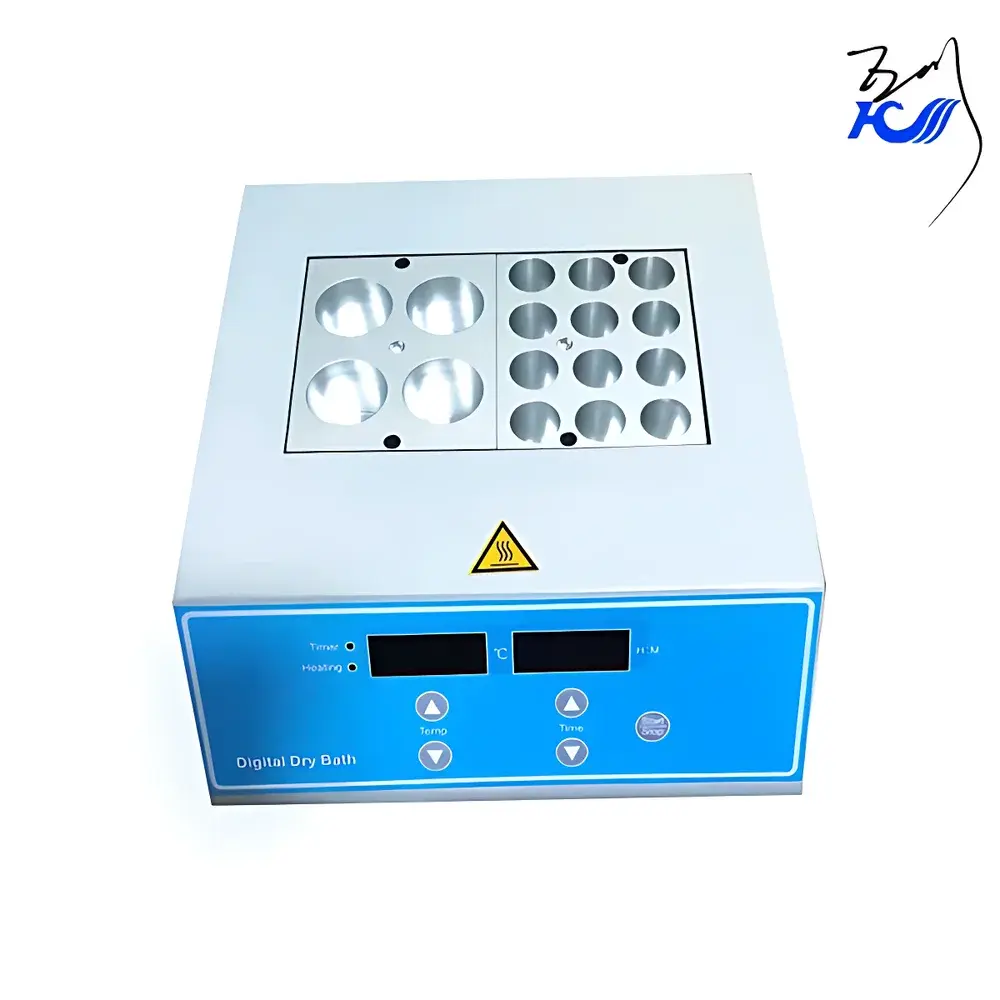
HCN-48 Bacterial Endotoxin Gel-Clot Testing Incubator
| Brand | HU CHUAN / HC |
|---|---|
| Origin | Jiangsu, China |
| Model | HCN-48 |
| Temperature Control Range | Ambient +5°C to 160°C |
| Temperature Accuracy | ±0.5°C (@40°C), ±1°C (@120°C) |
| Temperature Uniformity | ±0.5°C |
| Display Resolution | 0.1°C |
| Timer Range | 1–99 h 59 min or continuous (∞) |
| Heating Time | ≤15 min (25°C → 160°C) |
| Block Configuration | Dual 24-well modules (total 48 wells) |
| Rated Power | 500 W |
| Voltage | 220 V, 50/60 Hz |
| Dimensions | 260 × 220 × 100 mm |
| Weight | 5.0 kg |
Overview
The HCN-48 Bacterial Endotoxin Gel-Clot Testing Incubator is a purpose-built thermal incubation system engineered specifically for the gel-clot method of bacterial endotoxin testing as prescribed in the Chinese Pharmacopoeia (ChP) 2002 edition and subsequent revisions. It operates on the principle of precise, uniform, and stable temperature maintenance at 37 ± 1°C for exactly 60 ± 2 minutes — the critical incubation condition required for Limulus Amebocyte Lysate (LAL) reagent activation and endotoxin-induced gel formation. Unlike conventional water baths — which suffer from thermal stratification, condensation-related contamination risk, and poor inter-vessel temperature consistency — the HCN-48 employs solid-state heating elements combined with pulse-width modulation (PWM) temperature control to deliver exceptional thermal stability (±0.15°C at 37°C) and inter-well uniformity (≤0.3°C deviation across all 48 positions). This architecture ensures high reproducibility in qualitative endotoxin detection, directly supporting compliance with pharmacopeial validation requirements for assay robustness and inter-laboratory comparability.
Key Features
- Dual independent 24-position aluminum heating blocks (total 48 wells), compatible with standard 10 × 75 mm test tubes and 2 mL ampoules — configurable per user specification.
- Advanced PWM-based temperature regulation delivering ±0.15°C stability at 37°C and ±0.5°C uniformity across full block surface — significantly exceeding ChP-specified tolerance (±1°C) and outperforming conventional water baths.
- Integrated dual-layer safety system: hardware-based overtemperature cutoff (independent of microcontroller) plus software-monitored thermal watchdog — compliant with IEC 61010-1 functional safety principles.
- Intuitive LED interface with real-time display of setpoint, actual temperature, elapsed time, and remaining timer — enabling unambiguous monitoring during GLP/GMP-compliant runs.
- Programmable auto-start, power-failure recovery, and preheat modes — ensuring protocol adherence even under variable lab operating conditions.
- Self-calibration function accessible via front-panel menu — facilitating routine verification without external reference equipment.
- Compact footprint (260 × 220 × 100 mm) and lightweight design (5.0 kg) optimized for benchtop deployment in QC laboratories with space constraints.
Sample Compatibility & Compliance
The HCN-48 accommodates common endotoxin test formats including single-use glass or plastic test tubes (10 × 75 mm), 2 mL ampoules, and LAL reagent vials conforming to USP <71>, EP 2.6.14, and ChP General Chapter 1143. Its dry-block architecture eliminates condensation ingress — removing the need for parafilm sealing or caps that may introduce variability in gel formation kinetics. The instrument supports full traceability when operated within validated laboratory workflows; its timer and temperature logging capability (via optional RS232/USB output) aligns with FDA 21 CFR Part 11 expectations for electronic records where audit trails are implemented. While the device itself is not certified to ISO/IEC 17025, it is routinely deployed in ISO 9001- and GLP-certified environments as a critical ancillary tool for endotoxin assay execution.
Software & Data Management
The HCN-48 operates via embedded firmware with no external PC dependency. All operational parameters — including set temperature, incubation duration, start time, and calibration offsets — are stored in non-volatile memory. Optional serial (RS232) or USB interface enables integration with laboratory information management systems (LIMS) or custom data acquisition scripts for timestamped temperature logging. Firmware supports firmware-upgradable architecture — future versions may include enhanced event logging (e.g., door-open detection, thermal deviation alerts) and CSV export functionality. No proprietary software installation is required; basic communication uses standard ASCII command sets compatible with Python, LabVIEW, or MATLAB.
Applications
- Routine qualitative endotoxin testing of injectables, ophthalmic solutions, and medical device rinsates per ChP, USP, and EP monographs.
- Validation and requalification of LAL reagent sensitivity (λ-value determination) under controlled thermal conditions.
- Supporting hold-time studies for sample stability prior to endotoxin analysis.
- Use in teaching laboratories for hands-on demonstration of gel-clot methodology principles and thermal influence on enzymatic cascade kinetics.
- Backup or primary incubation unit in multi-instrument QC labs where water bath maintenance downtime poses operational risk.
FAQ
Does the HCN-48 meet pharmacopeial requirements for endotoxin testing?
Yes — it satisfies the ChP 2002–2020 and USP <71> stipulation of “vertical placement in a 37 ± 1°C恒温器 for 60 ± 2 minutes” through superior thermal precision (±0.15°C at 37°C) and spatial uniformity (≤0.3°C well-to-well).
Can the instrument be used for assays other than gel-clot?
While optimized for gel-clot, its programmable temperature and timing range (up to 160°C, 99h59m) permits adaptation for kinetic-turbidimetric or chromogenic LAL assays requiring alternative incubation profiles — subject to user validation.
Is calibration documentation provided with the unit?
A factory calibration certificate is included, listing as-shipped temperature accuracy against NIST-traceable reference standards at 37°C and 100°C. Users are responsible for periodic in-house verification using accredited thermometers per ISO/IEC 17025 guidelines.
What tube sizes are supported without modification?
Standard configuration accepts 10 × 75 mm round-bottom test tubes and 2 mL ampoules. Custom bore diameters (e.g., for 13 mm or 16 mm tubes) are available upon request with lead-time adjustment.
How is thermal uniformity verified across all 48 wells?
Uniformity is validated during production using 48-channel thermocouple mapping per ASTM E2251-17 Annex A1 methodology, with results documented in the unit’s Certificate of Conformance.
Related Products





