
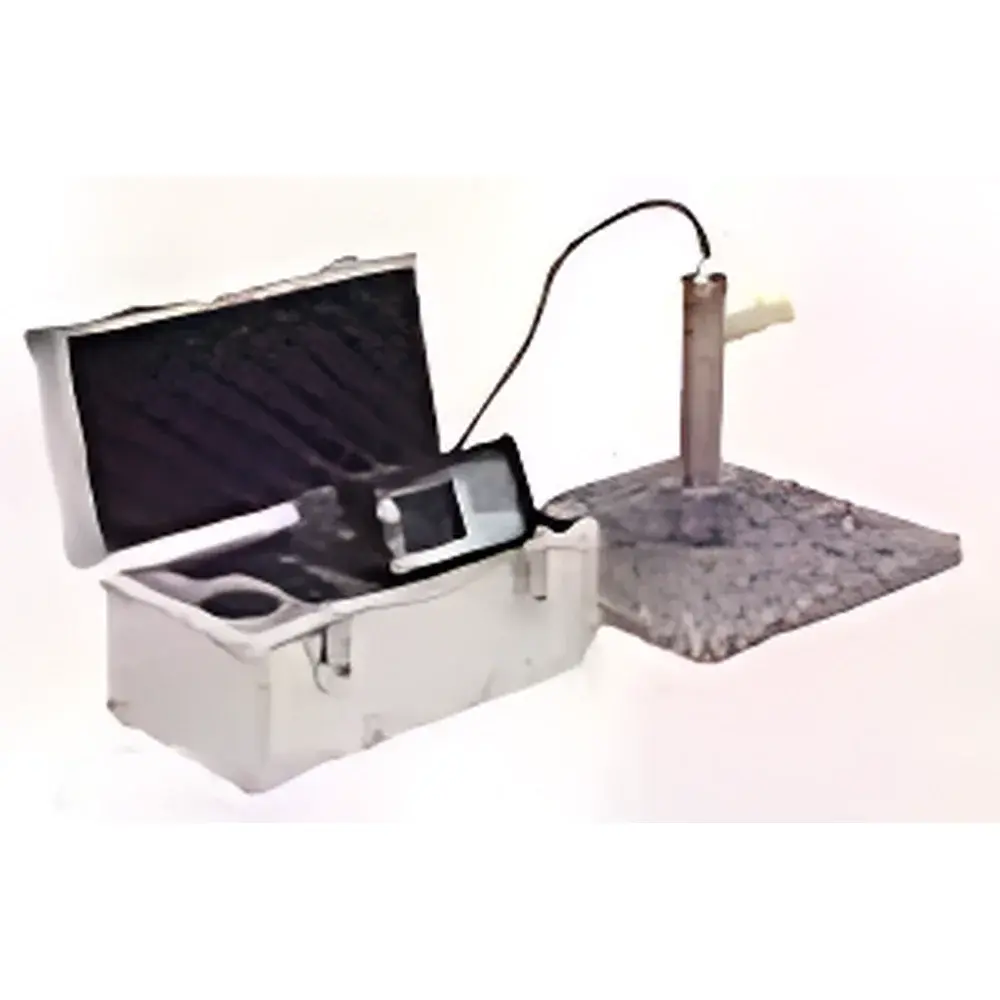
HD-2000 Portable Building Material Radioactivity Analyzer
| Origin | Beijing, China |
|---|---|
| Manufacturer Type | Authorized Distributor |
| Origin Category | Domestic (PRC) |
| Model | HD-2000 |
| Price | USD 1,240 (FOB) |
| Measurement Range | 0.01–100 µGy/h |
| Energy Threshold | 60 keV |
| Linearity (r vs. CPS) | ≥0.999 |
| Stability | ≤6% |
| Accuracy | ±20% |
| Sensitivity | ≥350 cps at 1 µGy/h |
| Power Consumption | ≤100 mW |
| Operating Temperature | 0–40 °C |
| Relative Humidity | ≤90% @ 40 °C |
| Weight | 6 kg |
| Dimensions | 35 × 20 × 25 cm |
Overview
The HD-2000 Portable Building Material Radioactivity Analyzer is a field-deployable radiation detection instrument engineered for quantitative assessment of natural radionuclide activity in construction materials—including granite, marble, concrete aggregates, industrial slag, and recycled building components. It operates on the principle of gamma-ray scintillation detection using a high-efficiency NaI(Tl) or CsI(Tl) solid-state detector coupled with low-noise pulse processing electronics. The system measures ambient absorbed dose rate (in µGy/h) from 226Ra, 232Th, and 40K decay chains—key contributors to indoor gamma exposure in residential and commercial structures. Designed in strict compliance with GB 6566–2010 (“Limits of Radionuclides in Building Materials”) and aligned with IAEA Safety Standards Series No. RS-G-1.7, the HD-2000 delivers rapid, on-site classification of materials into regulatory categories A (unrestricted use), B (interior use only), or C (external use only), based on calculated activity concentration indices and dose rate thresholds.
Key Features
- Real-time dual-parameter display: simultaneous readout of count rate (CPS) and absorbed dose rate (µGy/h), with automatic category labeling per national classification criteria
- Configurable measurement protocols: selectable integration times (10 s, 30 s, 60 s, 300 s, 600 s) plus continuous 3-second sampling mode for dynamic surveying
- Optimized energy response: 60 keV lower-level discriminator ensures rejection of low-energy background while retaining sensitivity across the 50–2000 keV gamma spectrum relevant to natural radioisotopes
- Microcontroller-based architecture with ultra-low-power design (≤100 mW), enabling >24 hours of continuous operation on rechargeable Li-ion battery pack
- Ruggedized enclosure rated IP54 for dust and splash resistance; ergonomic handle and integrated leveling bubble support stable placement during stationary measurements
- Factory-calibrated traceability: certified reference sources (137Cs, 60Co) used for energy and efficiency calibration; full calibration report supplied with each unit
Sample Compatibility & Compliance
The HD-2000 is validated for direct surface measurement of flat, homogeneous building material samples ≥20 cm × 20 cm and ≥5 cm thick—meeting minimum geometry requirements specified in GB/T 14582–1993 and ISO 18589-2:2015. It supports both loose bulk samples (e.g., crushed slag, sand) and finished products (tiles, slabs, precast panels). Regulatory alignment includes certification under PRC Metrology Law (Certificate No. JingZhi 00000304-02), adherence to enterprise standard Q/CYDZY001–2001 (verified by Beijing Institute of Metrology), and functional equivalence to requirements in ASTM C1148–16 (Standard Test Method for Determination of Radionuclides in Building Materials) for screening-level evaluation. While not a laboratory-grade spectrometer, its performance satisfies field verification needs under GB 6566–2010 Annex A and EU Council Directive 2013/59/Euratom for construction product conformity assessment.
Software & Data Management
The instrument stores up to 1,000 measurement records internally, each timestamped and tagged with operator ID, location code, and measurement duration. Data export is supported via USB-C interface to Windows-compatible desktop software (HD-DataLink v3.2), which generates compliant reports including raw CPS values, dose rate averages, uncertainty estimates (±20%), and automatic pass/fail status against GB 6566 thresholds. Audit trail functionality logs all parameter changes and calibration events, satisfying basic GLP documentation requirements. Export formats include CSV (for LIMS integration) and PDF (for regulatory submission). Firmware updates are delivered via signed binary packages to ensure integrity and traceability.
Applications
- Pre-market screening of natural stone quarries and ceramic tile manufacturers to verify compliance prior to distribution
- On-site verification during construction phase inspections, especially for public infrastructure projects subject to mandatory radiological safety review
- Environmental health assessments in renovation projects involving legacy materials (e.g., phosphogypsum, fly ash concrete)
- Customs and border control screening of imported building materials at ports and rail terminals
- Field support for geological surveys evaluating radon-prone bedrock formations and soil-gas potential
- Quality assurance in nuclear medicine facilities where shielding integrity of structural elements must be periodically verified
FAQ
Does the HD-2000 identify specific radionuclides (e.g., 226Ra vs. 232Th)?
No—it provides total gamma dose rate and infers composite activity index. Isotopic discrimination requires high-resolution gamma spectrometry (e.g., HPGe systems).
Can it be used for radon gas measurement?
No. The HD-2000 detects gamma photons only. Radon gas quantification requires alpha-track detectors, electret ion chambers, or continuous radon monitors.
Is factory recalibration required annually?
Yes. Annual recalibration against traceable standards is recommended to maintain metrological validity per JJF 1001–2011 General Requirements for Metrological Verification.
What is the minimum detectable activity (MDA) for typical granite samples?
Under 600-second integration, MDA is approximately 15 Bq/kg for 226Ra equivalent activity in standard 20 cm × 20 cm × 5 cm geometry.
Does the device comply with FDA 21 CFR Part 11 for electronic records?
No—HD-DataLink v3.2 does not implement electronic signatures or audit-trail encryption required under Part 11. It meets general data integrity expectations for environmental monitoring but not regulated pharmaceutical or clinical trial use.







