
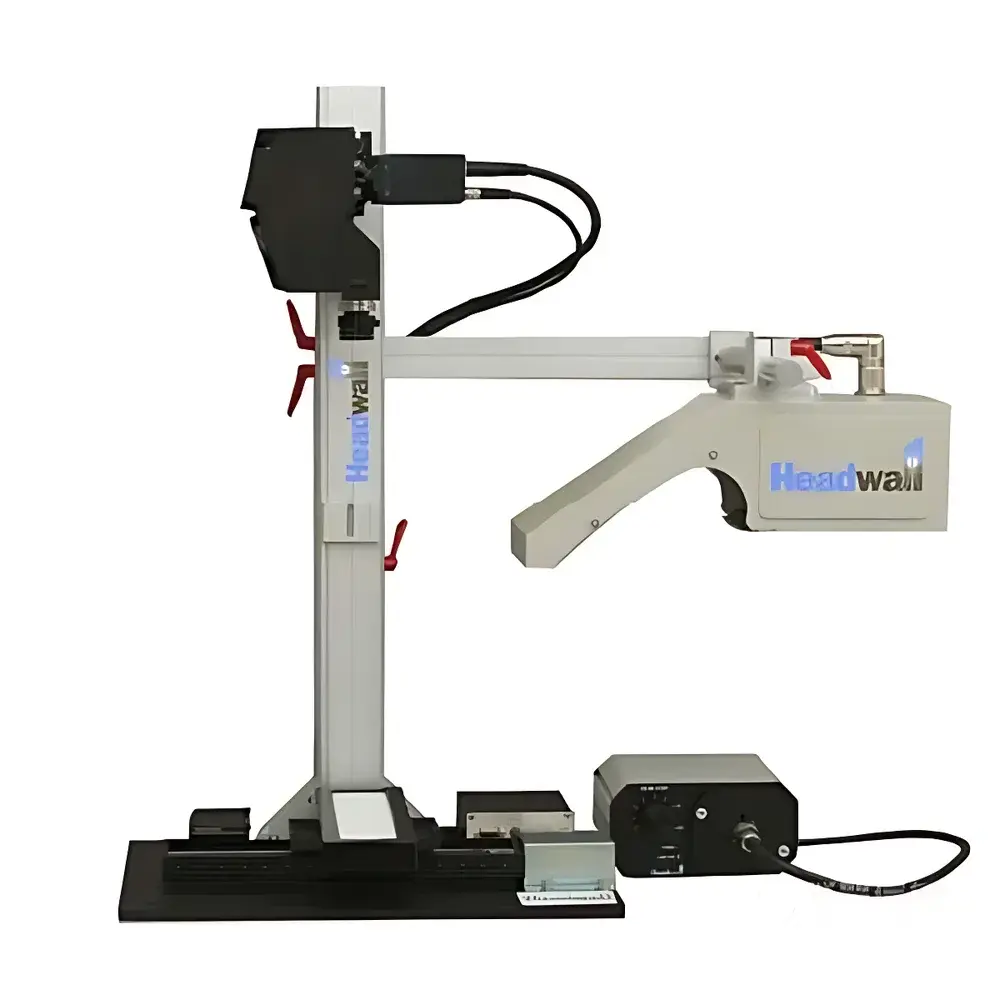
HeadWall Hyperspectral Scanning Kit – Indoor Laboratory Imaging System
| Brand | HeadWall |
|---|---|
| Origin | USA |
| Distribution Status | Authorized Distributor |
| Import Category | Imported |
| Models | Standard, Large-Format, Enclosed Dark-Box Configuration |
| Pricing | Available Upon Request |
Overview
The HeadWall Hyperspectral Scanning Kit – Indoor Laboratory Imaging System is a turnkey, modular platform engineered for high-fidelity, spatially resolved spectral acquisition across the ultraviolet–visible–near-infrared (UV–VIS–VNIR), extended VNIR (up to 1000 nm), and short-wave infrared (SWIR, 900–2500 nm) spectral ranges. Built upon HeadWall’s industry-proven push-broom hyperspectral imaging architecture, the system integrates a calibrated line-scan spectrometer with precision motorized translation stages, stabilized broadband illumination, rigid optical mounting infrastructure, and synchronized data acquisition electronics. Unlike freehand or handheld configurations, this laboratory-grade scanning rig ensures sub-pixel spatial registration, radiometric stability, and repeatable sample positioning—critical prerequisites for quantitative reflectance spectroscopy, spectral library development, and multivariate calibration modeling in regulated environments.
Key Features
- Modular hardware configuration supporting three operational variants: Standard (optimized for samples ≤30 cm × 30 cm), Large-Format (accommodates specimens up to 60 cm × 60 cm with extended travel rail), and Enclosed Dark-Box (UV–VIS–NIR compatible; eliminates ambient light interference and enables controlled illumination geometry)
- Integrated high-stability halogen or quartz-tungsten-halogen (QTH) broadband source with uniformity optics and optional fiber-coupled LED arrays for spectral band targeting
- Precision linear translation stage with closed-loop stepper motor control, repeatability ±1 µm, and programmable scan velocity (0.1–20 mm/s)
- Dedicated control unit featuring FPGA-based synchronization of camera exposure, stage motion, and illumination triggering—ensuring zero frame skew or motion blur
- Pre-aligned optical path with kinematic mounts for rapid spectrometer interchangeability (e.g., VNIR vs. SWIR modules) without realignment
- Factory-calibrated radiometric response using NIST-traceable standards; includes certified Spectralon® reflectance reference panels (99% and 2% reflectance)
Sample Compatibility & Compliance
The system accommodates flat, semi-rigid, or gently curved solid specimens—including agricultural produce (whole fruits, grain kernels, leaf sections), geological core slices, food tissue sections (fish fillets, meat cuts), archival documents, and painted artifact fragments. Sample height adjustment (±25 mm) and tilt compensation enable optimal focus across heterogeneous topographies. All mechanical and electronic components comply with IEC 61000-6-3 (EMC emission limits) and IEC 61000-6-2 (immunity). The enclosed dark-box variant meets ISO 17025 requirements for environmental control during spectral measurement, and software workflows support audit trails aligned with GLP and FDA 21 CFR Part 11 principles when deployed with validated configurations.
Software & Data Management
The kit ships with HeadWall’s SpectralView™ Lab Suite—a Windows-based application enabling real-time preview, spectral cube acquisition, geometric correction, and on-the-fly reflectance normalization. It supports batch processing of multi-sample datasets, ROI-based spectral extraction, and export to ENVI, HDF5, and MATLAB-compatible formats. The included 1 TB HDPU (High-Density Processing Unit) provides local preprocessing capability—including dark-current subtraction, bad-pixel correction, and spectral resampling—reducing post-acquisition computational load. Raw data integrity is preserved via checksummed file writing and optional metadata embedding (sample ID, illumination settings, calibration timestamp).
Applications
- Agricultural quality assessment: Detection of bruising, rot, sugar content (Brix), firmness, and pesticide residue via chemometric models trained on VNIR/SWIR spectral signatures
- Soil and mineralogical analysis: Identification of clay mineralogy (e.g., kaolinite, smectite), organic carbon content, and iron oxide speciation using diagnostic absorption features in the SWIR region
- Food safety and authenticity: Discrimination of species (e.g., salmon vs. tilapia), detection of spoilage metabolites, and verification of geographical origin through spectral fingerprinting
- Cultural heritage science: Non-invasive pigment identification, underdrawing visualization, and degradation mapping in manuscripts and paintings using UV–VIS reflectance and fluorescence modes
- Pharmaceutical solid-dose analysis: Uniformity assessment of active pharmaceutical ingredient (API) distribution in tablets via SWIR hyperspectral mapping
FAQ
What spectral ranges are supported by default, and can multiple spectrometers be interchanged?
The kit supports VNIR (400–1000 nm), extended VNIR (400–1000 nm with enhanced blue response), and SWIR (900–2500 nm) configurations. Spectrometer modules are mechanically and electronically interchangeable using standardized mounting interfaces and firmware profiles.
Is the system compatible with third-party chemometric software such as Unscrambler or Pirouette?
Yes—exported spectral cubes include full wavelength metadata and adhere to IEEE Std 1596.1 (HDF5 spectral data format), ensuring seamless import into commercial multivariate analysis platforms.
Does the HDPU perform real-time spectral preprocessing, or is it used solely for storage?
The HDPU executes on-device preprocessing including non-uniformity correction, radiometric calibration application, and spectral binning—reducing raw data volume by up to 60% prior to transfer to host systems.
Can the system be integrated into an existing LIMS or ELN environment?
Via RESTful API and configurable metadata templates, the SpectralView™ Lab Suite supports structured data export for ingestion into laboratory information management systems (LIMS) and electronic lab notebooks (ELN) compliant with ASTM E1578 and ISO/IEC 17025 Annex A.2 guidelines.






