
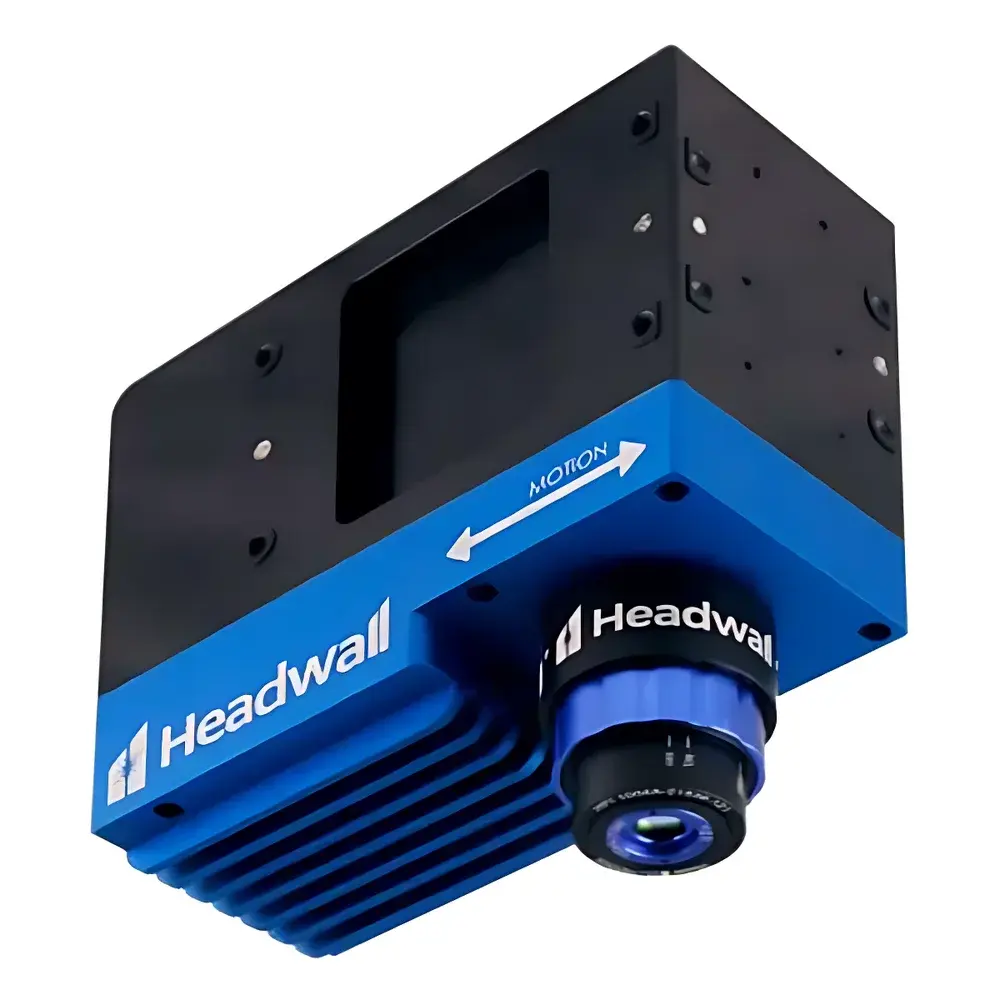
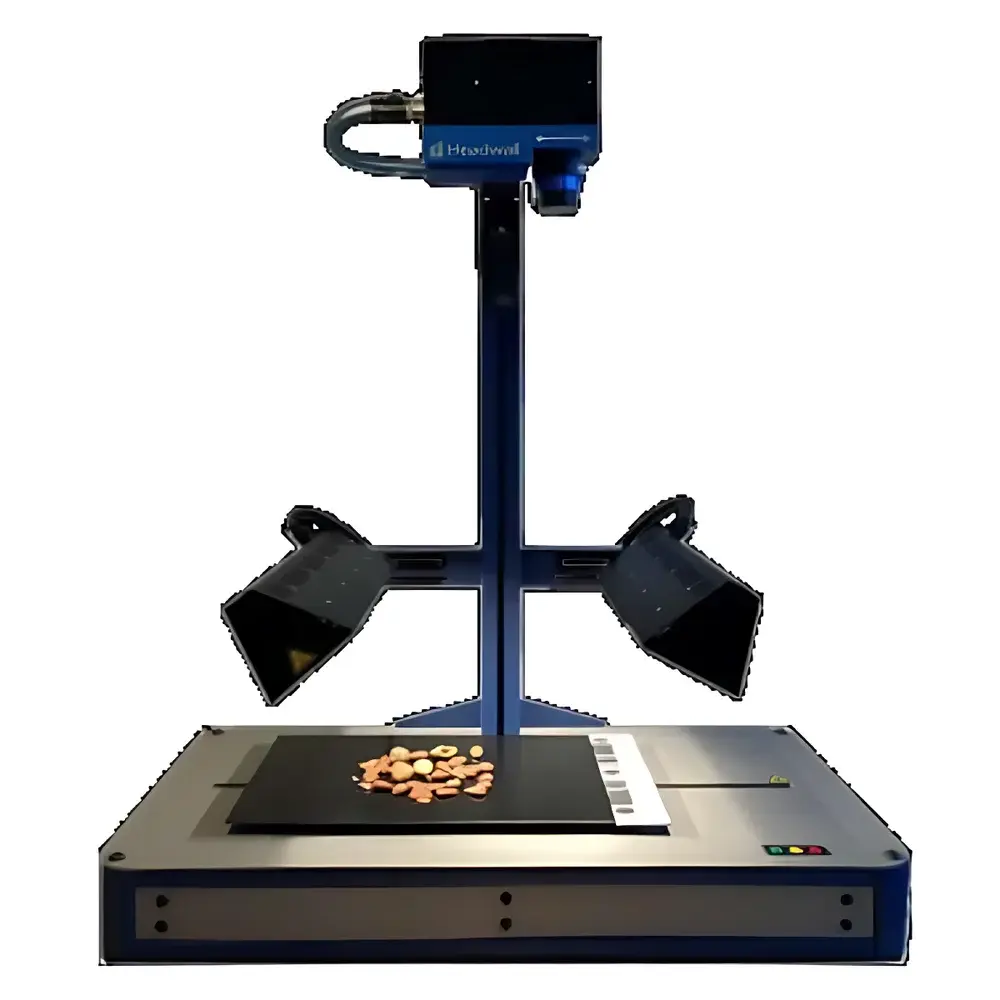
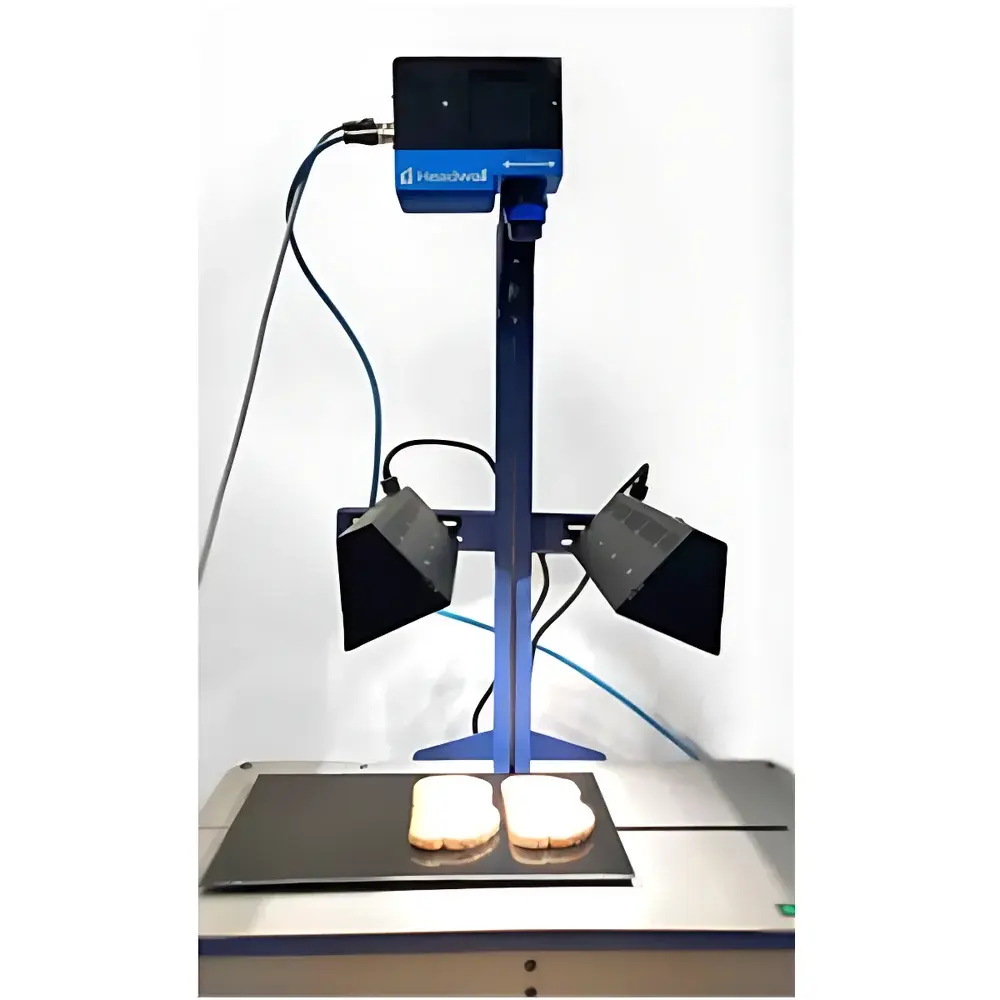
HeadWall MV.C NIR Machine Vision Hyperspectral Imaging Instrument
| Brand | HeadWall |
|---|---|
| Origin | USA |
| Manufacturer Type | Authorized Distributor |
| Product Origin | Imported |
| Model | MV.C NIR |
| Price Range | USD 70,000 – 210,000 (FOB) |
| Operating Principle | Push-broom |
| Imaging Method | Dispersive |
| Deployment Mode | Ground-based |
| Spectral Range | 900–1700 nm |
| Number of Spectral Bands | 214 |
| Frame Rate | 547 fps |
| Optical Design | Offner Holographic Concave Grating |
| Data Interface | Gigabit Ethernet |
| Enclosure Rating | IP54 |
| Onboard Processing | Real-time spectral classification engine |
| Software Compatibility | perClass Mira, HeadWall HyperSpectra Studio |
Overview
The HeadWall MV.C NIR Machine Vision Hyperspectral Imaging Instrument is a purpose-built, industrial-grade push-broom hyperspectral sensor engineered for real-time, in-line quality inspection and material classification on high-speed manufacturing lines. Operating within the 900–1700 nm near-infrared (NIR) spectral window—where key molecular absorption features of proteins, lipids, cellulose, starches, and organic functional groups are strongly expressed—the MV.C NIR captures 214 contiguous spectral bands with high radiometric fidelity. Unlike conventional hyperspectral systems that output raw cube data requiring post-acquisition processing, the MV.C NIR integrates a dedicated onboard FPGA- and ARM-based processing unit capable of executing trained spectral classification models directly on the edge. This architecture eliminates latency between acquisition and decision-making, enabling deterministic response times critical for closed-loop sorting, rejection, or process feedback control in continuous production environments.
Key Features
- Turnkey industrial imaging system: Pre-calibrated optical path, factory-aligned Offner holographic concave grating, and embedded firmware eliminate the need for custom platform integration or optical alignment.
- Real-time spectral classification engine: Executes supervised machine learning models (e.g., SVM, Random Forest, Linear Discriminant Analysis) at up to 547 full-frame classifications per second—each pixel assigned a class label with confidence metrics.
- GigE Vision-compliant interface: Standardized GenICam protocol support enables seamless integration with common industrial vision software suites (e.g., HALCON, Common Vision Blox, OpenCV-based pipelines) and PLC-triggered acquisition workflows.
- Web-based user interface (Web UI): Browser-accessible configuration portal for exposure control, region-of-interest (ROI) definition, model selection, and live classification overlay—no local software installation required.
- IP54-rated ruggedized enclosure: Sealed aluminum housing rated for dust resistance and water splashing from any direction; validated for continuous operation in ambient temperatures from 0 °C to 45 °C and relative humidity up to 85% non-condensing.
- perClass Mira interoperability: Native hardware control layer allows direct parameter setting, trigger synchronization, and model deployment via perClass Mira’s industrial ML workflow environment—enabling domain experts (not just spectroscopists) to build, validate, and deploy classification logic.
Sample Compatibility & Compliance
The MV.C NIR is optimized for solid, semi-solid, and granular samples moving on conveyor belts at speeds up to 3 m/s. Its 900–1700 nm spectral coverage provides robust discrimination for food commodities (e.g., meat fat/muscle ratio, poultry adulteration), pharmaceutical excipients (e.g., lactose polymorph identification), textile fiber blends (e.g., cotton/polyester ratio), herbal botanicals (e.g., species authentication, moisture content estimation), and polymer recycling streams (e.g., PET vs. HDPE). The system complies with CE marking requirements for electromagnetic compatibility (EMC Directive 2014/30/EU) and low voltage safety (LVD Directive 2014/35/EU). While not a medical device, its data output structure supports traceability frameworks aligned with ISO/IEC 17025 and FDA 21 CFR Part 11 when deployed within validated GMP or GLP-controlled environments—particularly when paired with audit-trail-enabled model management protocols in perClass Mira.
Software & Data Management
HeadWall HyperSpectra Studio serves as the primary desktop application for spectral library curation, ground-truth labeling, feature extraction, and model training using interactive, no-code drag-and-drop workflows. Trained models are exported in perClass Mira’s native .mcf format and uploaded directly to the MV.C NIR’s internal model repository via HTTPS or USB. Each model includes metadata (training dataset ID, cross-validation accuracy, spectral preprocessing steps) and is version-controlled. All classification decisions—including timestamp, frame ID, ROI coordinates, and per-pixel class probability—are logged in CSV/JSON format over GigE and can be streamed to OPC UA servers or time-series databases. Firmware updates are delivered via signed OTA packages with SHA-256 integrity verification.
Applications
- Food & Agriculture: Real-time detection of foreign material (FM), bruising in fruits, fat marbling in beef, spoilage indicators in poultry, and authenticity screening of herbs and spices.
- Pharmaceuticals: In-process monitoring of blend uniformity, tablet coating thickness homogeneity, and API-excipient distribution mapping during continuous manufacturing.
- Recycling & Waste Sorting: High-speed separation of plastic polymer types (PET, PP, PE, PS) based on unique NIR absorption fingerprints—supporting EU Circular Economy Action Plan targets.
- Textiles & Nonwovens: Quantitative analysis of fiber composition (e.g., wool/cotton/acrylic blends), dye lot consistency, and contaminant detection (e.g., metal fragments, silicone residues).
- Chemical Manufacturing: Identification of batch-to-batch variation in catalyst loading, solvent residue levels, or intermediate reaction completeness in extrusion or granulation lines.
FAQ
Does the MV.C NIR require external calibration sources for routine operation?
No. The system incorporates an internal shutter and reference lamp for automated dark-current and flat-field correction prior to each acquisition sequence. NIST-traceable reflectance standards are recommended annually for absolute radiometric validation.
Can multiple classification models be stored and switched on-the-fly during production?
Yes. The onboard storage supports up to 16 concurrent models. Model switching is triggered via GPIO input, Modbus TCP command, or HTTP POST request—with transition latency under 200 ms.
Is spectral data export supported for offline multivariate analysis?
Yes. Raw calibrated hypercubes (ENVI .hdr/.img format) and classification result overlays (.tiff with embedded GeoTIFF tags) are accessible via FTP or SMB share.
What is the minimum detectable feature size on a moving belt?
At a working distance of 300 mm and 1× optical magnification, spatial resolution is ~0.25 mm/pixel; effective classification reliability requires ≥3×3 pixel objects for statistical confidence.
How is cybersecurity addressed in remote deployment scenarios?
The Web UI enforces TLS 1.2+ encryption, configurable role-based access control (admin/operator/guest), and session timeout. Network-level security is enforced via customer-configured firewalls and VLAN segmentation—HeadWall does not implement cloud connectivity or outbound telemetry by default.
Related Products




