
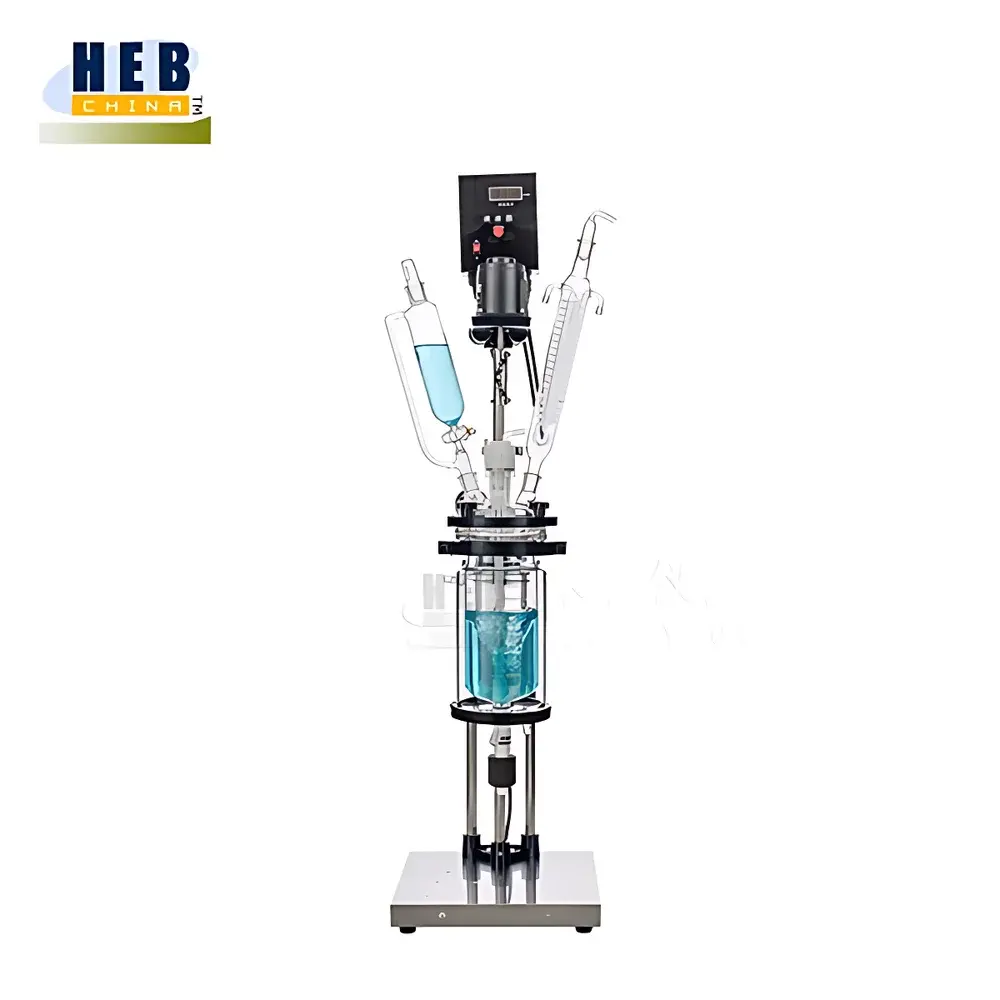
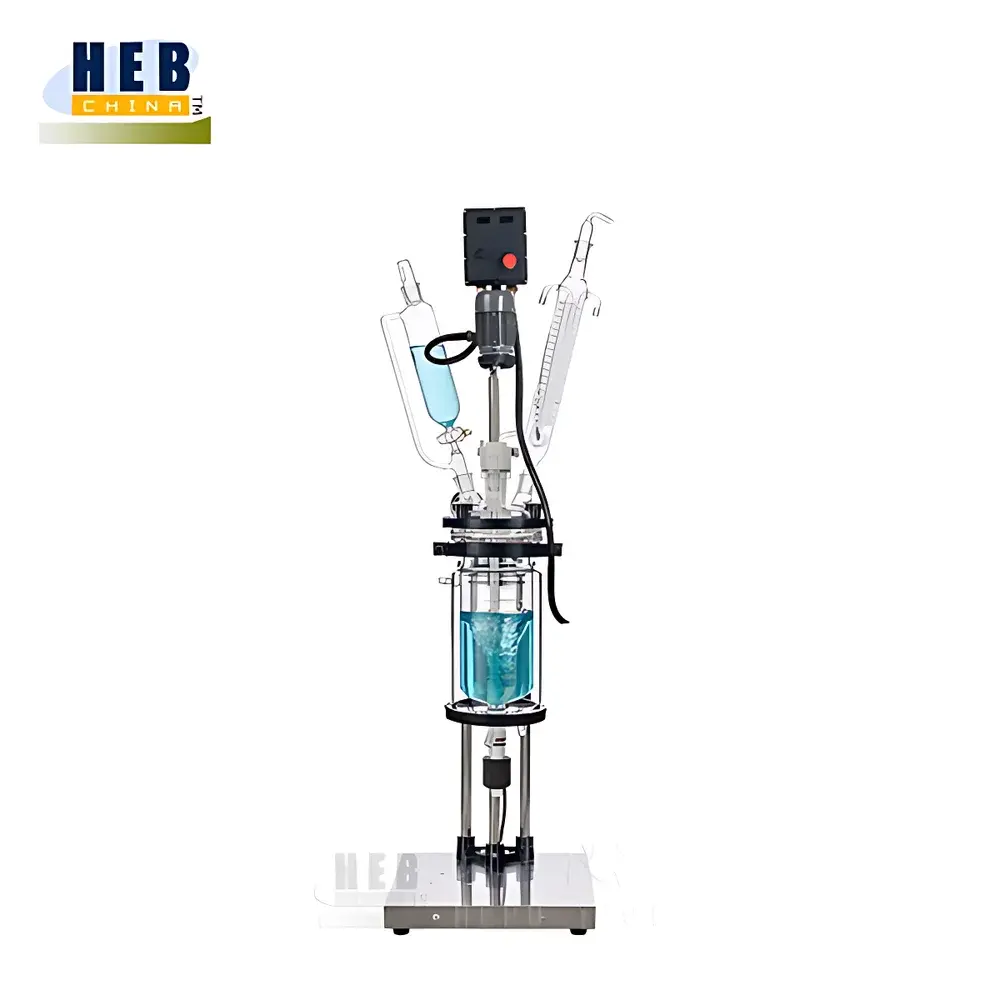
HEB-3L Dual-Jacketed Glass Reactor by Jihepu (Jinan Hepingpu)
| [Brand | Jihepu (Jinan Hepingpu) |
|---|---|
| Origin | Shandong, China |
| Model | HEB-3L |
| Capacity | 3 L |
| Working Pressure | Low-pressure |
| Vacuum Degree | 0.098 MPa |
| Operating Temperature Range | −80 °C to +250 °C |
| Stirring Speed | 0–1100 rpm |
| Motor Power | 60 W |
| Jacket Volume | 0.6 L |
| Feed Funnel Capacity | 500 mL |
| Vessel Material | GG-17 borosilicate glass |
| Sealing | PTFE components + imported fluororubber seals |
| Stirring Shaft Diameter | 10 mm |
| Discharge Port Height | 300 mm |
| Dimensions (L×W×H) | 350 × 410 × 1250 mm |
| Net Weight | 38 kg |
| Power Supply | 220 V / 50 Hz] |
Overview
The HEB-3L Dual-Jacketed Glass Reactor is an engineered laboratory-scale reaction system designed for controlled synthesis, distillation, reflux, concentration, and separation under precise thermal and mechanical conditions. It operates on the principle of jacketed heat transfer: a circulating thermal medium—such as silicone oil, ethylene glycol/water mixtures, or chilled coolant—is introduced into the annular space between the inner and outer walls of the GG-17 borosilicate glass vessel. This enables accurate temperature regulation of the reaction mass from −80 °C to +250 °C, while maintaining optical clarity for real-time visual monitoring. The reactor integrates a high-torque AC motor-driven stirring system with digital speed control, enabling reproducible mixing across heterogeneous or viscous reaction mixtures. Its low-pressure design (rated for operation up to 0.098 MPa vacuum) supports solvent evaporation, reduced-boiling-point distillation, and inert-atmosphere reactions when coupled with external vacuum pumps or gas manifolds.
Key Features
- GG-17 high-borosilicate glass vessel offering exceptional thermal shock resistance (ΔT ≥ 120 °C), chemical inertness toward acids, alkalis, and organic solvents, and >90% optical transmittance in the visible spectrum.
- Modular stainless steel frame with aluminum alloy structural elements—corrosion-resistant, rigid, and compliant with ISO 8502-3 surface cleanliness standards for lab equipment housings.
- PTFE-sheathed stainless steel stirring shaft and impeller, ensuring non-contaminating agitation across pH 0–14 environments and eliminating metal leaching risks in sensitive pharmaceutical or catalyst synthesis applications.
- Brushless AC motor (60 W nominal output) delivering consistent torque across the full 0–1100 rpm range, with zero electrical sparking—meeting IEC 60079-0 requirements for safe operation in potentially flammable vapor environments.
- Multi-port lid configuration (5 standard NS29/32 ground-glass joints) supporting simultaneous installation of condensers, thermometers, addition funnels, nitrogen inlets, and vacuum lines without adapter stacking.
- Digital RPM display with stepless electronic speed regulation, calibrated traceability via internal encoder feedback, and stable speed maintenance ±2 rpm under load variation.
- Vacuum-rated PTFE-fluoroelastomer composite sealing system achieving sustained vacuum integrity at ≤0.098 MPa (≤2 mbar abs), validated per ASTM E471 leak rate specifications for Class II laboratory reactors.
- Zero-dead-volume PTFE conical discharge valve with integrated tilt mechanism, minimizing residual hold-up volume (<0.5 mL) and enabling complete, residue-free material recovery—critical for GMP-aligned pilot batches.
Sample Compatibility & Compliance
The HEB-3L accommodates liquid, slurry, and suspension-phase reaction systems up to 3 L working volume. Its GG-17 glass construction resists attack from hydrochloric acid (≤37%), nitric acid (≤65%), sodium hydroxide (≤50%), acetone, THF, DMF, and most chlorinated solvents—verified per ISO 719 and ISO 720 hydrolytic resistance classifications. The reactor meets structural safety requirements outlined in EN 61010-1:2010 for laboratory electrical equipment, including dielectric strength testing (1500 V AC, 1 min) and creepage/clearance distances. While not certified for pressurized operation, its vacuum performance aligns with USP analytical instrument qualification criteria for vacuum-assisted evaporation steps in method development. Optional grounding kits and static-dissipative tubing connections support compliance with IEC 61340-5-1 ESD control protocols in API manufacturing settings.
Software & Data Management
The HEB-3L is a standalone analog-digital hybrid instrument with no embedded firmware or network interface. All operational parameters—including stir speed, observed vacuum level (via integrated analog gauge), and external bath temperature—are manually set and recorded externally. For regulated environments, users integrate the reactor into validated workflows using third-party data acquisition systems (e.g., LabVIEW, DeltaV, or Siemens Desigo CC). When paired with a calibrated external temperature probe (Pt100, Class A) and vacuum transducer (capacitance manometer), the system supports 21 CFR Part 11-compliant electronic records when deployed with audit-trail-enabled SCADA platforms. Raw parameter logs—time-stamped speed, vacuum, and bath setpoints—can be exported for IQ/OQ documentation during equipment qualification per ASTM E2500.
Applications
- Small-scale synthesis of active pharmaceutical ingredients (APIs) requiring strict thermal control and visual endpoint detection (e.g., Grignard additions, hydrogenations under N₂).
- Distillation and solvent recovery of heat-sensitive natural extracts (e.g., terpenes, alkaloids) using vacuum-assisted fractional distillation.
- Catalyst screening studies where transparency enables real-time observation of precipitation, phase separation, or colorimetric reaction progress.
- Polymerization kinetics experiments under inert atmosphere, leveraging the five-port lid for monomer feed, initiator injection, and headspace gas analysis.
- Academic teaching labs for demonstrating Le Chatelier’s principle, equilibrium shifts under vacuum, and Arrhenius-based rate constant determination.
- Materials science prototyping—including MOF crystallization, sol-gel processing, and nanomaterial nucleation—where contamination-free glass surfaces prevent catalytic side reactions.
FAQ
What temperature ranges can the HEB-3L safely maintain during exothermic or endothermic reactions?
The jacketed design supports continuous thermal control from −80 °C (with cryogenic coolant circulation) to +250 °C (using high-flashpoint silicone oil), provided external circulators meet corresponding flow rate and ΔT specifications.
Is the reactor suitable for use under positive pressure?
No—it is rated exclusively for low-pressure/vacuum service up to 0.098 MPa absolute; it lacks ASME Section VIII certification and should never be operated above ambient pressure.
How is vacuum integrity verified during commissioning?
A helium leak test per ASTM E499 is recommended; typical acceptance criterion is ≤1 × 10⁻⁶ mbar·L/s for all sealed joints and valve assemblies.
Can the stirring system handle highly viscous polymer solutions?
Yes—the 60 W AC motor delivers peak torque ≥0.35 N·m at low speeds, sufficient for Brookfield viscosity range up to ~50,000 mPa·s at 100 rpm with anchor or helical impellers.
What maintenance intervals are recommended for the PTFE-fluoroelastomer seals?
Under continuous vacuum operation, inspect seals every 200 operating hours; replace after 1000 hours or immediately upon visible compression set (>15% thickness loss) per ISO 3601-3 guidelines.



