
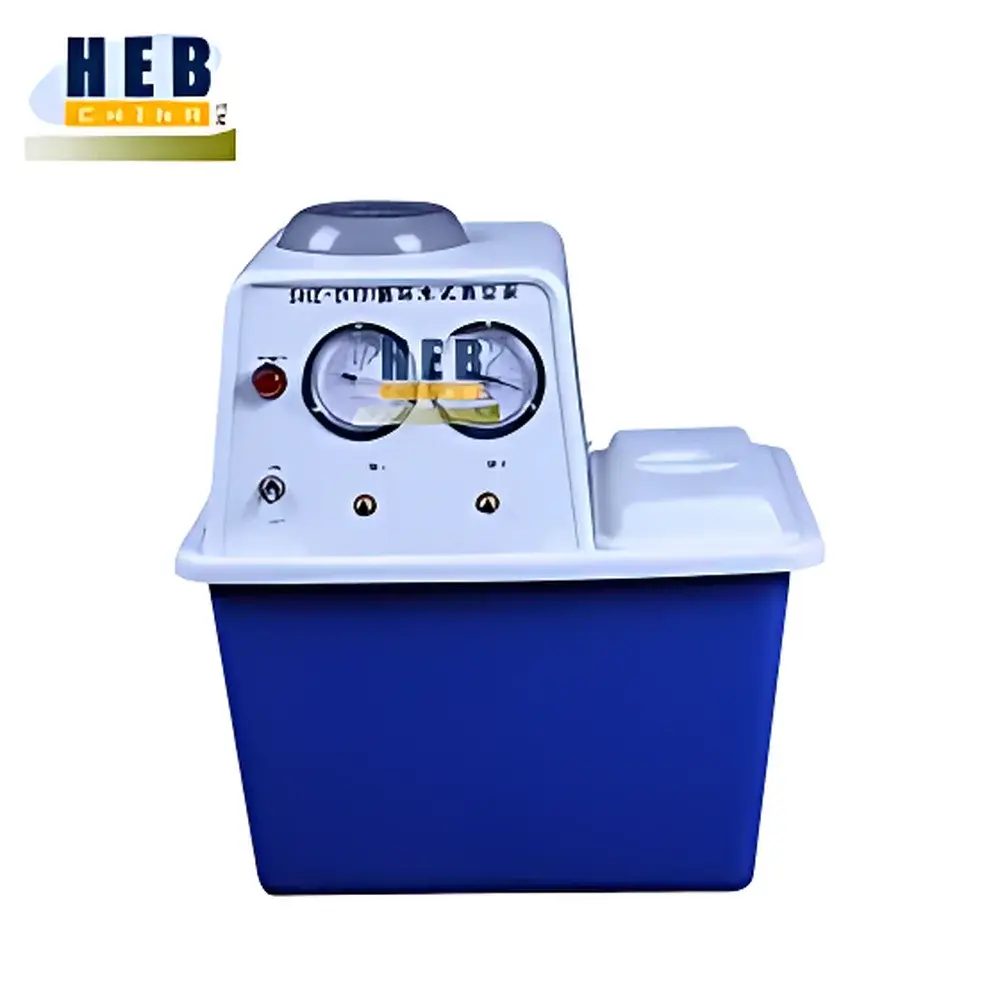
Hebei HOPU SHZ-D(III) Circulating Water Vacuum Pump
| Brand | Hebei HOPU |
|---|---|
| Origin | Shandong, China |
| Manufacturer Type | Authorized Distributor |
| Country of Origin | China |
| Model | SHZ-D(III) |
| Instrument Type | Circulating Water Vacuum Pump |
| Product Type | Oil-Free Vacuum Pump |
| Ultimate Vacuum | 0.098 MPa (abs) |
| Air Displacement Rate | 10 L/min |
| External Dimensions (L×W×H) | 400 × 280 × 420 mm |
| Net Weight | 15 kg |
| Motor Power | 180 W |
| Power Supply | AC 180–220 V, 50/60 Hz |
| Number of Vacuum Ports | 4 |
| Vacuum Gauges | 4 analog pressure indicators |
| Construction Materials | Corrosion-resistant housing with stainless steel or chemically resistant composite pump core |
| Optional Features | Integrated vacuum regulation valve, transparent water reservoir variant available |
| Water Tank Capacity | 15 L |
| Compliance | Designed for general laboratory use per GB/T 25172–2010 (Chinese standard for circulating water vacuum pumps), compatible with ISO/IEC 17025 laboratory environment requirements |
Overview
The Hebei HOPU SHZ-D(III) Circulating Water Vacuum Pump is an oil-free, water-sealed vacuum source engineered for routine vacuum applications in academic teaching laboratories, undergraduate chemistry labs, and small-scale research settings. Operating on the principle of water ring vacuum generation, it uses rotating impeller-driven water circulation to create negative pressure within sealed reaction systems—enabling distillation, filtration, rotary evaporation, and vacuum drying without introducing hydrocarbon contamination. Unlike mechanical or diaphragm vacuum pumps, this unit relies solely on deionized or tap water as both sealant and coolant, eliminating lubricant degradation risks and ensuring consistent performance across extended operation cycles. Its compact footprint (400 × 280 × 420 mm) and 15 kg mass support benchtop deployment in space-constrained environments, while the dual-sided, four-port configuration allows concurrent access for up to four users—making it especially suited for pedagogical demonstration setups where visibility and operational symmetry are critical.
Key Features
- Four independently controllable vacuum ports with individual analog vacuum gauges (0–0.1 MPa range), enabling real-time pressure monitoring at each station.
- Corrosion-resistant construction: housing fabricated from reinforced polypropylene or ABS; pump core options include stainless steel (SUS304) or chemically inert composite materials for compatibility with mild acids, bases, and organic solvents.
- Integrated 15-liter water reservoir with level indicator and overflow protection; optional transparent acrylic tank variant available for visual verification of water circulation and air bubble detection.
- Low-noise operation (<62 dB(A) at 1 m distance) achieved through balanced impeller design and vibration-dampening mounting.
- Modular vacuum regulation: optional inline vacuum control valve permits fine-tuned adjustment of suction pressure per port—critical for sensitive crystallization or gentle solvent removal.
- Energy-efficient 180 W induction motor rated for continuous duty under ambient temperatures ≤40°C and relative humidity ≤80% RH.
Sample Compatibility & Compliance
The SHZ-D(III) is designed for non-hazardous, non-explosive vapor handling only. It is not rated for solvent vapors with flash points below 60°C, halogenated hydrocarbons, or strongly oxidizing agents (e.g., concentrated nitric acid fumes). When used with appropriate cold traps and secondary condensers, it supports ASTM D1120 (boiling point determination), USP <797> (non-sterile compounding vacuum filtration), and ISO 7027 (turbidity measurement sample preparation). The unit meets GB/T 25172–2010 specifications for circulating water vacuum pumps and conforms to IEC 61010-1:2010 safety requirements for electrical equipment in laboratory use. No intrinsic safety certification (ATEX/IECEx) is provided; installation must comply with local electrical codes and institutional lab safety protocols.
Software & Data Management
This is a manually operated, analog-control vacuum system with no embedded microprocessor, digital interface, or data logging capability. Pressure readings are displayed exclusively via four calibrated Bourdon-tube vacuum gauges. For integration into GLP/GMP workflows requiring audit trails, external digital pressure transducers (e.g., Validyne DP15 or Omega PX409 series) may be installed downstream with third-party DAQ systems. The absence of firmware or network connectivity ensures immunity to cybersecurity vulnerabilities and eliminates software validation requirements under FDA 21 CFR Part 11.
Applications
- Simultaneous vacuum filtration for up to four student workstations in organic synthesis labs.
- Supporting rotary evaporators (up to 2 L capacity) during low-boiling-point solvent removal.
- Vacuum-assisted recrystallization and hot filtration under reduced pressure.
- Gas evolution collection in redox or carbonate decomposition experiments.
- Preparation of degassed solvents for electrochemical cell assembly.
- Primary vacuum source for simple vacuum desiccators and Schlenk line roughing (when paired with secondary high-vacuum pumps).
FAQ
What type of water should be used in the reservoir?
Deionized or distilled water is recommended to minimize scale buildup. Tap water may be used if total dissolved solids (TDS) < 200 ppm and pH 6.5–8.5; periodic descaling with 5% citric acid solution is advised.
Can this pump handle corrosive vapors?
Only mildly corrosive vapors (e.g., dilute HCl, acetic acid) are tolerated when used with a properly sized inline cold trap. Direct exposure to strong oxidizers or halogenated solvents will degrade seals and impeller surfaces.
Is the vacuum level adjustable per port?
Yes—via the optional vacuum regulation valve, which allows independent throttling of suction flow to each port without affecting others.
What maintenance is required?
Monthly inspection of water level, impeller clearance, and hose integrity; annual replacement of rubber gaskets and O-rings; biannual descaling if using hard water.
Does it meet international export compliance standards?
The unit carries CE marking per Directive 2014/35/EU (LVD) and 2014/30/EU (EMC); RoHS 2011/65/EU compliance documentation is available upon request.



