
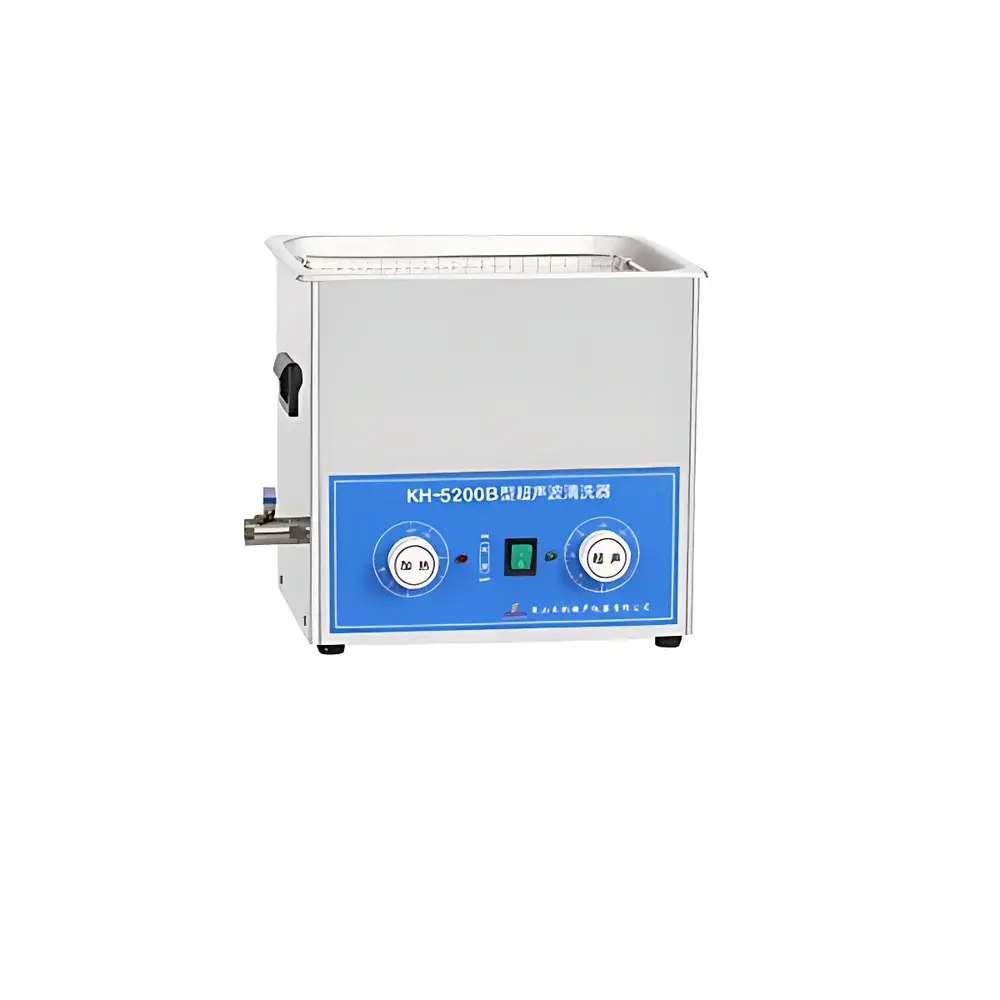
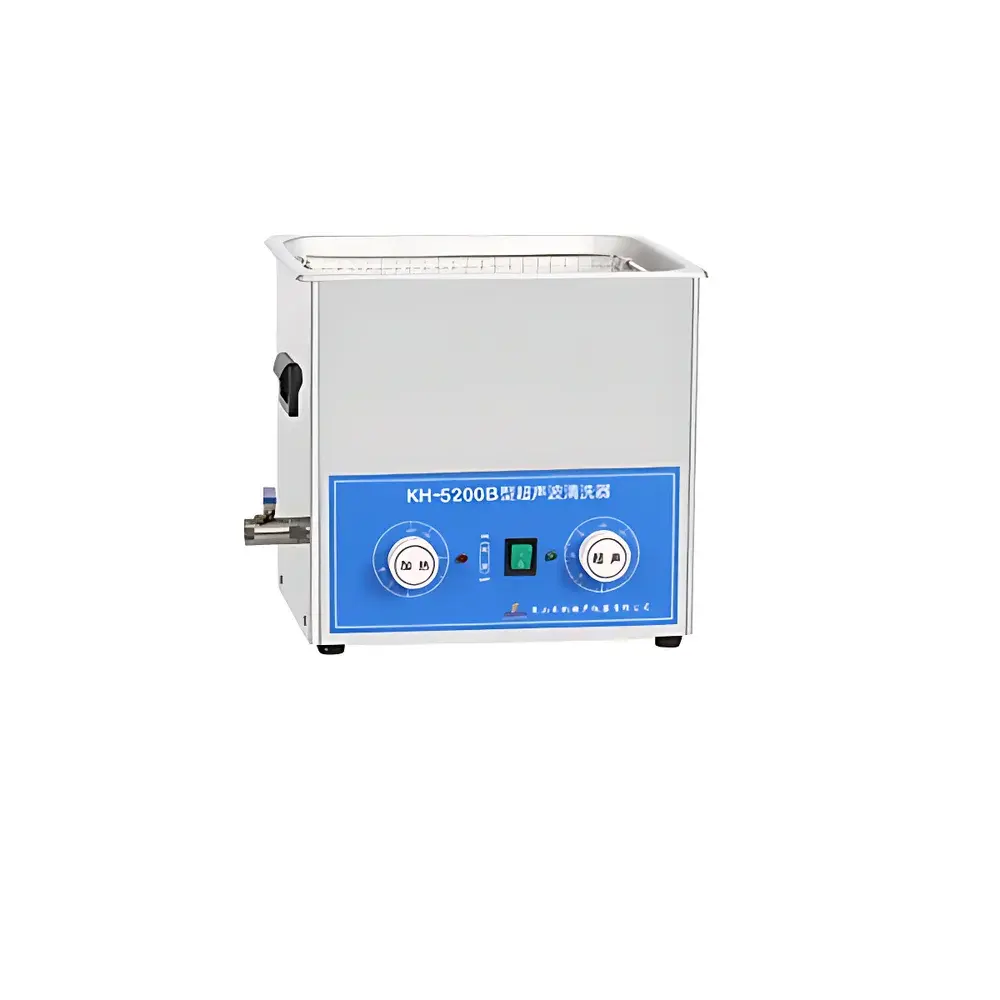
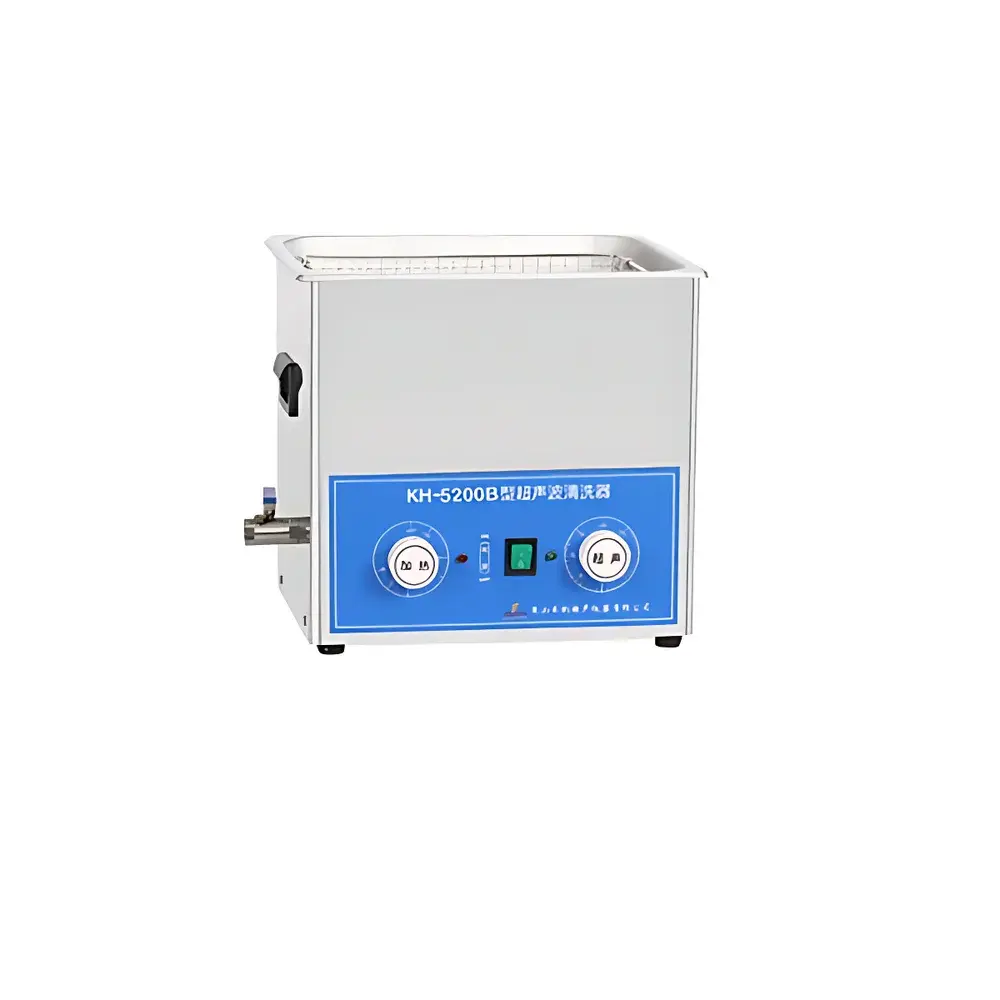
Hechuang KH5200B Rotary-Knob Ultrasonic Cleaner
| Brand | Hechuang |
|---|---|
| Origin | Jiangsu, China |
| Model | KH5200B |
| Tank Capacity | 10 L |
| Ultrasonic Frequency | 25 kHz & 40 kHz (selectable) |
| Ultrasonic Power | 200 W |
| Heating Power | 600 W |
| Temperature Range | Ambient to 80 °C |
| Timer Range | 1–30 min |
| Internal Tank Dimensions (mm) | 300 × 240 × 150 |
| Overall Dimensions (mm) | 320 × 264 × 320 |
| Stainless Steel Mesh Basket | Included |
| Drain Valve | Yes |
| Sound-Dampening Lid | Optional |
Overview
The Hechuang KH5200B Rotary-Knob Ultrasonic Cleaner is a benchtop laboratory instrument engineered for precision cleaning, degassing, dispersion, and cell disruption in research, quality control, and routine laboratory workflows. It operates on the principle of ultrasonic cavitation—where high-frequency sound waves generate microscopic vacuum bubbles in liquid media; their rapid collapse produces localized shockwaves and microstreaming that effectively remove particulate contamination from surfaces without mechanical abrasion. Designed for reproducible, non-destructive cleaning of delicate components—including optical lenses, semiconductor wafers, surgical instruments, chromatography vials, and microfluidic devices—the KH5200B delivers consistent energy distribution across its 10-liter stainless-steel tank. Its dual-frequency capability (25 kHz for heavy-duty particle removal and 40 kHz for fine-part cleaning and gentle sample processing) enables method flexibility aligned with ISO 13485, ASTM D2601, and USP guidance on particulate matter testing.
Key Features
- Rotary-knob interface for intuitive, tactile control of time, temperature, and frequency selection—no software dependency or touchscreen calibration required.
- Dual ultrasonic frequency output (25 kHz and 40 kHz), switchable via front-panel selector, supporting both aggressive contaminant removal and low-energy applications such as nanoparticle dispersion or enzymatic reaction mixing.
- Precise digital temperature regulation from ambient to 80 °C, powered by a 600 W heating element with ±2 °C stability over full range—critical for temperature-sensitive solvents and biological sample integrity.
- Programmable timer (1–30 minutes) with automatic shutdown and audible end-of-cycle alert, ensuring process repeatability and operator safety compliance per IEC 61010-1.
- Stainless steel tank (300 × 240 × 150 mm internal) with argon-welded seams and corrosion-resistant finish; includes removable stainless steel mesh basket for secure sample positioning and uniform acoustic coupling.
- Integrated drain valve for rapid, spill-free solution exchange—reducing downtime between cleaning protocols and facilitating solvent recovery workflows.
Sample Compatibility & Compliance
The KH5200B accommodates a broad range of sample types and container geometries, including glassware (vials, beakers, cuvettes), metal tools (tweezers, forceps), ceramic substrates, and polymer-based microplates. Its tank geometry and transducer array configuration minimize standing-wave interference, enabling uniform cavitation field distribution—validated per ASTM E1759-19 for ultrasonic cleaner performance mapping. The unit complies with CE marking requirements for electromagnetic compatibility (EMC Directive 2014/30/EU) and low-voltage safety (LVD Directive 2014/35/EU). While not certified for sterile processing under ISO 17664, it supports GMP-aligned cleaning validation when paired with documented SOPs, traceable calibration records, and periodic performance qualification (PQ) using aluminum foil erosion tests per ASTM E1299.
Software & Data Management
As a hardware-controlled analog instrument, the KH5200B does not incorporate embedded firmware, network connectivity, or electronic data logging. All operational parameters are set manually via calibrated rotary dials, eliminating software validation burden under FDA 21 CFR Part 11. This architecture ensures deterministic behavior, immunity to firmware corruption, and simplified IQ/OQ execution in regulated environments. For laboratories requiring audit trails, manual logbook entries—including date/time, operator ID, cycle parameters, and visual inspection results—are recommended and fully compatible with GLP documentation standards.
Applications
- Pre-analytical sample preparation: removal of residual oils, flux residues, and polishing compounds from analytical components prior to SEM, XRD, or mass spectrometry analysis.
- Pharmaceutical manufacturing: cleaning of stainless-steel contact parts and glass packaging components in accordance with EU GMP Annex 11 risk-based validation principles.
- Academic research: cell lysis optimization for protein extraction, sonication-assisted synthesis of metal-organic frameworks (MOFs), and deagglomeration of colloidal suspensions.
- Electronics QA: post-reflow cleaning of PCB assemblies to verify solder paste residue absence per IPC-J-STD-001.
- Medical device reprocessing: adjunct cleaning of reusable laparoscopic instruments prior to sterilization—used only as a non-sterile pre-cleaning step per AAMI ST91.
FAQ
Is the KH5200B suitable for cleaning delicate optics or MEMS devices?
Yes—when operated at 40 kHz with aqueous or low-surface-tension solvents and controlled exposure time (≤5 min), it minimizes surface pitting while achieving >99% particulate removal efficiency on fused silica and silicon nitride substrates.
Can the unit be used with flammable solvents?
No. The KH5200B lacks explosion-proof certification and internal vapor management systems. Only water-based or flashpoint >60 °C solvents (e.g., isopropanol/water blends) should be used under well-ventilated conditions.
Does the optional sound-dampening lid affect cleaning efficacy?
It reduces airborne noise by ~15 dB(A) without attenuating ultrasonic energy transmission into the bath, as verified by hydrophone measurements per IEC 62127-1.
What maintenance is required to sustain performance?
Monthly inspection of tank integrity, transducer adhesion, and drain valve seal integrity; annual verification of temperature sensor accuracy against NIST-traceable reference thermometer.
Is calibration documentation provided with the instrument?
A factory calibration certificate for temperature and timer functions is included. Full metrological traceability requires third-party calibration per ISO/IEC 17025 by an accredited laboratory.



