
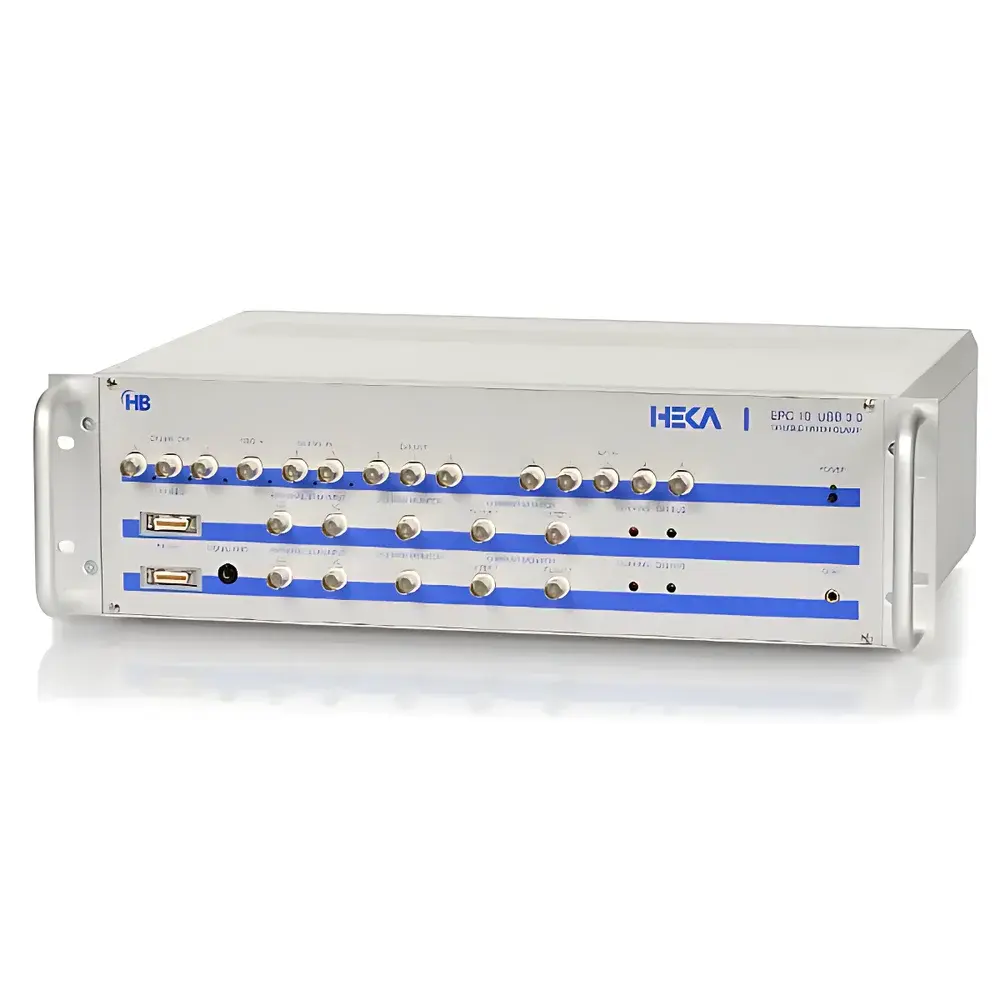
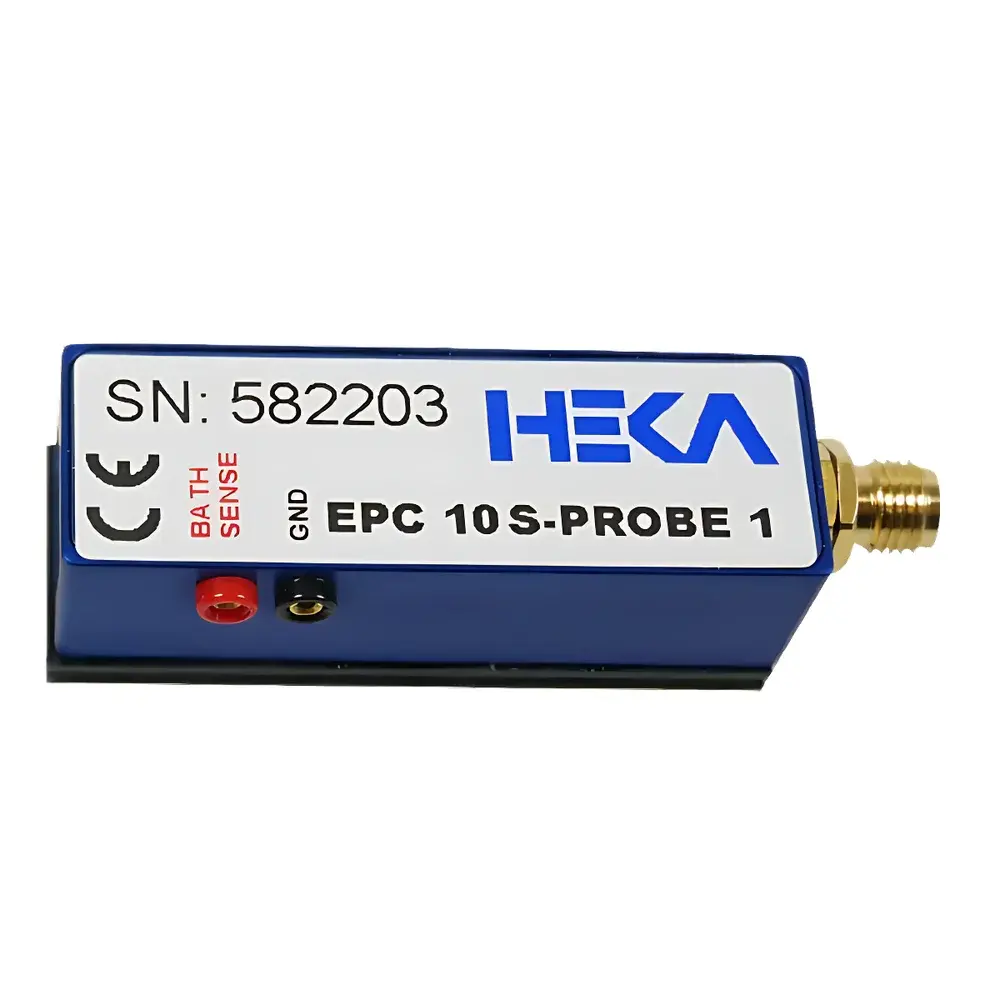
HEKA EPC 10 USB 3.0 Advanced Patch-Clamp Amplifier System
| Brand | HEKA |
|---|---|
| Origin | Germany |
| Model | EPC 10 USB 3.0 |
| Detection Principle | Voltage Clamp & Current Clamp |
| Instrument Type | Fully Automated Electrophysiology Workstation |
| Cell Types | Isolated neurons, cardiomyocytes, and related cell lines |
| Seal Quality | High |
| Success Rate | >90% |
| Recording Channels | 1/2/4/8 |
| Sampling Rate | Up to 2 MHz |
| ADC Channels | 5 |
| DAC Channels | 3 |
| Integrated Data Acquisition | LIH3.x Low-Noise Digitization Engine |
| Software Platform | PATCHMASTER NEXT & FITMASTER NEXT |
| Compliance | Designed for GLP/GMP-aligned electrophysiology workflows |
Overview
The HEKA EPC 10 USB 3.0 Advanced Patch-Clamp Amplifier System is a purpose-engineered, high-fidelity electrophysiology platform designed for rigorous voltage-clamp and current-clamp experiments in academic, pharmaceutical, and translational research laboratories. Built upon HEKA’s four-decade legacy in precision bioelectrical measurement, the EPC 10 USB 3.0 integrates analog signal conditioning, real-time digital conversion (LIH3.x architecture), and deterministic USB 3.0 data streaming into a single compact chassis—eliminating inter-unit timing jitter and external grounding dependencies. Its core measurement principle relies on low-noise operational amplifier topologies optimized for high-gain, high-bandwidth transmembrane current detection (pA to nA range) and sub-millisecond voltage step fidelity. The system supports both conventional and automated patch-clamp configurations—including whole-cell, cell-attached, perforated-patch, loose-patch, sharp-electrode intracellular, and bilayer/nanopore recording—enabling quantitative interrogation of ion channel kinetics, synaptic transmission, excitability dynamics, and disease-associated electrophysiological phenotypes.
Key Features
- Unified hardware architecture with integrated LIH3.x low-noise digitization engine—no external DAQ required; ensures phase-coherent sampling across all channels
- USB 3.0 interface enabling sustained data throughput up to 2 Gbps, minimizing latency for real-time visualization and closed-loop stimulation protocols
- Simultaneous multi-channel acquisition: scalable from 1 to 8 independent recording channels via synchronized amplifier units
- Programmable ZAP pulses, p/n leak subtraction, automatic series resistance (Rs) and capacitance (C-fast/C-slow) compensation—fully configurable per protocol
- Dual-mode operation: bridge balance for current-clamp and low-frequency voltage-clamp modes for stable membrane potential maintenance
- Five analog input (ADC) and three analog output (DAC) channels per unit—supports concurrent electrophysiological + optical (e.g., fluorescence photometry) or mechanical stimulation experiments
- Gentle Switch functionality enables seamless transition between voltage- and current-clamp without manual reconfiguration or signal interruption
- Auto-compensation algorithms for electrode offset potential, Rs, and membrane capacitance—validated for high-gain full-cell recordings with minimal transient artifact
Sample Compatibility & Compliance
The EPC 10 USB 3.0 is routinely deployed in studies involving primary dissociated neurons, iPSC-derived cardiomyocytes, HEK293 and CHO expression systems, brain slices, and artificial lipid bilayers. Its noise floor (< 100 fA RMS, 10 kHz bandwidth) and dynamic range (> 120 dB) meet stringent requirements for resolving single-channel gating events and small-amplitude synaptic currents. The system complies with international standards for laboratory instrumentation including IEC 61010-1 (safety), EN 61326-1 (EMC), and supports implementation of ALCOA+ data integrity principles. When configured with PATCHMASTER NEXT’s optional audit trail module, it satisfies FDA 21 CFR Part 11 requirements for electronic records and signatures—making it suitable for preclinical safety pharmacology (e.g., hERG screening), neurotoxicity assessment, and GLP-compliant cardiac electrophysiology studies.
Software & Data Management
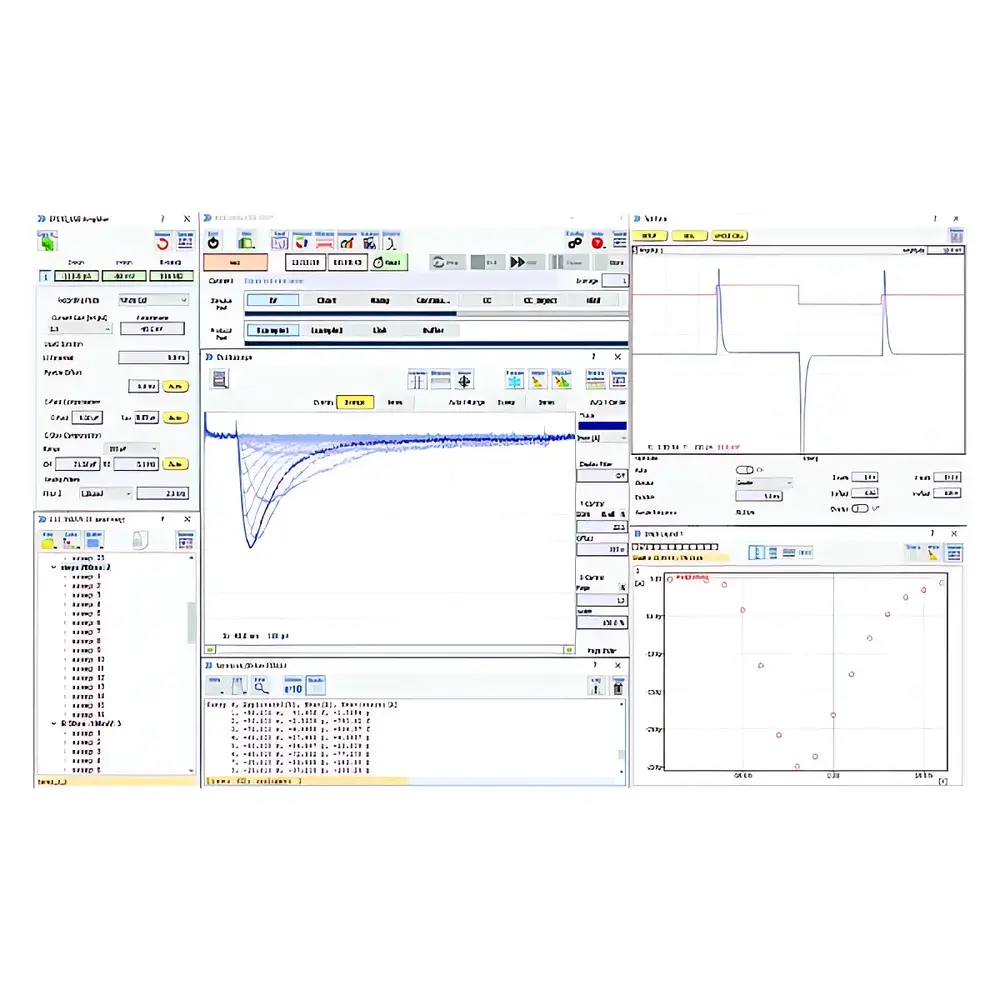
PATCHMASTER NEXT serves as the central control, acquisition, and stimulus orchestration environment—featuring a drag-and-drop protocol editor, hardware-synchronized trigger routing, and real-time parameter modulation. All amplifier settings, stimulus sequences, and metadata are saved alongside raw binary data in HEKA’s proprietary .dat format (open specification, supported by third-party tools). FITMASTER NEXT provides advanced post-acquisition analysis: automated event detection (amplitude, latency, dwell time), exponential trajectory fitting (e.g., activation/inactivation kinetics), ensemble averaging, and statistical comparison across conditions. Both applications support export to ASCII, HDF5, and MATLAB-compatible formats; direct integration with Igor Pro, Python (via heka-pylib), and MATLAB is documented and maintained. DocuLUX (microscopy image acquisition) and SmartLUX (fluorescence ratio analysis) operate as native modules within the PATCHMASTER NEXT framework—enabling synchronous acquisition of electrical and optical signals without time-drift artifacts.
Applications
- Characterization of voltage-gated (Na+, K+, Ca2+), ligand-gated (nAChR, GABAA, NMDA), and mechanically gated ion channels
- High-throughput screening of compound effects on hERG, Nav1.5, or Cav1.2 channels under standardized protocols
- Investigation of synaptic plasticity (LTP/LTD), miniature postsynaptic current (mEPSC/mIPSC) frequency/amplitude, and network burst dynamics
- Electrophysiological phenotyping of disease models: epilepsy, Alzheimer’s, Parkinson’s, long QT syndrome, arrhythmogenic cardiomyopathy
- Nanopore sensing applications—including DNA translocation kinetics, protein unfolding, and small-molecule interaction assays
- Combined patch-clamp and optogenetic interrogation using integrated DAC-controlled LED or laser stimulation
FAQ
What is the maximum achievable sampling rate per channel?
The EPC 10 USB 3.0 supports up to 2 MHz per channel with hardware-configurable anti-aliasing filters—optimized for resolving rapid channel gating transitions and high-frequency synaptic events.
Can multiple EPC 10 units be synchronized for >8-channel recordings?
Yes—units can be daisy-chained via TTL synchronization signals, enabling deterministic inter-unit timing alignment with sub-microsecond precision.
Is PATCHMASTER NEXT compatible with macOS?
Native macOS support is available through a dedicated build; Windows 10/11 (64-bit) remains the primary development and validation platform.
Does the system support automated seal formation or gigaseal optimization?
While the EPC 10 itself does not include pressure or capacitance-based auto-seal algorithms, its real-time feedback interfaces seamlessly with third-party micromanipulator controllers and pressure systems for semi-automated patching workflows.
How is data integrity ensured during long-duration recordings (e.g., >24 hours)?
Continuous checksum validation, segmented file writing, and optional journaling mode prevent data corruption; FITMASTER NEXT includes built-in data consistency verification prior to analysis.



