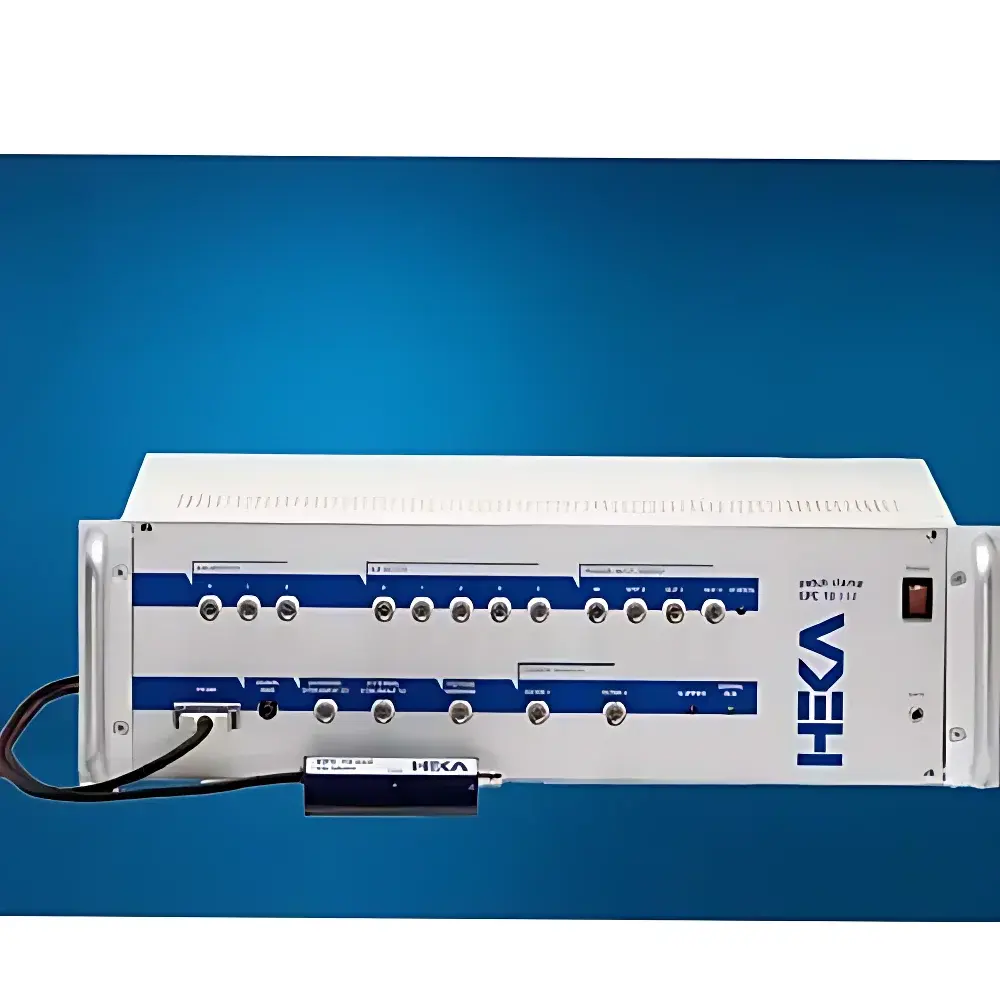
HEKA EPC 10 USB Patch Clamp Amplifier System
| Brand | HEKA (now part of Harvard Bioscience) |
|---|---|
| Origin | Germany (manufactured in Lambrecht, Germany |
| Model | EPC 10 USB |
| Architecture | Integrated analog amplifier + digital I/O (LIH 8+8 AD/DA interface) |
| Interface | High-speed USB 2.0 |
| Configurations | Single-, dual-, triple-, and quad-patch headstage options |
| Compatible Software | PatchMaster v2.x / PatchMaster Next, FitMaster, SmartLux |
| Compliance | CE-marked, RoHS-compliant, designed for GLP/GMP-adjacent electrophysiology labs |
Overview
The HEKA EPC 10 USB Patch Clamp Amplifier System is a high-fidelity, computer-controlled electrophysiological recording platform engineered for precision voltage-clamp and current-clamp experiments in single-cell and multi-cell patch clamp configurations. Developed by HEKA Elektronik (now operating under Harvard Bioscience), the EPC 10 USB represents the culmination of decades of iterative design in extracellular and intracellular electrophysiology instrumentation. Unlike legacy amplifiers with manual front-panel controls, the EPC 10 USB implements full software-defined operation—every gain setting, filter cutoff, holding potential, and headstage configuration is programmatically set via PatchMaster or PatchMaster Next, minimizing operator-induced drift and enabling precise experimental reproducibility across sessions and laboratories. Its integrated LIH 8+8 analog-to-digital/digital-to-analog interface provides synchronized 8-channel analog input and 8-channel analog output at up to 500 kS/s per channel (dependent on configuration), supporting simultaneous acquisition from multiple electrodes or parallel recordings in brain slice, cultured neuron, or oocyte preparations.
Key Features
- Fully software-controlled architecture: All amplifier parameters—including gain, filtering (Bessel or Butterworth, 1–10 kHz adjustable), series resistance compensation, capacitance neutralization, and headstage selection—are managed in real time through PatchMaster’s graphical user interface.
- Modular headstage support: Compatible with HEKA’s range of low-noise, high-input-impedance headstages (e.g., HS-2a, HS-3a, HS-4a) for single-, dual-, triple-, and quad-patch configurations—enabling simultaneous whole-cell, cell-attached, inside-out, or outside-out recordings.
- Integrated LIH 8+8 interface: Eliminates external DAQ dependency; features 16-bit resolution, programmable sampling rates (100 Hz to 500 kHz), and hardware-triggered acquisition for stimulus synchronization and event-driven protocols.
- USB 2.0 high-bandwidth connection: Ensures deterministic latency (< 100 µs round-trip) and stable data streaming without frame drops—even during extended multi-hour recordings.
- Low-noise design: Input-referred noise < 3 fA/√Hz (at 1 kHz, 1 GΩ feedback) and DC offset stability < ±10 µV/hour, critical for resolving sub-picoampere currents in ion channel kinetics studies.
Sample Compatibility & Compliance
The EPC 10 USB system supports standard glass micropipettes (1–5 MΩ tip resistance), conventional bath chambers (e.g., RC-26GLP, Warner Instruments), and perfusion systems compatible with HEKA’s VMC-6T or ALA Scientific valve controllers. It interfaces seamlessly with common inverted and upright microscopes (Olympus IX73, Zeiss Axioskop, Nikon Eclipse FN1) via TTL trigger lines and analog sync outputs. The system complies with EU Directive 2014/30/EU (EMC), 2011/65/EU (RoHS), and carries CE marking for use in research environments. While not FDA-cleared for clinical diagnostics, its architecture meets essential requirements for GLP-aligned workflows—including audit-trail-enabled software logging (via PatchMaster Next’s secure mode), electronic signature support, and exportable raw binary (.dat) + metadata-rich HDF5 file formats compliant with NIH-supported data standards (e.g., NWB 2.0).
Software & Data Management
PatchMaster v2.x and its successor PatchMaster Next serve as the primary acquisition and analysis environment. PatchMaster Next introduces role-based user permissions, encrypted project files, and 21 CFR Part 11–compatible audit trails—supporting traceability of protocol modifications, calibration events, and data export actions. FitMaster enables automated non-linear curve fitting for dose-response, activation/inactivation, and kinetic modeling (e.g., Hodgkin-Huxley formalism). SmartLux provides real-time optical-electrical correlation for combined patch clamp and fluorescence imaging (e.g., Ca²⁺ or voltage-sensitive dye experiments). All software modules run natively on Windows 10/11 (64-bit), support MATLAB and Python (via HEKA’s official API), and generate timestamp-synchronized datasets with embedded stimulus metadata.
Applications
- Ion channel pharmacology: Quantitative IC₅₀/EC₅₀ determination for small-molecule modulators, peptide toxins, or biologics targeting Nav, Kv, Cav, TRP, or ligand-gated channels.
- Neuronal excitability profiling: Action potential waveform analysis, synaptic transmission kinetics, and network burst detection in primary cortical/hippocampal cultures or acute brain slices.
- Cardiomyocyte electrophysiology: Late sodium current (INaL) characterization, hERG inhibition screening, and APD90 restitution mapping.
- Oocyte expression systems: Two-electrode voltage clamp (TEVC) adaptation using HEKA’s OC-725C amplifier interface and custom headstage adapters.
- Automated patch clamp validation: Reference-standard benchmarking for high-throughput platforms (e.g., SyncroPatch, QPatch) due to its gold-standard signal fidelity and low variability.
FAQ
Is the EPC 10 USB compatible with macOS or Linux operating systems?
No—PatchMaster and associated HEKA software are Windows-exclusive applications. However, raw .dat files can be imported into cross-platform tools (e.g., Python with neo library, Igor Pro) for post-hoc analysis.
Can I upgrade an older EPC 9 system to EPC 10 USB functionality?
No—the EPC 10 USB is a complete hardware redesign with integrated DAQ; it is not retrofittable onto prior-generation chassis or headstages.
Does the system support temperature control integration?
Yes—via analog voltage outputs (±10 V) and TTL triggers, the EPC 10 USB synchronizes with commercial temperature controllers (e.g., Warner TC-344B, Luigs & Neumann ST-100) for ramped or stepwise thermal protocols.
What calibration procedures are required before recording?
Daily verification using HEKA’s built-in self-test signals (square wave, sine sweep) and pipette capacitance compensation routines is recommended; full factory calibration is advised every 12 months or after mechanical shock.
Is technical support available outside North America?
Yes—Harvard Bioscience maintains regional service centers in Germany (Lambrecht), the UK, Japan, and China, with certified field application scientists providing remote troubleshooting and on-site training.