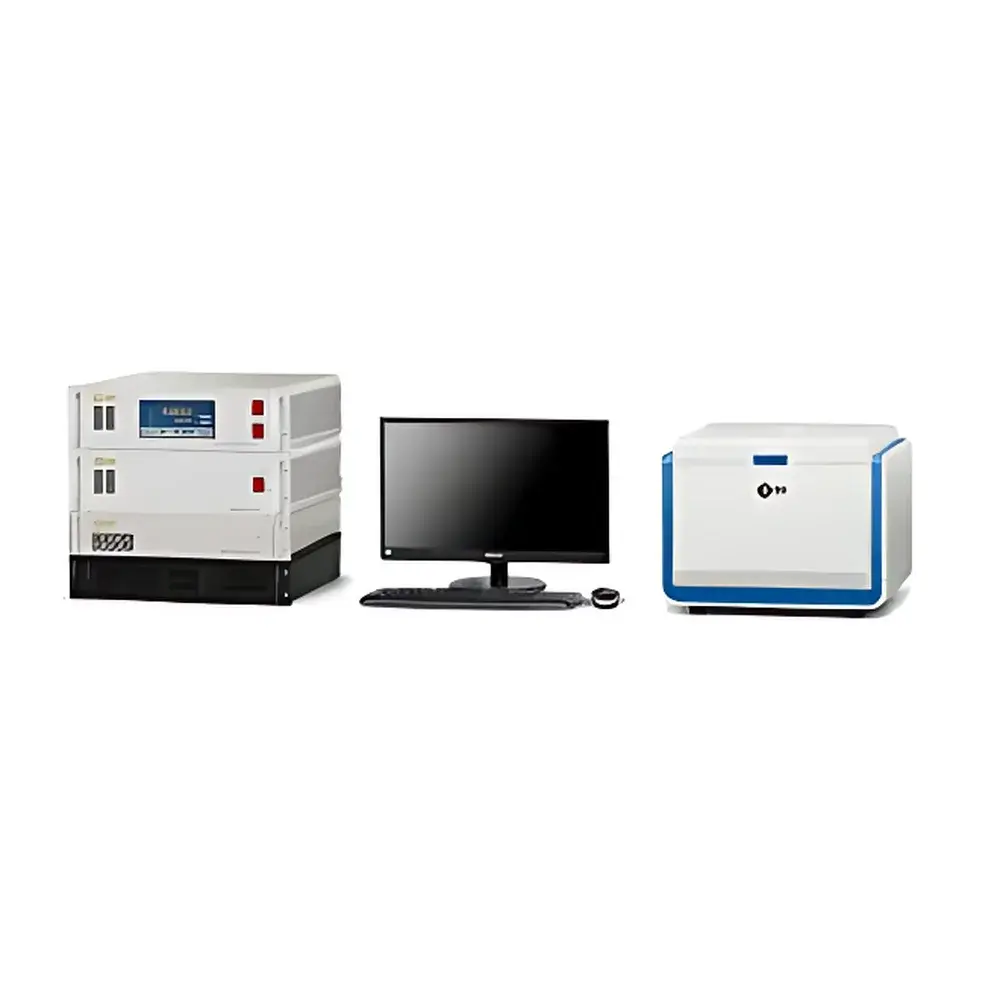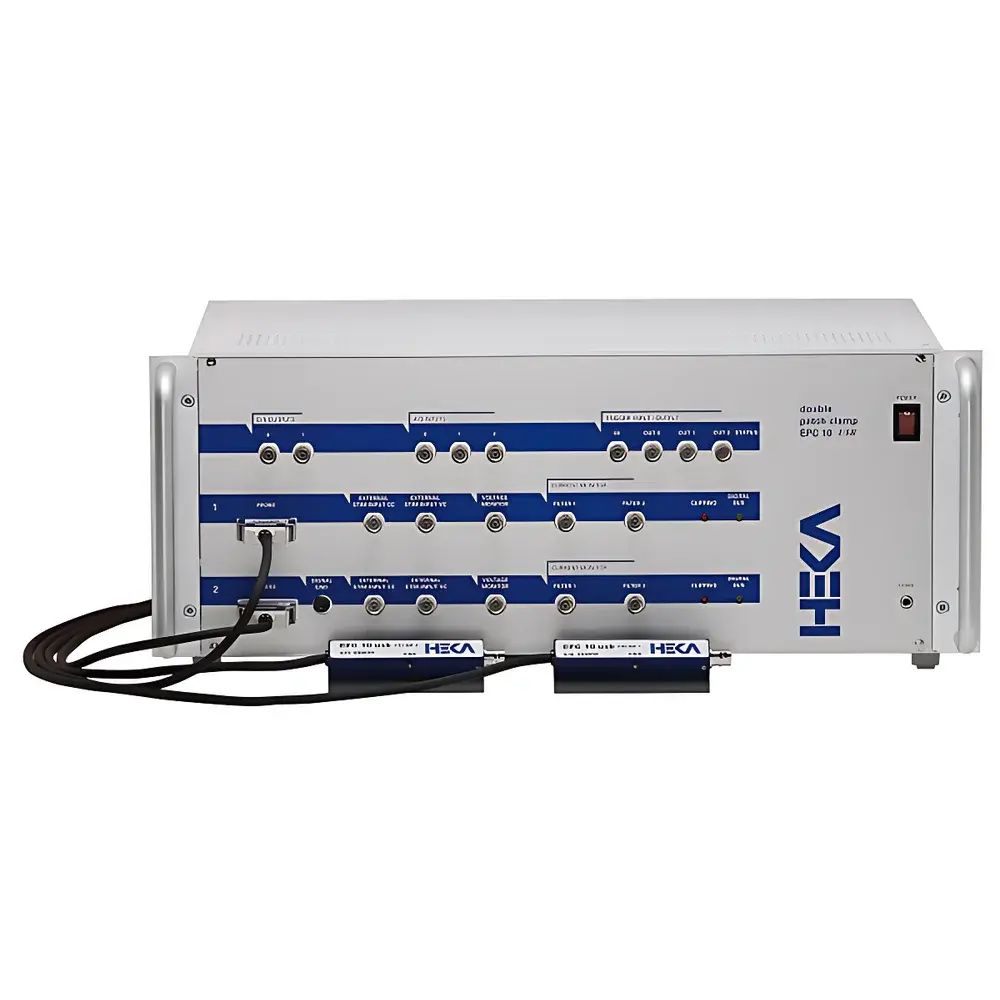
HEKA EPC10 USB Patch Clamp Amplifier
| Brand | HEKA |
|---|---|
| Origin | Germany |
| Model | EPC 10 USB |
| Interface | USB 2.0 |
| Operating Systems | Windows 7/10/11, macOS (via Pulse/TIDA compatibility layers), legacy Mac OS 9/X |
| Calibration | Fully automated self-calibration & self-test |
| Capacitance Compensation | Fast/slow, series resistance, liquid junction potential — all software-controlled |
| Lock-in Amplifier | Integrated for membrane capacitance measurement (ΔCm) |
| Stimulus Generator | Programmable multi-segment waveform editor with sub-millisecond timing resolution |
| Data Acquisition | 16-bit ADC/DAC (ITC-1600 interface integrated via optical fiber) |
| Bandwidth | DC to 15 kHz (true low-noise performance up to 15 kHz) |
| Input Voltage Range | ±10 V |
| Current Range | ±1 nA to ±100 nA (12 gain settings) |
| Power Supply | 100–130 V AC or 200–260 V AC, 50/60 Hz |
| Probe Configurations | Single-, dual-, triple-, and quad-patch headstage options available |
| Compliance Standards | CE-marked |
Overview
The HEKA EPC10 USB Patch Clamp Amplifier is a high-fidelity, fully computer-controlled electrophysiology platform engineered for precision voltage-clamp and current-clamp experiments across diverse biological preparations. Built upon the proven architecture of the EPC-9 series and refined for modern USB-based integration, the EPC10 delivers exceptional signal integrity, ultra-low noise floor (< 0.5 pA RMS, 100 Hz–10 kHz), and deterministic real-time control—critical for resolving single-channel kinetics, sub-millisecond synaptic currents, and slow capacitive transients associated with exocytosis or endocytosis. Its core design adheres to the principles of feedback-stabilized operational amplifiers operating in either voltage-clamp (high-gain, high-input-impedance mode) or current-clamp (low-output-impedance, high-slew-rate mode), with active guarding, shielded cabling, and optical isolation between analog front-end and host PC ensuring galvanic decoupling and minimal ground-loop interference. The system supports both conventional sharp-electrode intracellular recording and high-resistance seal (> 1 GΩ) patch configurations—including cell-attached, inside-out, outside-out, whole-cell, perforated-patch, and artificial bilayer membranes.
Key Features
- Fully automated software-driven compensation: simultaneous fast/slow capacitance cancellation, series resistance (Rs) correction (up to 95%), and liquid junction potential (LJP) offset adjustment—executed without manual potentiometer intervention.
- Integrated lock-in amplifier module enabling high-sensitivity membrane capacitance (Cm) tracking with sub-femtofarad resolution, supporting quantitative analysis of vesicular fusion/fission events in neuroendocrine cells, chromaffin cells, or pancreatic β-cells.
- Programmable multi-channel stimulus generator with nanosecond-level timing precision; supports arbitrary waveform synthesis (sinusoidal, ramp, pulse trains, user-defined .csv imports) for dynamic clamp, conductance injection, or dual-pathway modulation.
- Optically isolated ITC-1600 16-bit AD/DA interface embedded within the main unit—eliminating latency and jitter typical of USB-native DAQ systems—enabling synchronous acquisition across ≥4 independent patch channels at 100 kS/s per channel.
- Modular headstage architecture: interchangeable single-, dual-, triple-, and quad-headstage configurations accommodate parallel recordings from multiple neurons, cardiac myocytes, or tissue slices (e.g., hippocampal or ventricular slices).
- True current-clamp capability with <1 mV baseline drift over 60 min and <10 µV input-referred noise—validated for long-duration resting potential stability and action potential threshold mapping.
Sample Compatibility & Compliance
The EPC10 is routinely deployed in primary neuronal cultures, acute brainstem/spinal cord slices, dissociated cardiomyocytes, Xenopus oocytes, plant protoplasts, and reconstituted lipid bilayers. Its low-noise front-end and adjustable filtering (Bessel or linear-phase digital filters, 10 Hz–15 kHz cutoff) meet experimental requirements defined in ISO/IEC 17025-accredited electrophysiology labs. The instrument complies with IEC 61010-1:2012 for laboratory electrical safety and carries CE marking under the EU Medical Device Regulation (MDR 2017/745) Annex II Class I non-invasive device classification when used with certified electrodes and perfusion systems. While not FDA 510(k)-cleared as a diagnostic device, its data output structure conforms to MIAME-compliant metadata standards and supports audit trails required under GLP and GCP frameworks when paired with PatchMaster’s optional 21 CFR Part 11-compliant extension module.
Software & Data Management
PatchMaster v2x serves as the native acquisition and analysis environment, offering deterministic real-time control via deterministic USB interrupt handling and kernel-mode drivers. It supports synchronized multi-channel stimulation/acquisition, online leak subtraction, automatic event detection (amplitude, rise time, decay τ), and batch processing of >10,000 sweeps using Python- or MATLAB-linked post-processing pipelines. Raw data are stored in HDF5 format with embedded metadata (temperature, pipette resistance, seal quality, holding potential), ensuring FAIR (Findable, Accessible, Interoperable, Reusable) compliance. Optional extensions enable TTL-triggered fluorescence acquisition (via Hamamatsu/Andor camera sync), photolysis uncaging control (with UV LED drivers), and impedance spectroscopy integration for membrane dielectric profiling.
Applications
- Single-channel biophysics: dwell-time analysis, conductance state identification, and voltage-dependent gating kinetics of ligand-gated (nAChR, GABAA) or voltage-gated (Nav, Kv, Cav) ion channels.
- Whole-cell synaptic physiology: miniature EPSC/IPSC quantification, short-term plasticity (paired-pulse ratio, facilitation/depression), and long-term potentiation (LTP) induction protocols in acute brain slices.
- Cardiac electrophysiology: action potential duration (APD) mapping, inward rectifier (IK1) characterization, and late sodium current (INaL) assessment in human iPSC-derived cardiomyocytes.
- Secretory cell dynamics: capacitance tracking of granule exocytosis in adrenal chromaffin cells or insulin release in pancreatic β-cells under glucose or receptor agonist stimulation.
- Pharmacological screening: concentration-response curve generation for novel modulators targeting hERG, Nav1.7, or TRPV1 channels under standardized voltage protocols (e.g., ASTM E3157-19).
FAQ
Is the EPC10 compatible with modern macOS versions beyond macOS 10.15?
Yes—PatchMaster v2.92+ includes native Apple Silicon (ARM64) support and operates natively on macOS 12–14 via Quartz Compositor acceleration; legacy Pulse/TIDA dependencies have been fully deprecated.
Can the EPC10 perform simultaneous voltage-clamp and current-clamp on the same cell?
No—the EPC10 operates in one clamp mode per headstage at any given time; however, rapid mode switching (< 10 µs transition) enables interleaved protocols within a single sweep.
Does the system support offline leak subtraction for whole-cell recordings?
Yes—PatchMaster implements both P/N and online leak subtraction algorithms with configurable blanking intervals and polynomial fitting, validated against standard resistive-capacitive circuit models.
What is the maximum sampling rate achievable with full 16-bit resolution across four headstages?
100 kS/s per channel (400 kS/s aggregate) with hardware-triggered synchronization and zero inter-channel skew, confirmed via NIST-traceable oscilloscope validation.
Is optical isolation maintained during simultaneous stimulation and acquisition?
Yes—all analog inputs, outputs, and TTL lines are galvanically isolated via fiber-optic links to the ITC-1600 interface, eliminating ground loops even in multi-rig Faraday cage environments.