
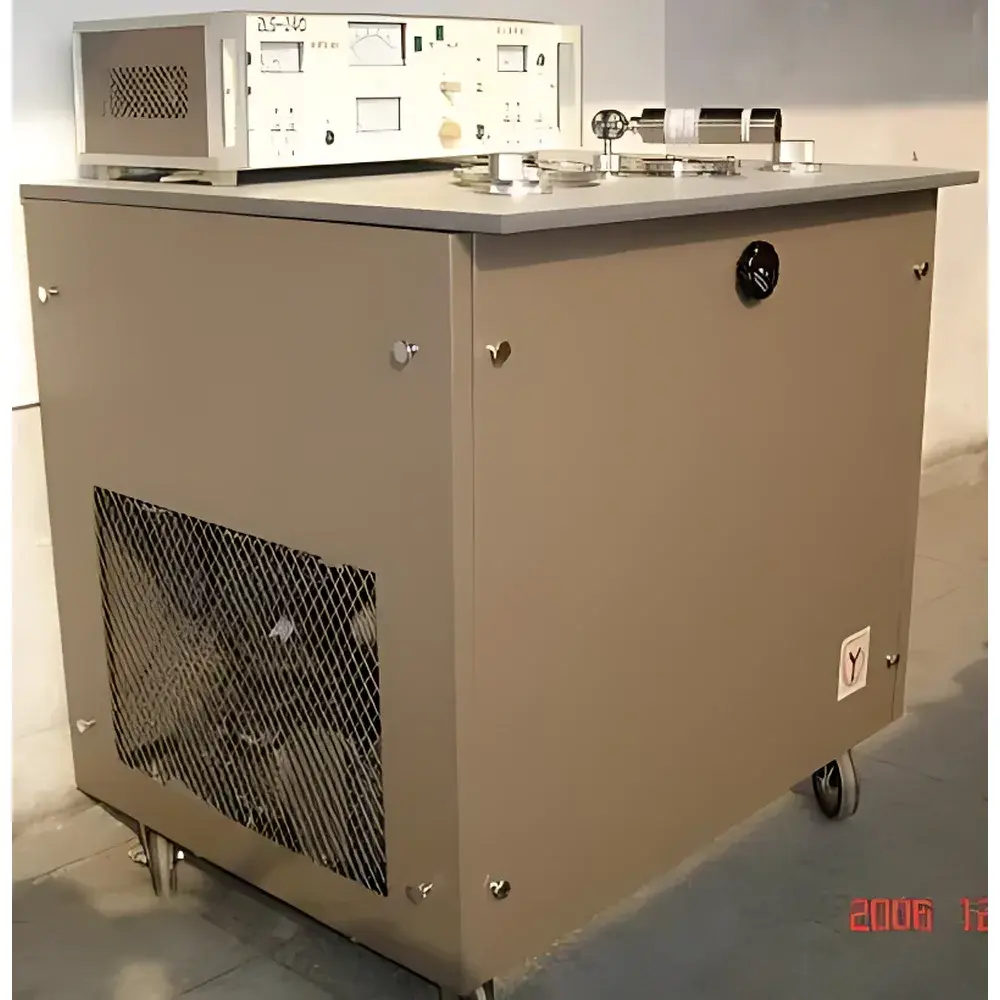
Helium Mass Spectrometer Leak Detector ZLS-23B/24C
| Origin | Sichuan, China |
|---|---|
| Manufacturer Type | Authorized Distributor |
| Origin Category | Domestic (PRC) |
| Model | ZLS-23B / ZLS-24C |
| Minimum Detectable Leak Rate | 2 × 10⁻¹¹ Pa·m³/s |
| Pump Type | Oil-Diffusion Vacuum System |
| Detection Gas | Helium (⁴He⁺) |
| Mass Separation Principle | Magnetic Sector Mass Filter |
Overview
The Helium Mass Spectrometer Leak Detector ZLS-23B/24C is a high-sensitivity vacuum-based leak detection instrument engineered for precision integrity verification of sealed systems in industrial, aerospace, semiconductor, and vacuum technology applications. It operates on the fundamental principle of magnetic sector mass spectrometry: helium gas (⁴He⁺), introduced as a tracer probe into or around a test object, is ionized in the detector’s ion source, accelerated through a magnetic field, and separated by mass-to-charge ratio. Only helium ions—mass 4 amu—are selectively focused onto the collector, generating a measurable current proportional to helium concentration. This selective ion detection eliminates interference from ambient air constituents (e.g., N₂⁺ at m/z = 28, O₂⁺ at m/z = 32), leveraging helium’s low natural abundance (~5.2 ppm in dry air) and distinct mass signature. The system employs an oil-diffusion vacuum pump as its primary high-vacuum stage, providing stable base pressure below 1 × 10⁻⁴ Pa—essential for achieving the specified minimum detectable leak rate of 2 × 10⁻¹¹ Pa·m³/s under standardized test conditions (per ISO 20486:2017 and ASTM E493-22).
Key Features
- Oil-diffusion vacuum pumping architecture delivering robust, continuous high-vacuum performance without reliance on cryogenic or turbomolecular pumps—ideal for environments with limited infrastructure or maintenance support.
- Dual-model configuration (ZLS-23B and ZLS-24C) offering identical sensitivity specifications while differing in control interface layout, vacuum gauge integration, and optional analog output configurations for legacy system integration.
- Magnetic sector mass filter with fixed-field magnet and electrostatic focusing—ensuring long-term mass resolution stability and minimal drift over extended operational cycles.
- Optimized ion source design with thermionic filament emission and adjustable electron energy (typically 70 eV), calibrated for maximum helium ionization efficiency and reduced fragmentation of background gases.
- Integrated analog leak rate display (0–10 V or 4–20 mA) and digital RS-232/RS-485 communication ports compliant with Modbus RTU protocol for SCADA and automated test station integration.
- Front-panel leak rate indicator with logarithmic scaling (10⁻⁶ to 10⁻¹¹ Pa·m³/s), real-time response time < 1.5 s, and built-in zero-stabilization algorithm to compensate for thermal drift during warm-up.
Sample Compatibility & Compliance
The ZLS-23B/24C supports testing of metallic, glass, ceramic, and polymer-sealed components—including vacuum chambers, heat exchangers, laser tubes, MEMS packages, and hermetic electronic enclosures—provided they withstand standard helium spray or vacuum chamber pressurization methods. It complies with ISO 20486:2017 (Leak testing — Mass spectrometer leak detectors — Vocabulary and general principles), ASTM E493-22 (Standard Test Methods for Leaks Using the Mass Spectrometer Leak Detector in the Inside-Out Testing Mode), and meets essential safety requirements per IEC 61010-1:2010 for electrical equipment used in measurement, control, and laboratory use. While not inherently 21 CFR Part 11 compliant (as it lacks audit-trail-capable software), its analog/digital outputs enable integration into validated GMP/GLP environments when paired with compliant data acquisition systems.
Software & Data Management
The ZLS-23B/24C operates as a standalone hardware platform with no embedded operating system or proprietary PC software. All operational parameters—including filament on/off, emission current adjustment, and gain calibration—are managed via front-panel controls and DIP-switch configurations. For traceable data logging, third-party DAQ systems (e.g., National Instruments LabVIEW or Siemens SIMATIC S7-1200 PLCs) may acquire analog outputs or serial telemetry using documented ASCII command sets. Calibration records—including sensitivity verification using certified leak standards (e.g., Vici Calibrations NIST-traceable 1 × 10⁻⁹ Pa·m³/s reference leaks)—must be maintained manually per ISO/IEC 17025 requirements.
Applications
- Aerospace: Verification of fuel tank weld integrity, hydraulic line assemblies, and satellite propulsion system seals.
- Semiconductor manufacturing: Leak screening of vacuum process chambers, load locks, and CVD/PVD tooling before installation.
- Power generation: Inspection of turbine condenser tubing, nuclear coolant loop components, and steam generator headers.
- Research infrastructure: Validation of ultra-high vacuum (UHV) systems in synchrotron beamlines and fusion experiment vessels.
- Medical device manufacturing: Final hermeticity testing of implantable pacemaker casings and sterilization packaging per ISO 11607-2.
FAQ
What vacuum level is required for optimal operation?
A base pressure ≤ 1 × 10⁻⁴ Pa must be achieved prior to helium introduction; this is sustained by the oil-diffusion pump in conjunction with a mechanical backing pump.
Can the instrument detect leaks in pressurized systems?
Yes—using the “sniffer mode” with external helium spraying, provided the test object is isolated from ambient drafts and the detector’s inlet is coupled to a calibrated sampling probe.
Is helium the only detectable tracer gas?
The magnetic sector is tuned for mass 4; while deuterium (²H₂⁺, m/z = 4) may yield signal, it is not recommended due to interference from hydrogen isotopes and lack of standardized calibration protocols.
How often does the oil-diffusion pump require maintenance?
Typical oil replacement interval is 6–12 months under continuous operation; cold traps should be regenerated every 200–300 hours to prevent hydrocarbon backstreaming.
Does the system support automated pass/fail decision logic?
No—threshold-based go/no-go output requires external programmable logic controller (PLC) integration via analog voltage or Modbus register mapping.
Related Products





