
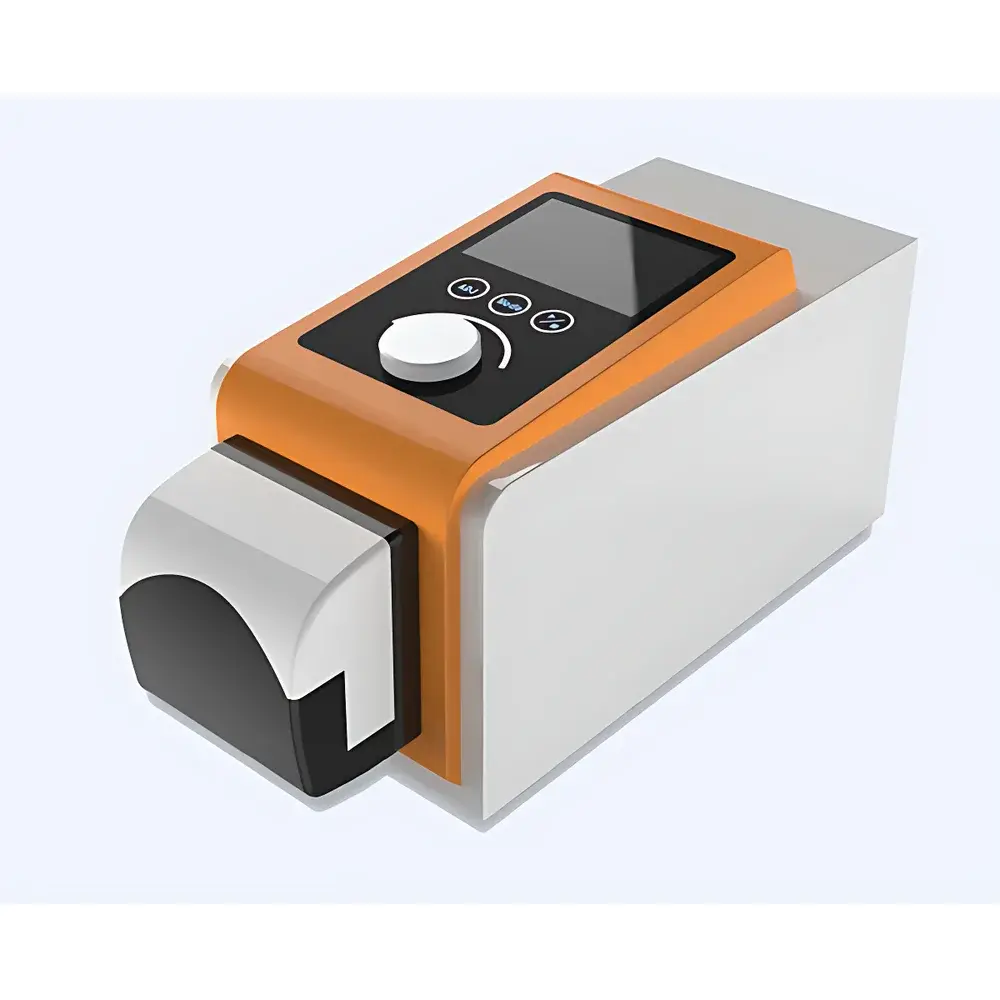
HengAo HPP-01 Portable Plate Dispenser
| Brand | Tianjin HengAo |
|---|---|
| Origin | Tianjin, China |
| Manufacturer Type | Direct Manufacturer |
| Model | HPP-01 |
| Dispensing Volume Range | 50 µL – 99 L |
| Precision | ±1.8% (9 mL, 3.2 mm ID tube), ±1% (18 mL), ±0.5% (225 mL) |
| Tubing ID Options | 1.6 mm, 3.2 mm, 4.8 mm, 6.4 mm, 8.0 mm |
| Wall Thickness (3.2 mm tube) | 1.6 mm |
| Pump Speed | 10–550 rpm |
| Intermittent Delay (Multi-dispense mode) | 0–99 s adjustable |
| Sterilization Compatibility | Autoclavable tubing only |
| Power Supply | Not specified |
| Tube Material | Medical-grade silicone or thermoplastic elastomer (user-supplied) |
Overview
The HengAo HPP-01 Portable Plate Dispenser is an engineered solution for precise, contamination-controlled liquid handling in life science laboratories where space, flexibility, and sterility are critical constraints. Built on a peristaltic pumping principle, the HPP-01 delivers repeatable volumetric dispensing without pump head contact with the fluid—eliminating carryover and enabling rapid changeover between reagents via disposable, autoclavable tubing sets. Unlike fixed-platform dispensers, its compact footprint (≤200 × 150 × 250 mm) and integrated handle support benchtop mobility, facilitating use across biosafety cabinets, cleanrooms, field sampling stations, and multi-user core facilities. The device is designed for non-pressurized, gravity-assisted or low-backpressure applications—ideal for aqueous buffers, microbial growth media, agar solutions (up to 1.5% w/v), saline dilutions, and environmental water samples. Its operational envelope spans from microliter-scale precision (50 µL minimum with 1.6 mm ID tubing under optimized speed and dwell settings) to liter-scale bulk transfers (up to 99 L per session), making it suitable for both high-throughput plate filling and low-volume sterile sampling protocols.
Key Features
- Peristaltic architecture with non-contact fluid path—pump head never contacts liquid; only user-supplied tubing interfaces with sample
- Three dispensing modes: Continuous flow, single-shot volume delivery, and programmable multi-dispense with adjustable inter-step delay (0–99 s)
- Modular tubing system supporting five inner diameters (1.6, 3.2, 4.8, 6.4, and 8.0 mm) to optimize flow rate, shear sensitivity, and target volume resolution
- Drip-free dispensing nozzle design with integrated valve action and post-dispense purge control
- Motor-driven speed range of 10–550 rpm enables fine-grained adjustment of volumetric output and minimizes turbulence in shear-sensitive formulations
- Optional footswitch interface supports hands-free operation inside laminar flow hoods or during aseptic procedures
- Compatible with standard autoclave cycles (121°C, 15 psi, 20 min) when using certified sterilizable tubing—validated per ISO 17664 for reprocessing of medical devices
Sample Compatibility & Compliance
The HPP-01 accommodates a broad range of low-to-medium viscosity liquids (≤500 mPa·s at 20°C), including phosphate-buffered saline (PBS), Tris-HCl buffers, LB and SOC broths, molten agarose (≤65°C), and potable or source water samples. It is not intended for volatile organic solvents, highly corrosive acids/bases, or particulate-laden suspensions exceeding 50 µm median particle size. From a regulatory standpoint, the system supports GLP- and GMP-aligned workflows through traceable manual operation logs (when paired with external lab notebooks or LIMS-integrated timestamps). While the instrument itself carries no CE/UKCA marking or FDA 510(k) clearance, its tubing-based fluid path allows full compliance with USP <1043> requirements for reusable and single-use systems in compounding and quality control labs. All tubing materials meet USP Class VI biocompatibility standards and ISO 10993-5 cytotoxicity criteria.
Software & Data Management
The HPP-01 operates via an embedded tactile keypad with LED status indicators—no onboard software, firmware updates, or cloud connectivity. This design prioritizes reliability, electromagnetic compatibility (EMC), and audit readiness in regulated environments where uncontrolled software changes pose validation risks. All dispensing parameters—including rpm setting, mode selection, number of repeats, and delay intervals—are manually entered and visually confirmed prior to actuation. For laboratories requiring electronic record retention, integration is achieved externally: time-stamped operation logs can be captured via connected digital timers or LIMS event triggers; volumetric accuracy verification is performed using gravimetric analysis per ASTM E542 and ISO 8655-3. The absence of internal memory or network interfaces ensures full compliance with FDA 21 CFR Part 11 Annex 11 data integrity principles for “static” instruments.
Applications
- Preparation of 96-/384-well microplates for ELISA, cell viability assays, and antimicrobial susceptibility testing
- Aseptic sampling of municipal or bottled water into sterile containers per EPA Method 1603
- Bulk dispensing of pre-warmed agar into Petri dishes under laminar airflow
- Calibration standard preparation with traceable volume transfer across concentration gradients
- QC/QA workflows in contract manufacturing organizations (CMOs) performing media fill simulations
- Field-deployable liquid handling in mobile biosurveillance units or veterinary diagnostic vans
FAQ
Is the HPP-01 suitable for sterile filtration integration?
No—the unit does not include or support in-line filter housings. Sterile dispensing relies exclusively on pre-filtered liquids and aseptic tubing installation.
Can dispensing accuracy be verified per ISO 8655?
Yes—gravimetric verification using Class I analytical balances (e.g., METTLER TOLEDO XSR series) and temperature-controlled weighing chambers satisfies ISO 8655-3 requirements for peristaltic dispensers.
What tubing certifications are required for GLP-compliant use?
Tubing must be supplied with manufacturer’s CoA listing extractables profile, endotoxin levels (<0.25 EU/mL), and autoclave cycle validation report per ISO 17664.
Does the device support serial dilution protocols?
Not natively—the HPP-01 lacks multi-channel or sequential aspiration/dispense capability. Serial dilutions require manual tube exchange between steps.
Is service calibration available outside China?
Local third-party metrology labs may perform functional verification against NIST-traceable standards; however, no authorized global service network currently exists.




