
HengaoDe H18061 High-Concentration Ozone Analyzer with Dual-Beam UV Absorption Pathway
| Brand | HengaoDe |
|---|---|
| Origin | Beijing, China |
| Manufacturer Type | Authorized Distributor |
| Country of Origin | China |
| Model | H18061 |
| Measurement Principle | UV Absorption (254 nm) |
| Range | 0–200 mg/L (configurable up to 900 g/m³ equivalent) |
| UV Source | Low-Pressure Mercury Lamp |
| Resolution | 0.1 mg/L |
| Accuracy | ±2% of full scale |
| Temperature & Pressure Compensation | Automatic |
| Output Signals | Isolated 0–5 V DC and 4–20 mA |
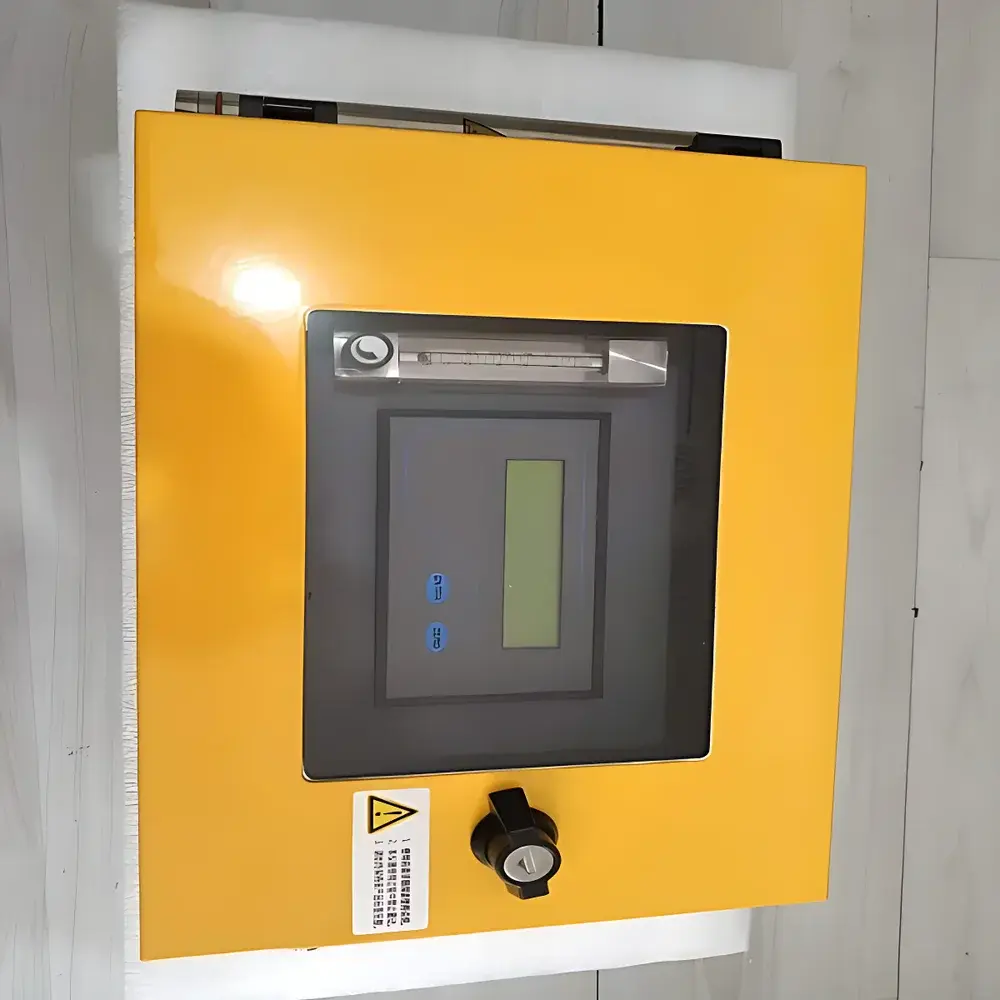
| Display | Backlit 32-character LCD |
| Dimensions | 400 × 300 × 155 mm |
| Weight | 11 kg |
| Power Supply | 220 VAC, 50 Hz |
Overview
The HengaoDe H18061 High-Concentration Ozone Analyzer is an industrial-grade analytical instrument engineered for continuous, real-time quantification of ozone (O₃) in gas streams at elevated concentrations—up to 900 g/m³ (equivalent to ~200 mg/L at standard temperature and pressure). It operates on the fundamental principle of ultraviolet (UV) absorption spectroscopy at 254 nm, where ozone exhibits strong, selective absorbance. The analyzer employs a dual-beam optical architecture: one beam passes through the sample gas path, while the reference beam traverses a sealed, ozone-free nitrogen path. This configuration eliminates drift caused by lamp aging or window fouling, ensuring long-term zero stability and measurement reproducibility without frequent recalibration. Designed for integration into ozone generation systems, the instrument meets functional requirements for process monitoring in municipal water treatment, industrial wastewater oxidation, pharmaceutical sterilization, food processing sanitation, swimming pool disinfection, and fine chemical synthesis.
Key Features
- Dual-beam UV absorption pathway with active reference compensation for high zero stability and minimal baseline drift
- Microprocessor-controlled automatic temperature and pressure compensation compliant with ISO 14644-3 and ASTM D5464 ambient correction protocols
- Isolated analog outputs (0–5 V DC and 4–20 mA) suitable for PLC integration and SCADA system interfacing
- Low-maintenance design: UV lamp replacement required only once per 12 months under continuous operation
- Robust mechanical housing rated IP54 for installation in industrial control rooms or near ozone generator skids
- Backlit alphanumeric LCD display supporting local readout without external software dependency
Sample Compatibility & Compliance
The H18061 is optimized for dry, particle-free ozone-air or ozone-oxygen mixtures. It is not intended for use with humid, corrosive, or particulate-laden streams without upstream conditioning (e.g., desiccant drying, particulate filtration, and acid scrubbing for HCl co-presence). While the instrument itself does not perform HCl detection, its optical path remains stable in environments where trace HCl may coexist—provided inlet gas is pre-treated per ISO 8573-1 Class 3/4 specifications. The analyzer supports compliance with operational validation frameworks including GMP Annex 1 (sterile processing), USP (water system monitoring), and EN 1279-2 (glass container ozone testing). Its analog outputs are compatible with FDA 21 CFR Part 11–compliant data acquisition systems when paired with audit-trail-enabled controllers.
Software & Data Management
The H18061 operates as a standalone hardware sensor with no embedded operating system or onboard data logging. All configuration, calibration, and diagnostic functions are executed via front-panel keypad navigation. For centralized data management, users integrate the 4–20 mA output into existing DCS or LIMS platforms. When deployed with third-party DAQ hardware (e.g., National Instruments cDAQ or Siemens S7-1200), the instrument supports time-stamped trend recording, alarm thresholding (e.g., high-concentration trip at 150 mg/L), and automated report generation aligned with GLP documentation standards. Calibration verification logs—including date, operator ID, span gas concentration, and post-calibration deviation—must be maintained externally per ISO/IEC 17025 clause 7.7.
Applications
- Ozone generator outlet concentration monitoring for dose control in drinking water ozonation plants
- Real-time feedback control of ozone mass transfer efficiency in industrial wastewater reactors
- Validation of residual ozone decay kinetics during space disinfection cycles in cleanrooms and isolators
- Quality assurance of ozone-based sterilization parameters in medical device packaging lines
- Process optimization in ozonolysis reactions for fragrance and pharmaceutical intermediate synthesis
- Compliance auditing for EPA Method O3-01 and ISO 14644-3 airborne ozone limits in controlled environments
FAQ
What is the maximum allowable humidity level for sample gas?
The analyzer requires inlet gas dew point ≤ –20 °C; higher moisture content causes condensation on optical windows and measurement interference.
Can the instrument measure ozone in pure oxygen streams?
Yes—calibration must be performed using ozone-in-oxygen standard gases; default factory calibration assumes air matrix.
Is routine zero calibration required?
No; the dual-beam architecture provides inherent zero stability. Full calibration with certified span gas is recommended every 3 months or after maintenance.
Does the device comply with explosion-proof requirements?
No—it is not ATEX or IECEx certified. Installation in hazardous areas requires external purging or placement in non-classified zones with sample extraction.
How is pressure compensation implemented?
An integrated piezoresistive pressure transducer and Pt100 temperature sensor feed real-time corrections to the Beer-Lambert calculation engine.





