
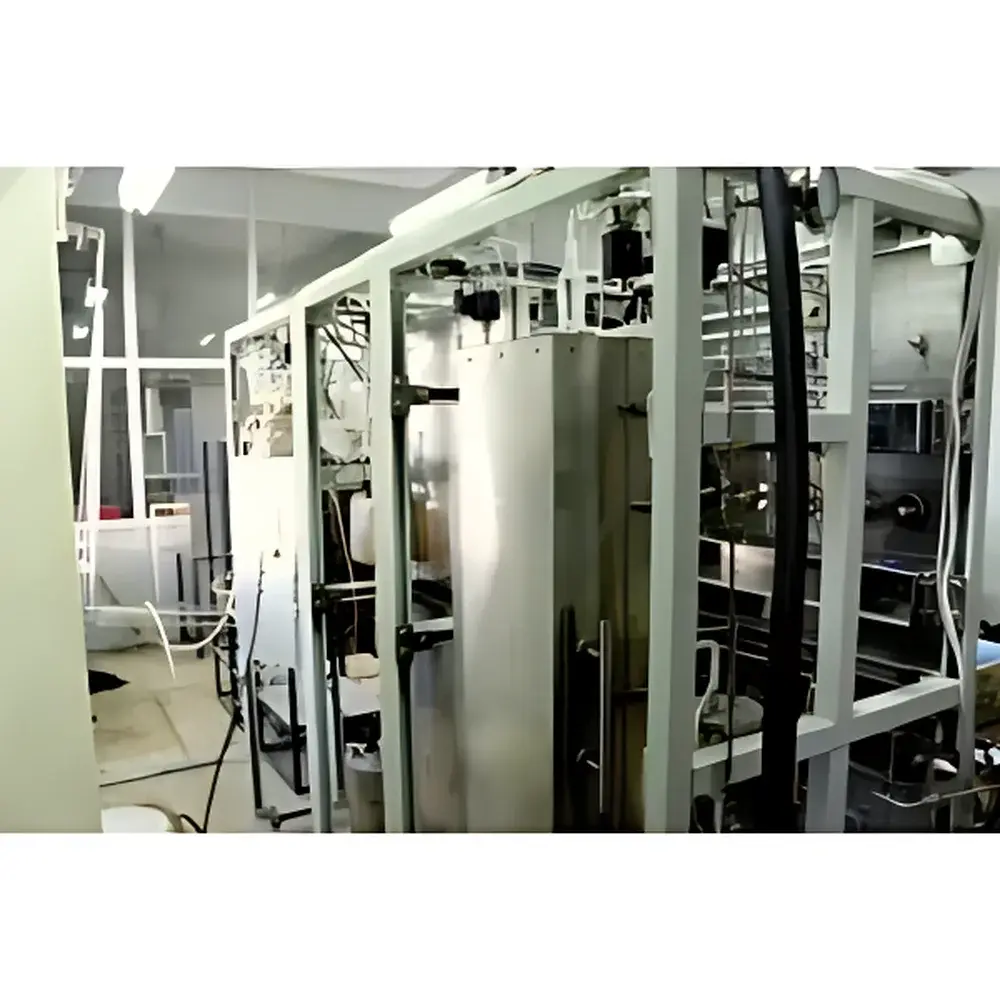
Hengjiu HJ.3 Dual-System Heavy Oil Hydroprocessing Pilot Plant
| Brand | Hengjiu (Henven) |
|---|---|
| Origin | Beijing, China |
| Manufacturer Type | Direct Manufacturer |
| Model | HJ.3 |
| Temperature Range | Up to 650 °C |
| Linear Ramp Rate | 0.1–40 °C/min |
| Isothermal Stability | ±0.1 °C |
| Operating Pressure | 0.1–22 MPa |
| Gas Flow Range | 0–500 mL/min |
| Gas Flow Accuracy | ±0.1% FS |
| Liquid Flow Range | 0–40 mL/min |
| Liquid Flow Resolution | 0.01 mL/min |
| Control Interface | Integrated LCD Touchscreen with Embedded Fluidized-Bed Logic |
| Structural Frame | High-Strength Stainless Steel Monocoque Chassis |
Overview
The Hengjiu HJ.3 Dual-System Heavy Oil Hydroprocessing Pilot Plant is a purpose-engineered laboratory-scale catalytic evaluation platform designed for high-pressure hydrotreating, hydrocracking, and hydrogenation studies of heavy feedstocks—including vacuum residue, deasphalted oil, and bitumen-derived fractions. It operates on the fundamental principles of heterogeneous catalysis under elevated hydrogen partial pressure, where reaction kinetics, catalyst deactivation, and coke formation are systematically quantified under representative process conditions. The system integrates two independent, parallel reaction trains—each comprising a fixed-bed or fluidized-bed reactor section, high-pressure gas/liquid delivery subsystems, and real-time thermodynamic monitoring—enabling comparative catalyst screening, kinetic modeling, and process parameter optimization without cross-contamination. Its architecture adheres to ASME B31.3 process piping design guidelines and incorporates pressure-retaining components rated to 22 MPa, ensuring mechanical integrity during extended operation at temperatures up to 650 °C.
Key Features
- Dual-reaction train configuration with fully isolated gas and liquid supply lines—supports simultaneous comparative testing of two catalyst formulations or feedstock blends.
- Embedded touchscreen HMI (Human-Machine Interface) with intuitive navigation, programmable ramp/soak temperature profiles, and real-time PID loop visualization for all critical control variables.
- Multi-zone reactor heating system enabling axial temperature profiling and segment-wise linear ramping (0.1–40 °C/min) with isothermal stability maintained within ±0.1 °C over durations exceeding 100 hours.
- High-fidelity flow control: mass flow controllers (MFCs) for H₂, N₂, and other process gases (0–500 mL/min, ±0.1% full-scale accuracy); precision syringe pumps for liquid feed (0–40 mL/min, 0.01 mL/min resolution).
- Integrated Renmai fluidized-bed logic module—automatically adjusts distributor gas velocity, bed density feedback, and entrainment suppression based on differential pressure and capacitance sensor inputs.
- Dedicated fault detection and mitigation subsystem: independent redundant sensors monitor critical nodes (reactor inlet/outlet, furnace zones, separator vessels); triggers audible/visual alarms and initiates safe shutdown sequences upon deviation from user-defined thresholds.
- Structural assembly built on a monolithic 316 stainless steel frame with electropolished 304 SS control panel—designed for long-term corrosion resistance in H₂S/H₂ environments and compatibility with cleanroom or Class I Div 1 hazardous area installations.
Sample Compatibility & Compliance
The HJ.3 accommodates solid catalysts in pellet, extrudate, or powdered form (particle size range: 20–2000 µm), as well as viscous liquid feeds with kinematic viscosities up to 5000 cSt at 50 °C. Feed compatibility includes untreated atmospheric/vacuum residues, solvent-deasphalted oils, and model compounds such as dibenzothiophene and quinoline. All wetted materials conform to NACE MR0175/ISO 15156 for sour service. Pressure equipment complies with PED 2014/68/EU Category IV requirements. Data acquisition meets ALCOA+ principles for raw data integrity; audit trails, electronic signatures, and role-based access control align with FDA 21 CFR Part 11 readiness when paired with optional validated software modules.
Software & Data Management
The embedded control firmware supports continuous acquisition of >32 analog channels (temperature, pressure, flow, differential pressure, valve position) at 10 Hz sampling rate. Raw time-series data is timestamped with microsecond precision and stored locally on industrial-grade SSDs in HDF5 format—ensuring compatibility with MATLAB, Python (Pandas/H5Py), and AspenTech process modeling environments. Export options include CSV, Excel (.xlsx), and XML for LIMS integration. Optional add-ons include automated report generation per ASTM D6730 (hydrodesulfurization activity), USP analytical instrument qualification templates, and GLP-compliant electronic lab notebook (ELN) synchronization.
Applications
- Catalyst lifetime assessment under cyclic sulfidation/regeneration protocols.
- Hydrogen consumption stoichiometry and selectivity mapping for nitrogen/oxygen removal pathways.
- Thermal stability benchmarking of novel NiMo/Al₂O₃ or CoMo/zeolite bifunctional catalysts.
- Scale-up correlation studies linking bench-scale kinetics (LHSV 0.1–2.0 h⁻¹) to pilot-plant performance.
- Process safety evaluation—including runaway reaction onset detection via adiabatic temperature rise monitoring.
- Development of digital twins for refinery hydrotreater units using first-principles + ML hybrid models.
FAQ
What reactor configurations does the HJ.3 support?
It accepts both fixed-bed and fluidized-bed reactor inserts (standard 1/2″ OD × 600 mm length), with interchangeable thermowell layouts and optional quench sections for rapid post-reaction cooling.
Can the system operate under hydrogen partial pressures below 1 MPa?
Yes—gas blending capability allows precise control of H₂ concentration (1–100 vol%) in carrier gases (e.g., N₂, CH₄), enabling low-H₂ partial pressure experiments down to 0.1 MPa absolute.
Is third-party calibration documentation provided?
Each unit ships with NIST-traceable calibration certificates for all primary sensors (RTDs, strain-gauge pressure transducers, Coriolis flow meters), valid for 12 months from commissioning.
What maintenance intervals are recommended for high-temperature operation?
Heating zone insulation inspection every 500 operating hours; thermocouple verification every 1000 hours; MFC recalibration every 6 months or after 2000 hr cumulative runtime.
Does the system support remote monitoring via Ethernet/IP?
Yes—Modbus TCP and OPC UA server interfaces are standard; secure TLS 1.2-enabled web dashboard accessible via authenticated HTTPS connection.



