
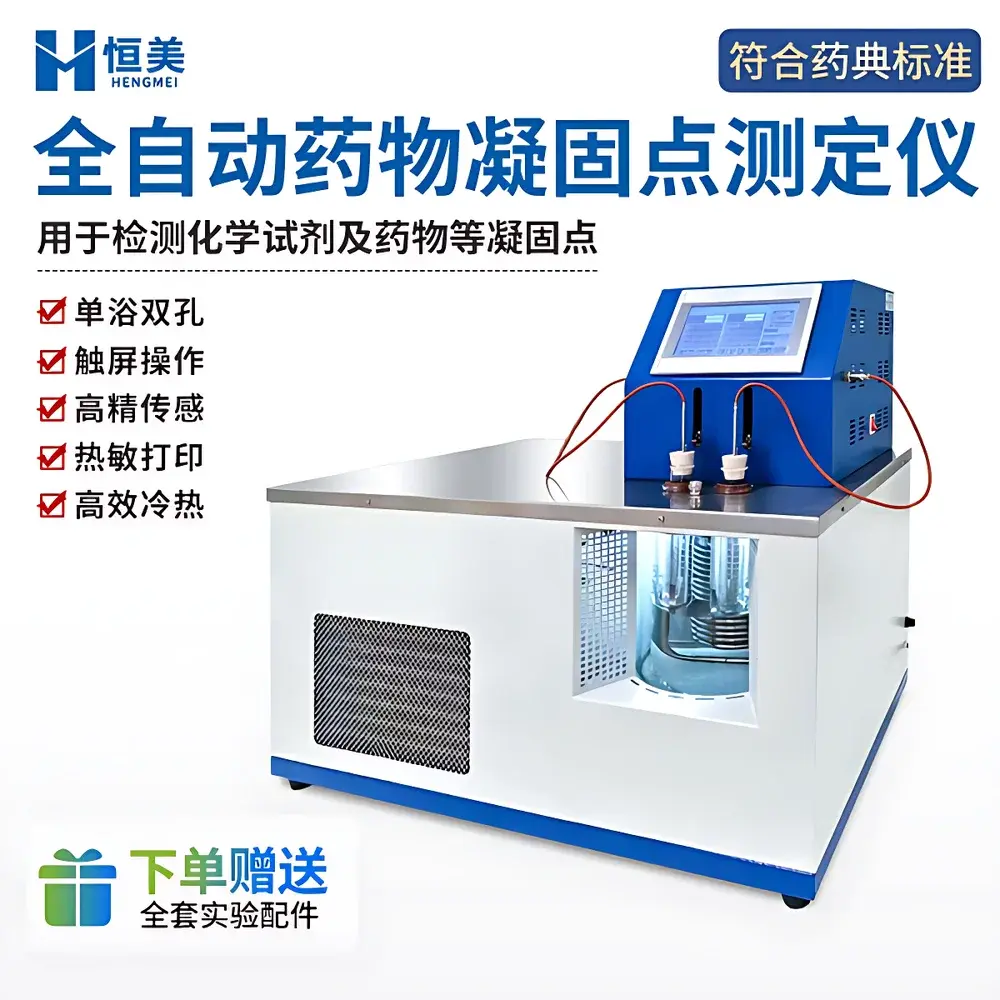
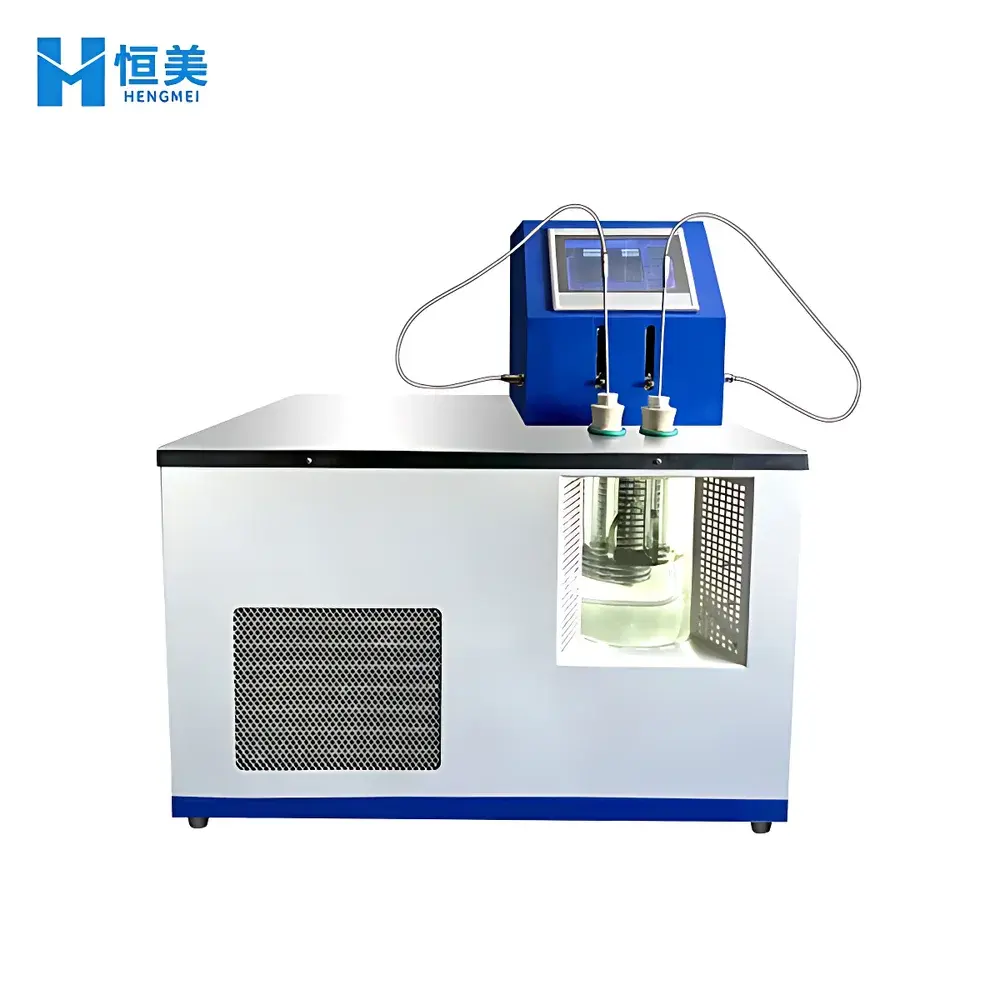
Hengmei HM-YNQ2 Automatic Drug Freezing Point Analyzer
| Brand | Hengmei |
|---|---|
| Origin | Shandong, China |
| Manufacturer Type | Direct Manufacturer |
| Origin Category | Domestic (China) |
| Model | HM-YNQ2 |
| Price | USD 10,800 (FOB Qingdao) |
| Power Supply | AC 220 V ±10%, 50 Hz |
| Compliance | Chinese Pharmacopoeia 2020 Edition, General Chapter 0613 |
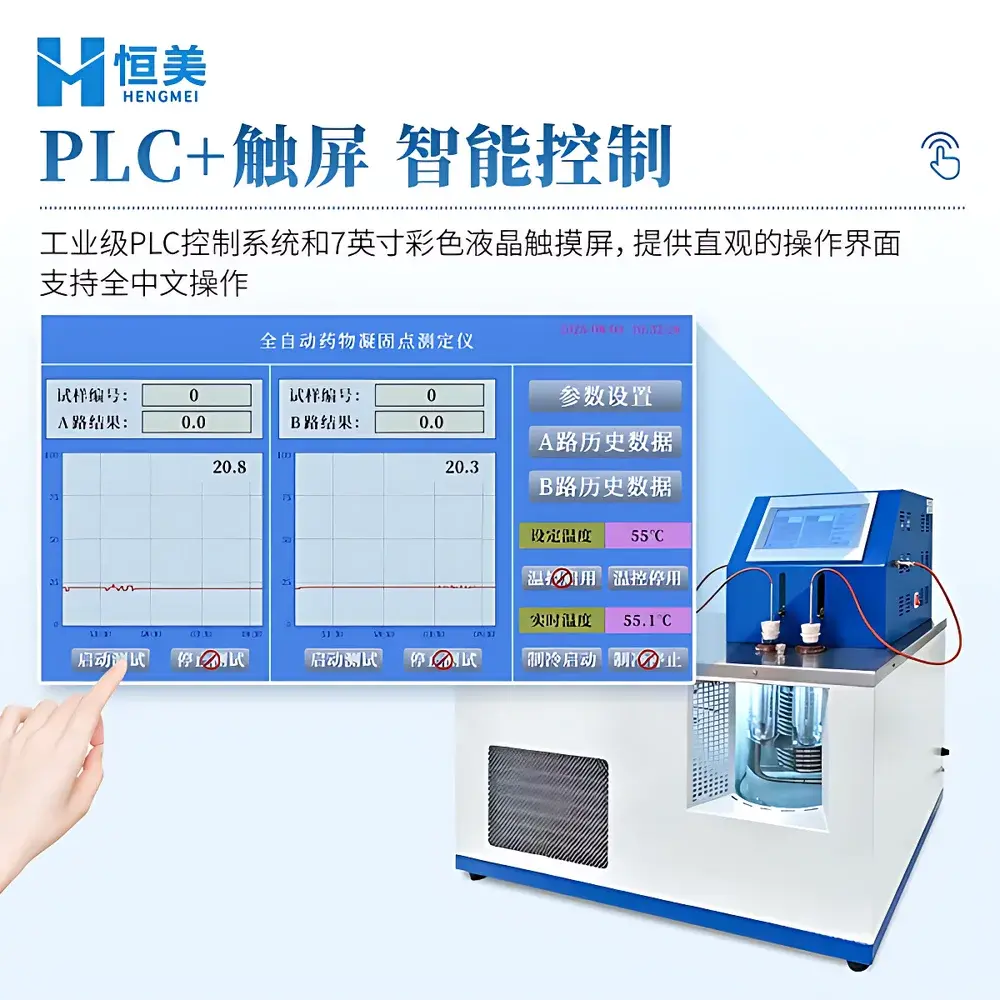
| Display | 7-inch industrial-grade color TFT touchscreen (Chinese UI) |
| Control System | Industrial PLC |
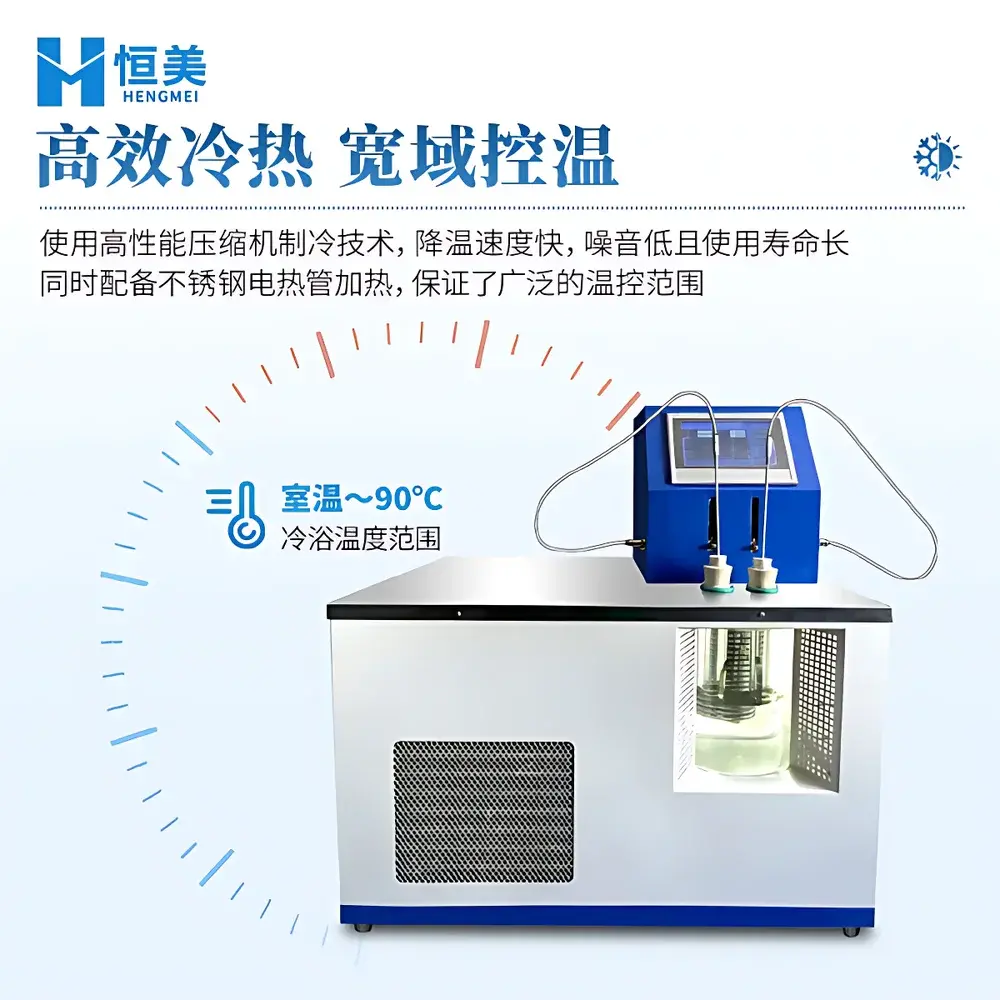
| Cooling Range | Ambient to –90 °C (with optional low-temp bath) |
| Heating Range | Up to +90 °C |
| Temperature Resolution | 0.1 °C |
| Sensor Type | High-accuracy platinum RTD (Pt100) with built-in calibration offset correction |
| Bath Configuration | Dual independent test ports in single thermostatic bath |
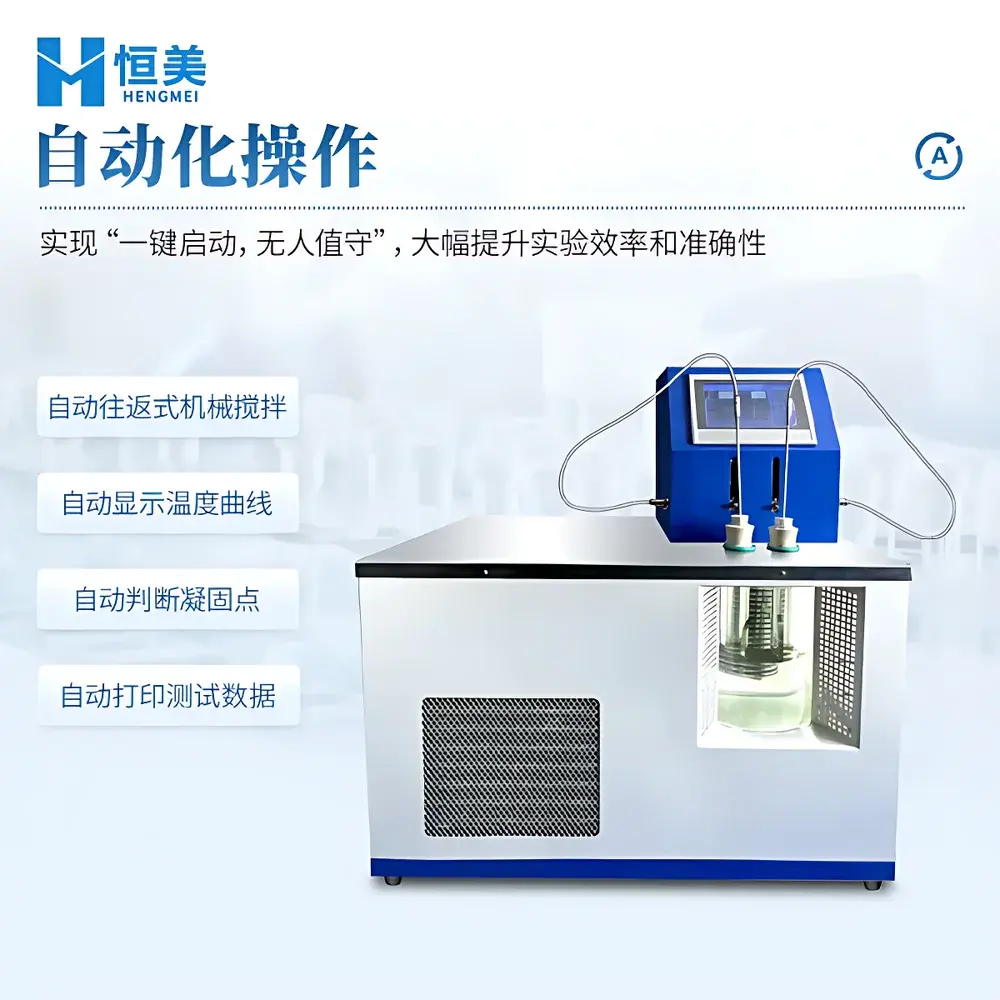
| Stirring Mechanism | Motor-driven mechanical stirrer, 60 cycles/min, synchronized with phase transition detection |
| Bath Media Compatibility | Water, ethylene glycol antifreeze, ethanol, or other low-viscosity, non-corrosive thermal fluids |
| Data Output | Integrated thermal line printer (fast, smudge-resistant) |
| Data Storage | Internal memory for ≥1,000 test records with timestamp, sample ID, and full cooling curve metadata |
| Operating Environment | 5–30 °C, 30–70% RH |
| Construction | Vacuum-insulated Dewar-style bath vessel (borosilicate glass inner, stainless steel outer jacket) |
Overview
The Hengmei HM-YNQ2 Automatic Drug Freezing Point Analyzer is a dedicated pharmaceutical quality control instrument engineered for precise, repeatable determination of freezing points in active pharmaceutical ingredients (APIs), excipients, solvents, and small-molecule drug substances. It operates on the principle of dynamic cooling curve analysis: a sample is cooled under controlled conditions while continuously stirred; the onset of solidification is identified by detecting the thermal arrest point—the plateau in temperature vs. time—where latent heat release counteracts further cooling. This thermodynamic inflection point corresponds directly to the freezing point, a critical parameter for assessing chemical identity, batch-to-batch consistency, and purity per pharmacopoeial monographs. Designed in strict accordance with the Chinese Pharmacopoeia (ChP) 2020 Edition, General Chapter 0613, the HM-YNQ2 supports regulatory submissions and routine QC workflows in GMP-compliant environments where trace impurity detection via freezing point depression is required.
Key Features
- Industrial PLC-based control architecture ensures deterministic timing, fault tolerance, and long-term operational stability under continuous laboratory use.
- Dual independent test ports within a single thermostatically controlled Dewar bath enable parallel or sequential analysis without cross-contamination or thermal interference.
- Vacuum-insulated borosilicate/stainless-steel hybrid bath vessel provides exceptional thermal inertia and uniformity across the full operating range (–90 °C to +90 °C), minimizing overshoot and drift during rapid cooling cycles.
- Motor-driven mechanical stirring at precisely 60 cycles per minute ensures homogeneous nucleation conditions and eliminates supercooling artifacts common in static or poorly agitated systems.
- High-stability Pt100 resistance temperature detector (RTD) with factory-traceable calibration and real-time offset correction delivers temperature measurement repeatability ≤ ±0.1 °C over extended operation.
- Integrated 7-inch industrial touchscreen interface displays live cooling curves, annotated phase-transition markers, and pass/fail status against ChP acceptance criteria—fully in Chinese language for local operator efficiency.
- Onboard thermal printer outputs compliant hardcopy reports including date/time stamp, sample ID, observed freezing point, curve derivative data, and operator signature field—supporting ALCOA+ data integrity principles.
Sample Compatibility & Compliance
The HM-YNQ2 accommodates standard 10–15 mL glass freezing point tubes (e.g., ChP-specified U-tube or capillary formats) and is validated for use with organic solvents (e.g., ethanol, chloroform), aqueous buffers, glycerol solutions, and low-viscosity APIs. Its bath fluid flexibility—supporting water, ethanol, ethylene glycol mixtures, or custom low-freezing-point media—enables method adaptation across diverse pharmacopoeial requirements (e.g., USP <741>, EP 2.2.16, JP 2.05). The instrument meets essential design and performance criteria outlined in ChP 2020 General Chapter 0613 and is suitable for inclusion in laboratory validation protocols (IQ/OQ/PQ) under ISO/IEC 17025 and WHO TRS 961 Annex 4. While not pre-certified to FDA 21 CFR Part 11, its audit trail–capable data storage, user-access controls (via password-protected UI layers), and immutable print output facilitate alignment with electronic record requirements in regulated biopharma settings.
Software & Data Management
All operational logic resides in embedded firmware with no external PC dependency. Test parameters—including target cooling rate, stir-on delay, freeze-point confirmation threshold (dT/dt ≤ 0.02 °C/min for ≥30 s), and pass limits—are configurable via the touchscreen interface. Each test generates a timestamped record containing raw temperature-time pairs (sampled at 0.5 Hz), first-derivative curve, annotated freezing point, and operator ID. One thousand such records are retained in non-volatile memory with search-by-date, sample ID, or result range. Export is limited to printed reports; however, the system supports manual transcription into LIMS or ELN platforms via standardized report templates. Firmware updates are performed via USB flash drive with version-locked checksum verification.
Applications
- Identity testing of raw materials (e.g., confirming benzocaine or paracetamol purity via expected freezing point depression thresholds).
- Stability-indicating assay for thermal degradation products in accelerated stability studies.
- In-process control of crystallization steps in API manufacturing (e.g., monitoring solvent removal endpoints).
- Verification of solvent quality prior to lyophilization or extraction processes.
- Supporting ICH Q5A/Q5C assessments of biopharmaceutical excipient compatibility through freezing behavior profiling.
- Academic and contract research lab use for physical property characterization of novel synthetic intermediates.
FAQ
Does the HM-YNQ2 comply with international pharmacopoeias beyond the Chinese Pharmacopoeia?
Yes—it implements the fundamental physical methodology described in USP <741>, EP 2.2.16, and JP 2.05. While hardware validation must be performed per site-specific protocols, its measurement principle, temperature accuracy, and stirring dynamics meet the core technical expectations of all major pharmacopoeias.
Can the instrument detect eutectic mixtures or multiple freezing transitions?
No. The HM-YNQ2 is designed for single-phase, sharp freezing point detection per ChP 0613. It does not perform differential thermal analysis (DTA) or support multi-peak deconvolution. Samples exhibiting broad or stepped transitions require orthogonal methods (e.g., DSC).
Is remote monitoring or network connectivity available?
Not natively. The system operates as a standalone instrument. Ethernet or RS-232 interfaces are not included, though third-party serial-to-IP gateways may be integrated at the user’s risk for basic status polling.
What maintenance is required for the compressor cooling system?
Annual inspection of refrigerant pressure, condenser coil cleaning, and verification of oil level are recommended. Hengmei supplies OEM service kits and certified technician referrals in mainland China; international users should engage local HVAC-R specialists familiar with compact hermetic compressors.
How is temperature calibration verified during routine use?
Users perform daily verification using NIST-traceable reference standards (e.g., pure camphor, stearic acid) per ChP 0613 Section 3.2. The built-in sensor offset correction allows adjustment within ±0.3 °C without hardware intervention.




