
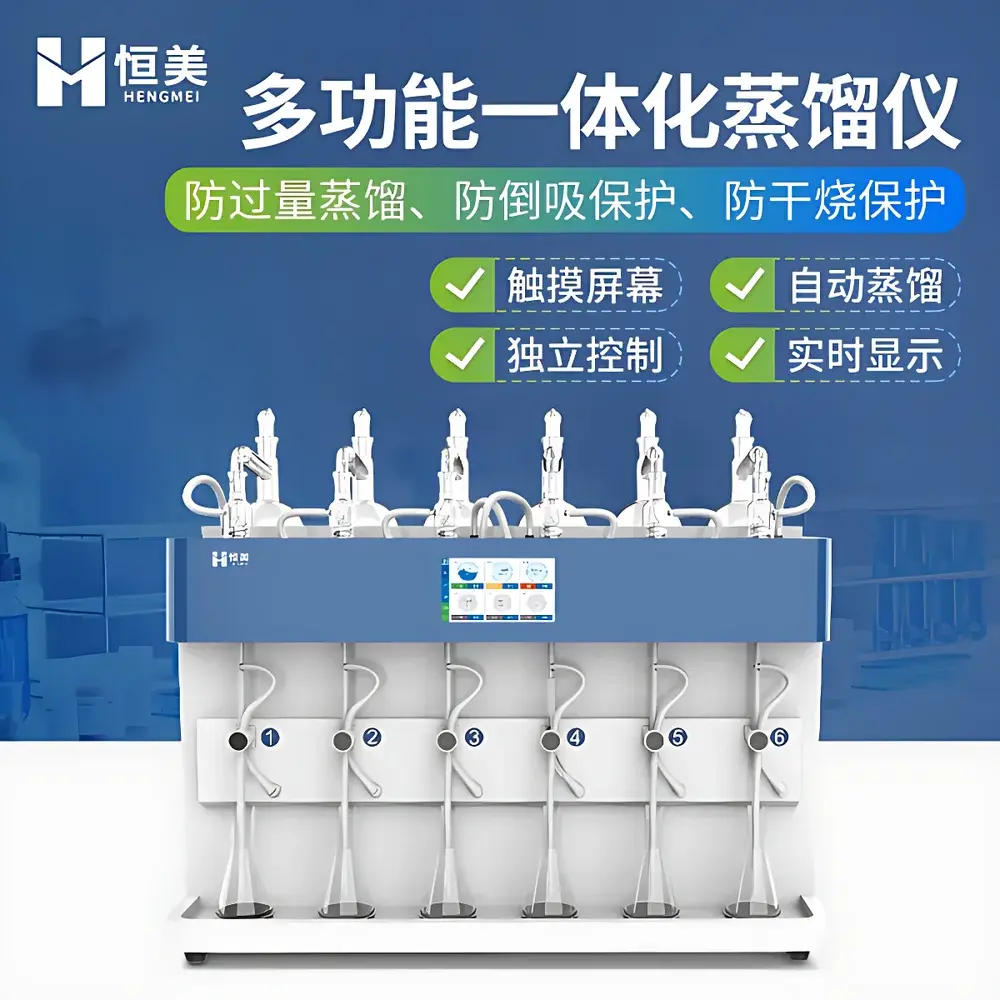
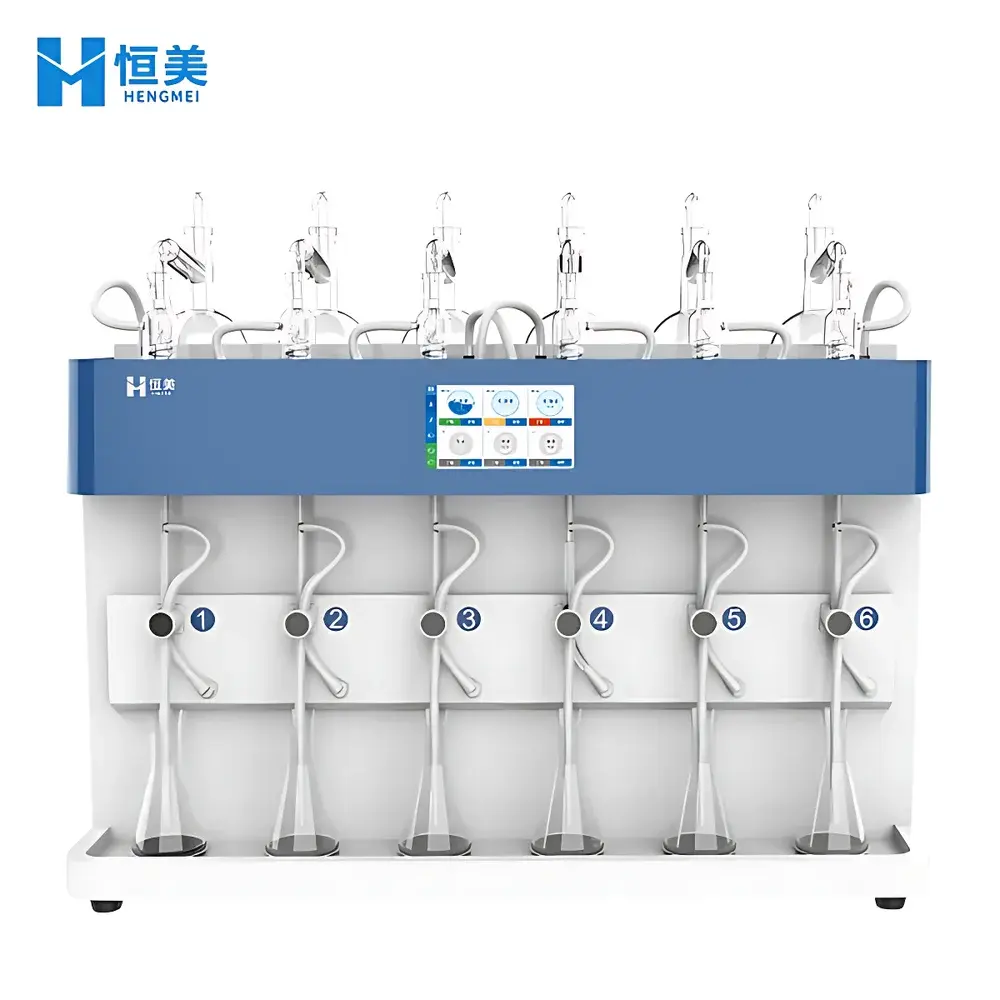
Hengmei HM-ZLA Automated Distillation System
| Brand | Hengmei |
|---|---|
| Origin | Shandong, China |
| Manufacturer Type | Direct Manufacturer |
| Country of Origin | China |
| Model | HM-ZLA |
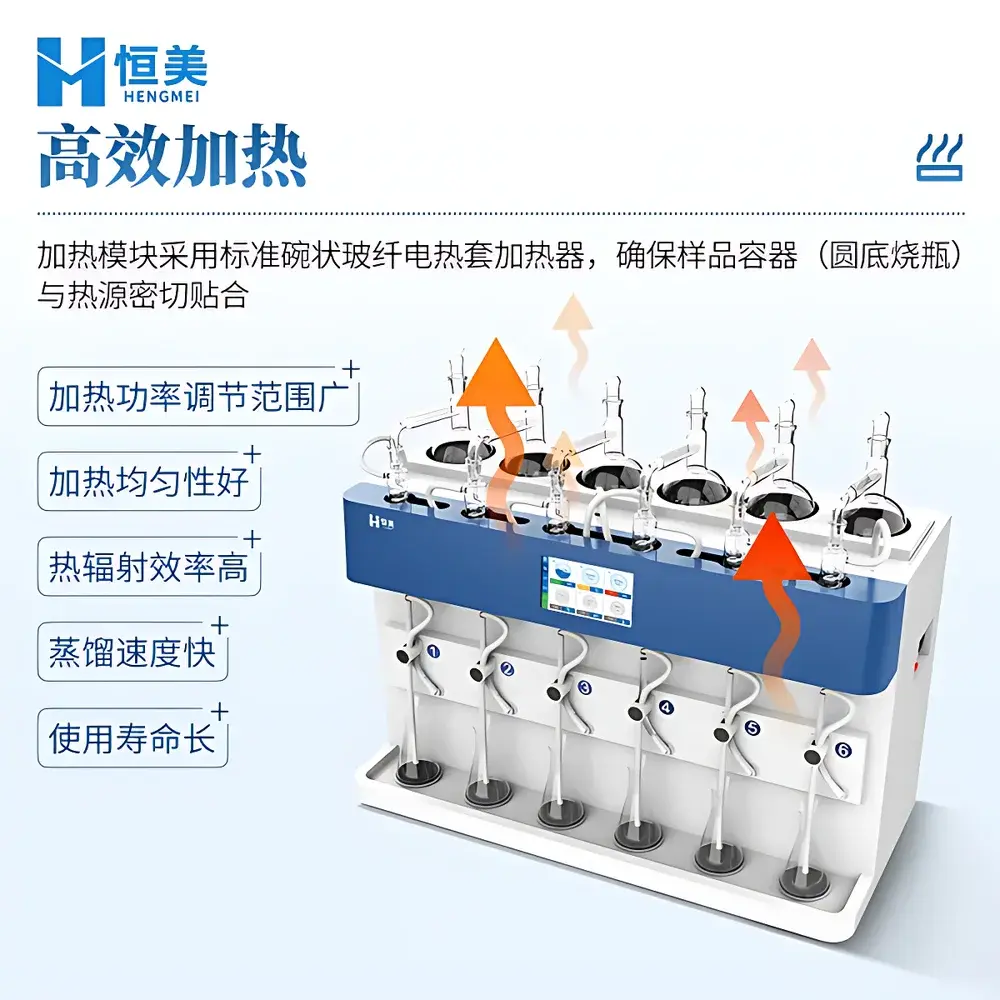
| Heating Method | Far-Infrared Electric Heating Mantle (Flame-Free) |
| Cooling Method | External Chilled Water Circulator (Recommended) or Tap Water (Not Recommended Due to Scaling Risk) |
| Distillation Rate | 0–6 mL/min |
| Heating Ramp Time | <20 min |
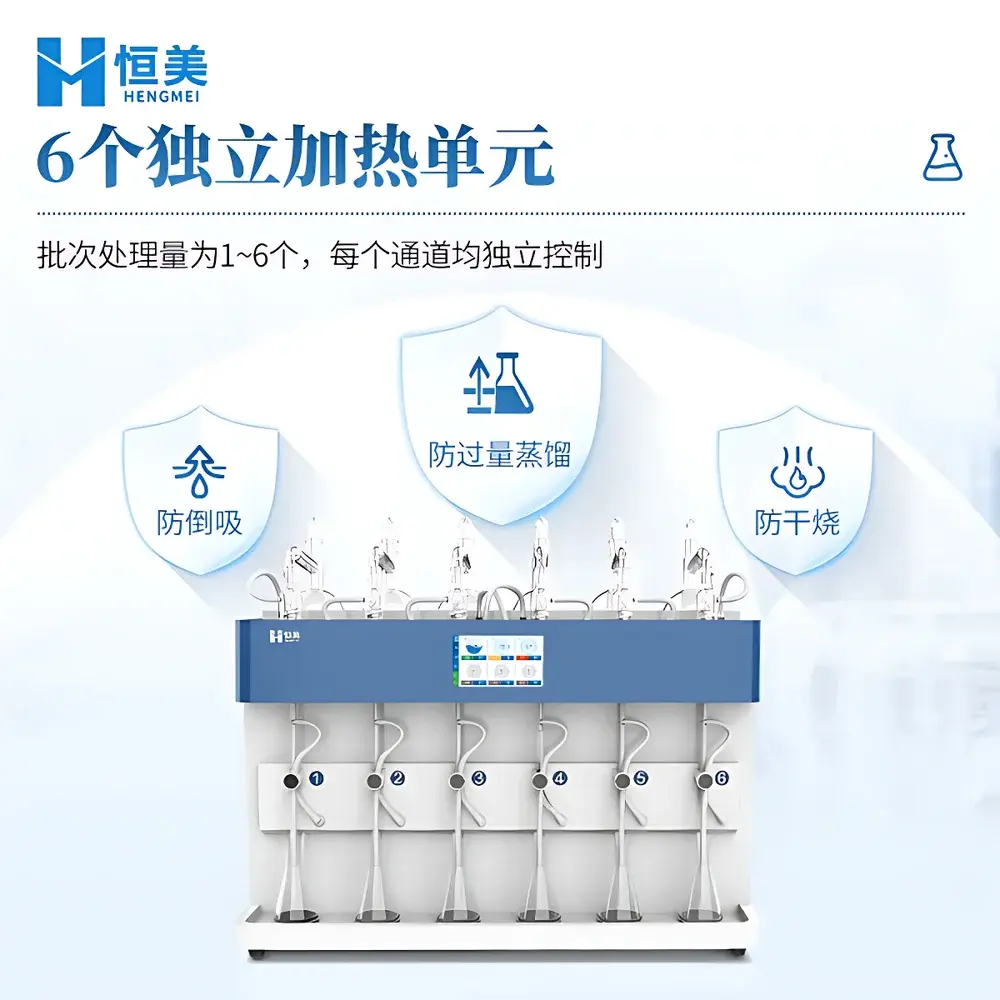
| Independent Heating Zones | 6 |
Overview
The Hengmei HM-ZLA Automated Distillation System is an integrated, programmable distillation platform engineered for precision, reproducibility, and unattended operation in environmental, food safety, and regulatory testing laboratories. It implements classical batch-wise distillation based on controlled thermal vaporization and condensation—principles aligned with standardized wet-chemistry methods such as those defined in EPA, ISO, and Chinese national standards (e.g., GB/T, HJ series). Unlike conventional glassware-based setups, the HM-ZLA integrates heating, condensation, liquid-level monitoring, pressure management, and endpoint detection into a single modular architecture. Each of its six independent distillation channels operates under user-defined method parameters—including target volume, time limit, temperature ramp profile, and density-based volume correction—ensuring consistent separation of volatile analytes (e.g., ammonia, cyanide, phenols, sulfides, ethanol, methanol, SO₂) from complex aqueous or digested matrices.
Key Features
- Six independently controllable distillation channels, each equipped with dual-sensor endpoint detection (time + volumetric), real-time flow monitoring, and closed-loop distillate rate regulation.
- Far-infrared electric heating mantles with ceramic-fiber insulation ensure uniform thermal transfer to 500 mL two-neck round-bottom flasks, eliminating hot spots and minimizing thermal degradation of thermally labile compounds.
- Custom-engineered coiled condenser with optimized surface area and coolant path geometry delivers high-efficiency heat exchange while preventing vapor channeling or condensate carryover.
- Comprehensive safety architecture: anti-suckback valves prevent backflow during pressure fluctuations; dry-run protection activates automatically upon detected low liquid level or abnormal temperature rise; integrated earth-leakage circuit breaker complies with IEC 61000-4-5.
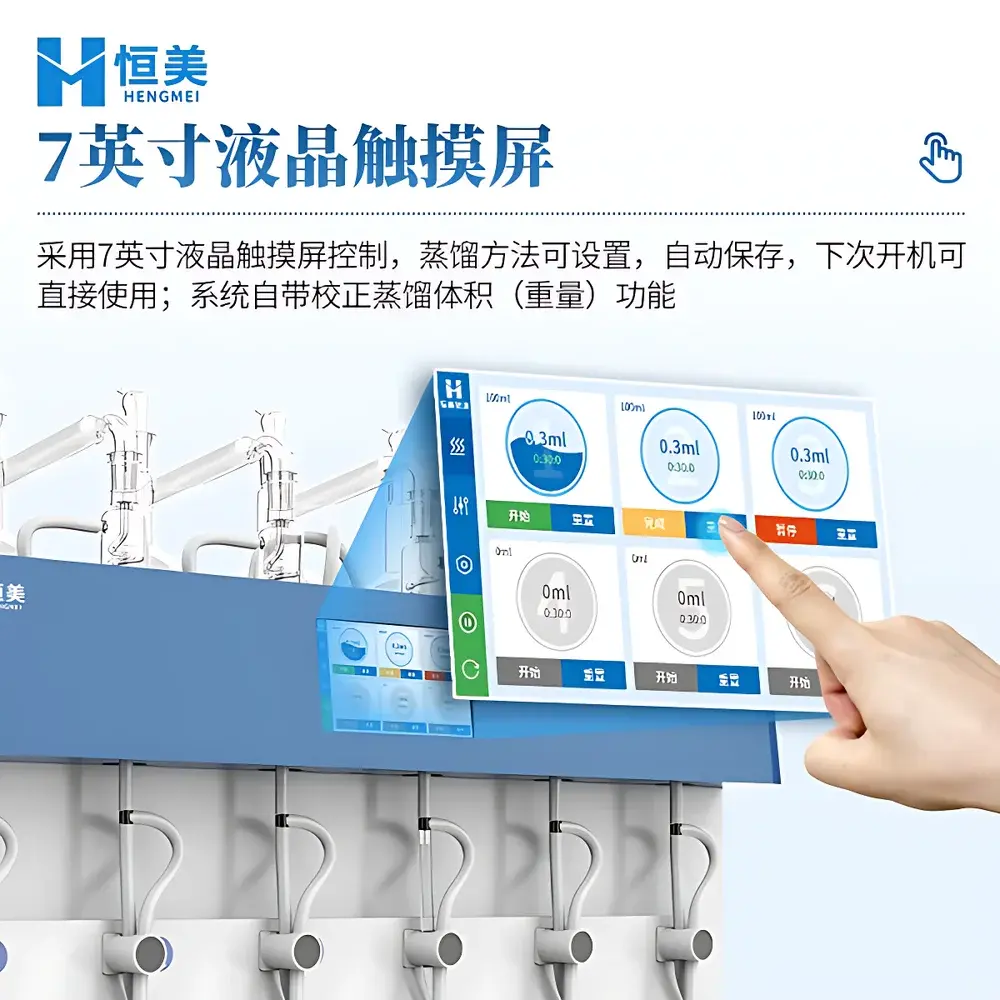
- 7-inch full-color capacitive touchscreen running embedded Linux OS supports intuitive method creation, parameter logging, and one-touch recall of up to 100 saved protocols.
- Automated post-run cleaning cycle—activated via software command—flushes condenser tubing and distillate lines with deionized water to minimize cross-contamination between samples.
Sample Compatibility & Compliance
The HM-ZLA is validated for use with standard EPA, ISO, and Chinese national method suites requiring distillative sample preparation. It meets operational requirements for GB/T 5750.5–2023 (drinking water inorganic nonmetallics), HJ 537–2009 (ammonia-nitrogen), HJ 484–2009 (cyanide), HJ 503–2009 (phenols), HJ 1226–2021 (sulfides), GB 5009.225–2016 (ethanol in alcoholic beverages), and GB 5009.266–2016 (methanol in food). All hardware interfaces—including fluidic paths, heating zones, and sensor outputs—are constructed from chemically inert materials (borosilicate glass, PTFE, 316 stainless steel) compatible with acidic, alkaline, and saline matrices. The system supports GLP-compliant data integrity through timestamped method execution logs, operator ID tagging, and audit-trail-enabled parameter changes—fully traceable for FDA 21 CFR Part 11 readiness when paired with validated LIMS integration.
Software & Data Management
The embedded Linux-based control firmware provides deterministic real-time process control with millisecond-level timing resolution. All distillation runs generate structured CSV log files containing start/stop timestamps, setpoints vs. actuals (temperature, volume, time), alarm events, and endpoint confirmation status. These files are exportable via USB or network interface (Ethernet port, DHCP-enabled). Remote over-the-air (OTA) firmware updates ensure long-term compliance with evolving analytical standards. Optional software modules enable direct export to Excel-compatible templates aligned with HJ and GB reporting formats, including automatic calculation of recovery rates, blank subtraction, and dilution factor application. No proprietary drivers or cloud dependencies are required—full local control and data sovereignty are maintained at all times.
Applications
The HM-ZLA serves as a core sample preparation tool in accredited environmental labs performing wastewater, surface water, soil leachate, and drinking water analysis. It is routinely deployed for ammonia-nitrogen quantification prior to titration or colorimetry; cyanide liberation from metal-cyanide complexes; phenol extraction under alkaline conditions; sulfide volatilization for subsequent spectrophotometric detection; and alcohol content determination in fermented products. Its precise volumetric endpoint control (±0.1 mL) and density-compensated volume calculation make it suitable for applications where gravimetric accuracy is critical—such as methanol analysis in spirits or SO₂ determination in wine using ICP-OES coupling. The system also supports method development for novel distillation-based extractions requiring multi-parameter optimization (e.g., variable ramp rates, staged condensation temperatures).
FAQ
What cooling options are supported—and why is a chiller recommended over tap water?
The HM-ZLA accepts either chilled water circulation (recommended) or municipal tap water (not recommended). Tap water introduces calcium carbonate scaling in condenser coils, reducing thermal efficiency and increasing maintenance frequency. A recirculating chiller maintains stable coolant temperature (typically 5–15 °C) and eliminates scale formation, ensuring long-term reproducibility.
Can the system handle viscous or suspended-matrix samples?
Yes—when used with appropriate pre-filtration or digestion steps. The HM-ZLA’s robust heating mantle design accommodates heterogeneous samples provided they remain within the 500 mL flask capacity and do not obstruct vapor pathways. For high-solids content, optional anti-bumping boiling chips or magnetic stirring integration can be configured.
Is method validation documentation available for regulatory submissions?
Hengmei provides IQ/OQ documentation templates compliant with ISO/IEC 17025 and CNAS requirements. Full traceability of calibration certificates for integrated temperature and volume sensors is included with each unit shipment.
How is data integrity ensured during unattended overnight runs?
All run metadata—including operator ID, method version, environmental ambient temperature, and power-event logs—is written to non-volatile memory before each distillation cycle begins. Power-loss recovery resumes from last valid checkpoint without data corruption.
What maintenance intervals are recommended for optimal performance?
Condenser coil inspection and descaling (if tap water was used) every 200 cycles; heating mantle visual inspection quarterly; annual verification of volumetric sensor linearity against NIST-traceable standards.



