
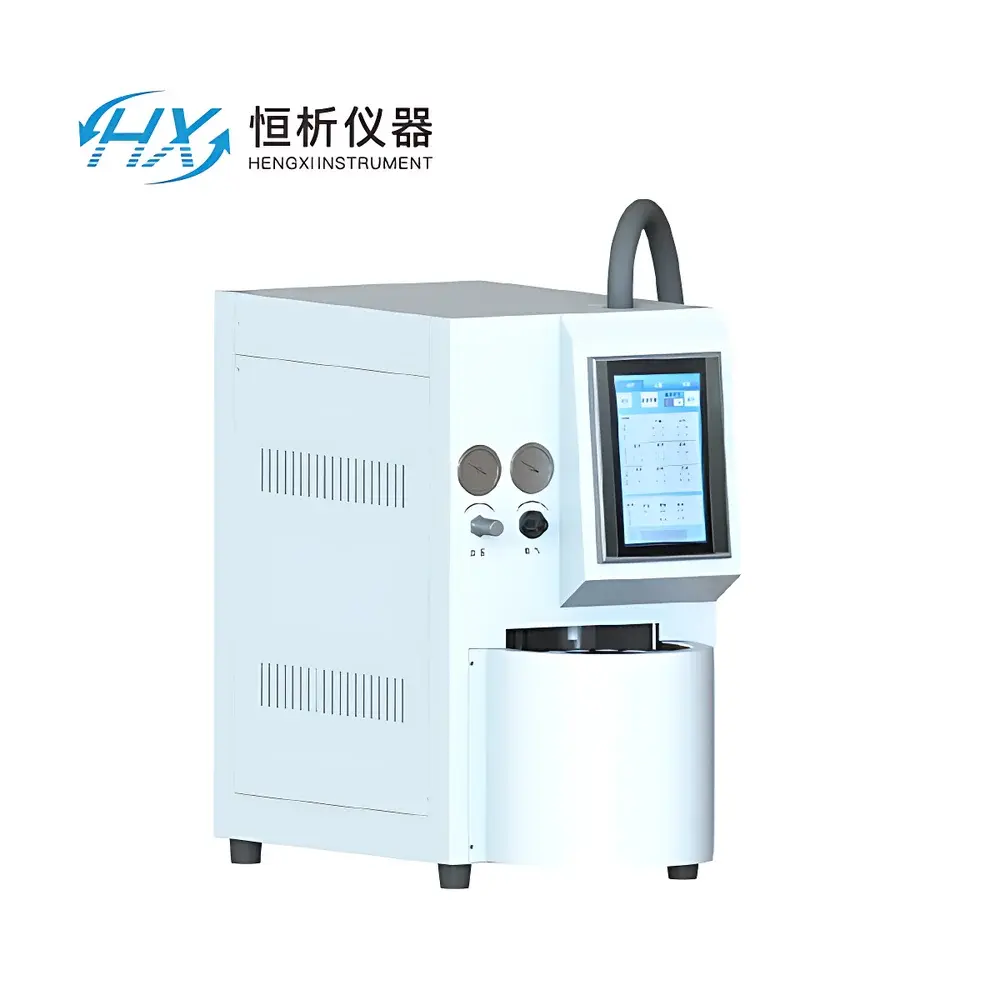
Hengxi HS-951A Fully Automated Static Headspace Sampler
| Brand | Hengxi Instruments |
|---|---|
| Origin | Shanghai, China |
| Manufacturer Type | Original Equipment Manufacturer (OEM) |
| Product Category | Domestic |
| Model | HS-951A |
| Instrument Type | Static Headspace Sampler |
| Automation Level | Fully Automated |
| Oven Temperature Range | Ambient to 260 °C |
| Valve Temperature Range | Ambient to 220 °C |
| Sample Transfer Line Temperature Range | Ambient to 220 °C |
| Temperature Control Accuracy | < ±0.1 °C |
| Temperature Uniformity | < ±0.1 °C |
| Sample Position Capacity | 12 vials |
| Vial Format | Standard 20 mL (10 mL optional) |
| Loop Volume | 1 mL |
| Pressurization Range | 0–0.4 MPa (continuously adjustable) |
| Pressure Monitoring Range | 0–0.4 MPa (digital gauge) |
| RSD for Repeatability | < 1.5% (200 ppm ethanol in water, GC-dependent) |
| Power Supply | AC 220 V, 50 Hz |
| Power Consumption | 450 W |
| Dimensions (W×D×H) | 505 × 295 × 535 mm |
| Weight | ~32 kg |
Overview
The Hengxi HS-951A Fully Automated Static Headspace Sampler is an engineered solution for quantitative analysis of volatile and semi-volatile organic compounds (VOCs and SVOCs) in solid, liquid, or polymer matrix samples. It operates on the principle of static headspace equilibrium: a sealed sample vial is heated to a defined temperature, allowing analytes to partition into the vapor phase above the sample (the headspace). Once equilibrium is reached, a precise volume of headspace gas is withdrawn via a pressurized, thermostatically controlled sampling loop and transferred directly to a gas chromatograph (GC) injector. This technique eliminates solvent extraction, minimizes matrix interference, and enhances method robustness—particularly critical for residual solvent testing per ICH Q3C guidelines, environmental VOC monitoring (EPA Method 502.2, 8240), and food packaging migration studies (ISO 1186).
Key Features
- Triple-zone independent temperature control: Separate, PID-regulated heating for the oven (ambient–260 °C), six-port valve assembly (ambient–220 °C), and transfer line (ambient–220 °C), ensuring zero cold spots and full analyte integrity throughout the transfer path.
- 12-position carousel with standardized 20 mL vial compatibility: Supports ASTM D3792-compliant vials; optional 10 mL vial adapters available for high-throughput screening or limited-sample applications.
- High-precision 1 mL fixed-volume sampling loop: Coupled with a pneumatically actuated, inert-surface six-port valve to deliver reproducible injection volumes and minimize carryover (< 0.05% for chloroform after cleaning cycle).
- Full-pressure control system: Programmable pressurization (0–0.4 MPa) and real-time pressure monitoring enable optimization of equilibration kinetics and headspace concentration—critical for low-volatility analytes or viscous matrices.
- Intuitive 7-inch capacitive touchscreen interface: Preloaded with 10 editable method templates; supports simultaneous GC start trigger, external event synchronization (TTL/relay), and multi-cycle auto-reinjection from a single vial—essential for calibration curve validation and QC replicate analysis.
- Comprehensive diagnostics: Built-in self-test for valve actuation timing, heater resistance verification, pressure sensor calibration, and leak detection at system startup and during idle cycles.
Sample Compatibility & Compliance
The HS-951A accommodates diverse sample types including aqueous solutions, pharmaceutical tablets, polymer films, soil slurries, beverages, cosmetics, and forensic evidence swabs. Its all-stainless-steel and silanized glass flow path meets USP <661.1> extractables requirements. The instrument supports GLP/GMP workflows through audit-trail-capable method storage, user-access-level password protection, and timestamped run logs exportable as CSV. It is compatible with major GC platforms—including Agilent, Thermo Fisher, Shimadzu, and PerkinElmer—via standard 1/16″ stainless-steel transfer tubing and universal GC inlet interfaces. Validation documentation aligns with ISO/IEC 17025 clause 5.5.2 for auxiliary equipment qualification and ASTM D6866-22 Annex A1 for headspace method verification.
Software & Data Management
No proprietary software installation is required: method parameters are configured entirely via the onboard touchscreen. All methods—including temperature ramps, pressurization profiles, loop fill time, and GC trigger logic—are saved in non-volatile memory with version-timestamping. Run data (vial ID, start/stop time, actual oven/valve temperatures, pressure trace, and error codes) are logged locally and exportable via USB to external drives for LIMS integration. For laboratories operating under FDA 21 CFR Part 11, the system supports optional third-party electronic signature modules and secure user role assignment (Admin, Analyst, Reviewer) when paired with validated chromatography data systems (CDS) such as OpenLab CDS or Chromeleon.
Applications
- Residual solvent quantification in APIs and excipients (ICH Q3C Class 1–3 solvents)
- VOC profiling in drinking water (EPA 524.4), wastewater (EPA 8260D), and ambient air canisters
- Migration testing of packaging materials (EU 10/2011, FDA 21 CFR 177)
- Flavor and fragrance compound analysis in beverages, dairy, and fermented products
- Forensic toxicology screening for ethanol, acetone, and volatile hydrocarbons in blood or tissue
- Quality control of coatings, adhesives, and composite resins for monomer and catalyst residue levels
FAQ
Is the HS-951A compatible with cryogenic GC injectors or PTV inlets?
Yes—the transfer line outlet is rated to 220 °C and features a standard female 10-32 UNF fitting; it interfaces seamlessly with programmable temperature vaporizing (PTV) inlets and cooled injection systems when using appropriate thermal insulation sleeves.
Can I perform multiple headspace extractions from the same vial without manual intervention?
Yes—method programming supports up to 9 repeated equilibration/injection cycles per vial, with configurable dwell times between cycles to monitor desorption kinetics or assess equilibrium stability.
What maintenance intervals are recommended for long-term reliability?
Valve rotor seal replacement every 10,000 injections; oven chamber cleaning every 6 months; pressure transducer calibration annually or per internal SOP. Full service manuals and spare parts kits (P/N HS-951A-MK1) are provided with shipment.
Does the system support unattended overnight operation?
Yes—equipped with automatic shutdown after final run completion, overtemperature cutoff, and pressure fault lockout. All safety interlocks comply with IEC 61010-1:2010 for laboratory electrical equipment.
How is method transfer validated between different GC platforms?
The HS-951A’s fixed-loop geometry and pressure-controlled sampling ensure consistent mass transfer across instruments. Validation requires only retention time alignment and peak area RSD assessment (n=6) using a certified reference standard—no re-optimization of headspace parameters is needed.





