
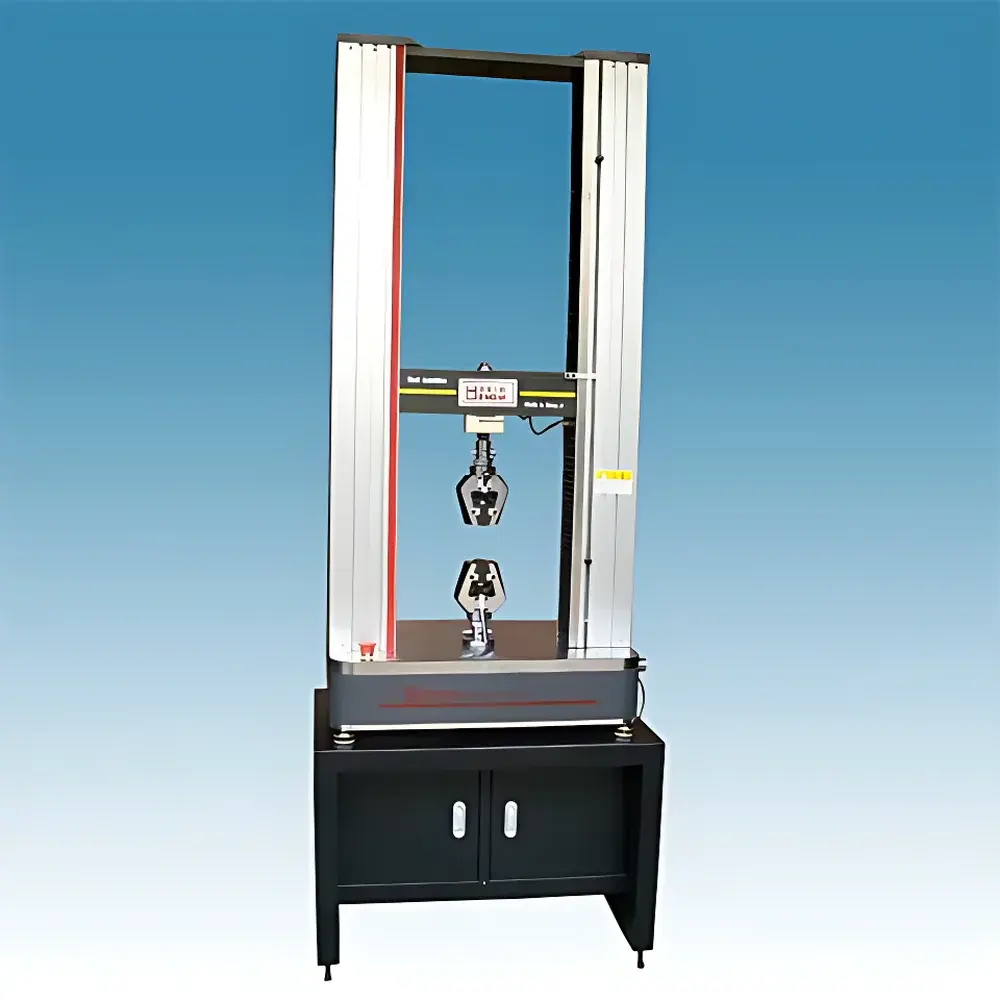
Hengyi HY-0580OUYUY Universal Testing Machine for Biomedical Materials (Door-Frame Type)
| Brand | Hengyi |
|---|---|
| Origin | Shanghai, China |
| Manufacturer Type | Direct Manufacturer |
| Country of Origin | China |
| Instrument Type | Electromechanical Universal Testing Machine |
| Load Capacity | 5000 N |
| Accuracy Class | 0.5 |
| Effective Test Width | 380 mm |
| Effective Vertical Test Space | 800 mm |
| Test Speed Range | 0.001–500 mm/min |
| Speed Accuracy | ±0.5% of indicated value |
| Force Resolution | ±500000 counts (full-scale, no range switching) |
| Force Measurement Range | 0.1/100–99.999% FS |
| Displacement & Strain Measurement Accuracy | ±0.5% of indicated value |
| Stress Control Rate Range | 0.005–6% FS/s |
| Strain Control Rate Range | 0.002–6% FS/s |
| Constant-Load/Displacement/Strain Control Accuracy | ±1% (if setpoint <10% FS), ±0.1% (if ≥10% FS) |
| Safety Protection | Electronic limit switches, overload protection at 110% FS, automatic fault diagnosis, emergency stop |
| Power Supply | 220 V AC, 50 Hz, 750 W |
| Dimensions (W×D×H) | 680 × 400 × 1420 mm |
| Net Weight | 120 kg |
| Total System Weight | 208 kg |
| Operating Environment | 20–40 °C, 20–80% RH |
Overview
The Hengyi HY-0580OUYUY Universal Testing Machine (Door-Frame Type) is an electromechanical static-dynamic testing system engineered for high-fidelity mechanical characterization of biomedical materials under ISO 5832, ASTM F2193, ASTM F1717, ISO 14879, and USP compliant test protocols. Designed specifically for regulatory-grade biomechanical evaluation, it implements closed-loop servo-controlled axial loading to quantify tensile, compressive, flexural, shear, peel, puncture, and fatigue responses in both standardized specimens and anatomically relevant constructs. Its modular load frame architecture supports interchangeable fixtures—including vertebral fusion cage compression platens, intramedullary nail bending jigs, suture anchor pull-out adapters, and soft-tissue clamping systems—enabling direct correlation between mechanical performance and clinical functional requirements. The system operates on fundamental principles of Hookean elasticity and plastic deformation modeling, delivering traceable force-displacement data essential for ISO 13485 quality management documentation and FDA 510(k) or PMA submission dossiers.
Key Features
- 0.5-class accuracy certified force measurement with ±500,000-count resolution across full 5000 N capacity—no range switching required for seamless transition from low-force soft tissue testing (e.g., collagen membranes at <1 N) to high-load orthopedic implant validation (e.g., titanium spinal rods at 4500 N)
- Precision-controlled crosshead movement from 0.001 to 500 mm/min with ±0.5% speed fidelity, supporting quasi-static creep tests per ISO 14879-1 and dynamic cyclic loading up to 5 Hz via optional controller upgrade
- Dual-mode control architecture: stress-rate (0.005–6% FS/s) and strain-rate (0.002–6% FS/s) modes with adaptive feedback loops meeting ASTM E2309 compliance for rate-dependent material behavior quantification
- Integrated electronic limit protection, real-time overpressure/overcurrent diagnostics, and programmable auto-return functionality ensure GLP-compliant operational safety and repeatability
- Modular fixture interface compatible with ISO 5832-1 metallic biomaterials, ISO 13782 polymeric scaffolds, and ASTM F2213 soft-tissue analogs—validated for use with porcine aortic valves, bovine cortical bone, hydrogel-based wound dressings, and PEEK spinal cages
Sample Compatibility & Compliance
The HY-0580OUYUY accommodates diverse specimen geometries—from micro-scale vascular graft segments (ID ≤ 2 mm) to macro-scale interbody fusion devices (up to 60 mm height). Its 380 mm test width and 800 mm vertical clearance enable side-loading configurations for torsional-bending hybrid tests per ASTM F2624. All mechanical outputs are traceable to NIST-certified reference standards, and the system supports audit-ready metadata tagging per 21 CFR Part 11 when paired with validated software modules. It meets essential requirements of ISO 17025-accredited laboratories for mechanical testing of medical devices under EN ISO 14242-1 (hip joint simulators), ISO 14243-1 (knee joint wear), and ASTM F2503 (MRI safety labeling support).
Software & Data Management
Equipped with Hengyi TestSuite v4.2 (Windows-based), the system delivers ISO/IEC 17025-aligned data acquisition with configurable sampling rates up to 1 kHz, real-time curve overlay, and automated report generation in PDF/XLS formats. Software modules include preconfigured test methods for ASTM D638 (tensile plastics), ISO 527-2 (film elongation), ASTM F2129 (corrosion fatigue), and custom protocol scripting for multi-step physiological loading profiles (e.g., sinusoidal + ramp superposition mimicking gait cycles). Audit trails record user actions, calibration events, and environmental logs—fully compliant with FDA 21 CFR Part 11 electronic signature and record retention mandates.
Applications
- Mechanical validation of resorbable polymer screws (PLLA/PCL) per ISO 10993-12 degradation kinetics coupling
- Compression testing of calcium phosphate bone void fillers under wet conditions (ASTM F1854)
- Flexural rigidity assessment of pedicle screw-rod assemblies (ISO 12189)
- Tensile strength and elongation-at-break analysis of electrospun nanofibrous scaffolds (ASTM D882)
- Peel adhesion quantification of pressure-sensitive surgical tapes (ASTM D903)
- Cyclic fatigue life prediction of nitinol stents using Goodman diagram integration
- Shear bond strength evaluation of dental composite-to-enamel interfaces (ISO 10477)
FAQ
Does the HY-0580OUYUY comply with FDA-required validation protocols for medical device mechanical testing?
Yes—it supports IQ/OQ/PQ documentation packages aligned with FDA Guidance for Industry: “General Principles of Software Validation” and includes built-in calibration certificate templates compliant with ISO/IEC 17025 Clause 6.5.
Can this system perform simultaneous force and displacement control during creep testing?
Yes—dual-loop control enables independent regulation of applied load and crosshead position, satisfying ASTM D2990 requirements for time-dependent deformation analysis.
Is third-party calibration certification available for ISO 17025 accreditation?
Hengyi provides factory calibration certificates traceable to CNAS-accredited labs; users may engage local ISO/IEC 17025 signatory providers for on-site verification.
What environmental conditions must be maintained during testing to ensure data validity?
Ambient temperature stability within ±2°C of setpoint (23±2°C recommended), relative humidity 30–60%, and vibration-isolated benchtop installation are required per ISO 5832-1 Annex A.
How is data integrity ensured during long-duration fatigue tests exceeding 10⁶ cycles?
The system employs non-volatile memory buffering, automatic power-fail recovery, and timestamped binary logging to prevent data loss—validated per IEC 62304 software lifecycle requirements.



