
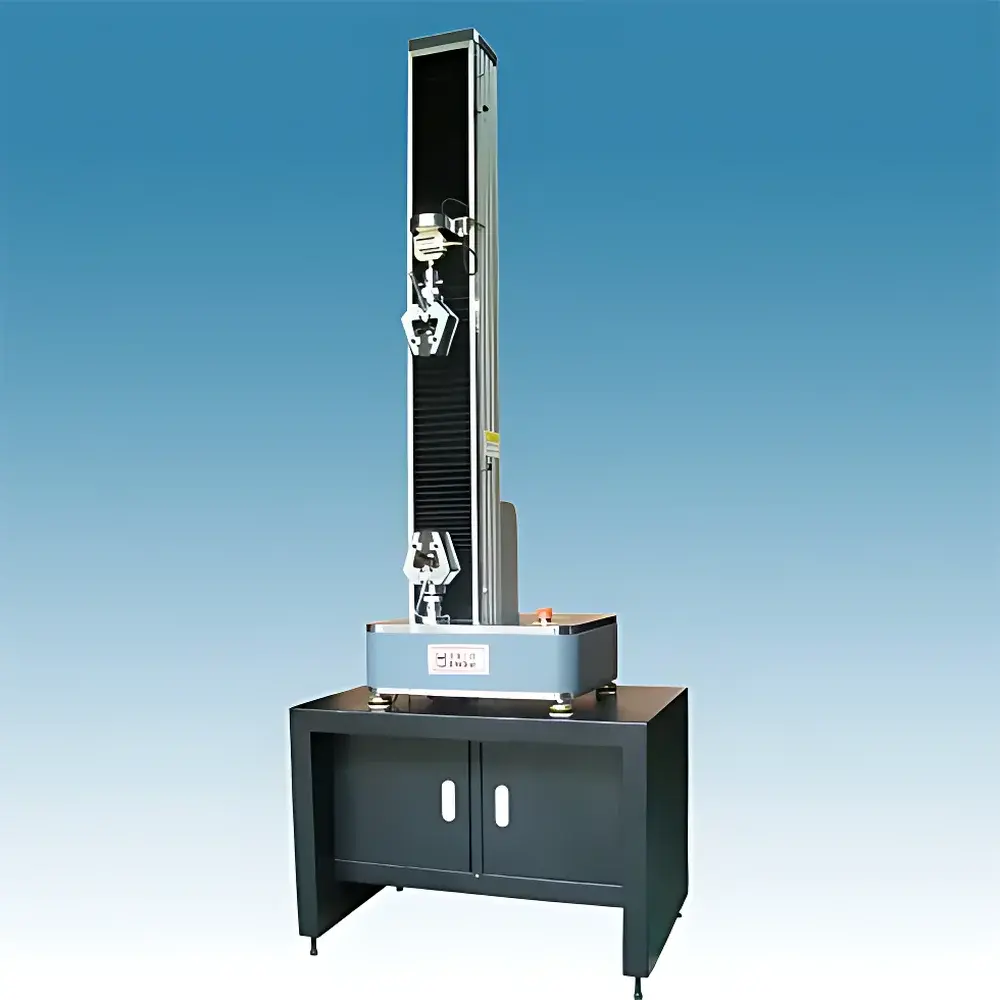
Hengyi HY-0580SG Rat Bone Biomechanical Testing System
| Brand | Hengyi |
|---|---|
| Origin | Shanghai, China |
| Manufacturer Type | Direct Manufacturer |
| Product Category | Domestic |
| Model | HY-0580SG |
| Instrument Type | Electromechanical Universal Testing Machine |
| Load Capacity Options | 1N, 5N, 10N, 20N, 50N, 100N, 200N, 500N, 1000N, 2000N, 3000N, 5000N (interchangeable load cells) |
| Force Accuracy | ≤0.5% of reading |
| Effective Test Width | 120 mm |
| Effective Vertical Travel | 800 mm |
| Speed Range | 0.001–500 mm/min (adjustable) |
| Speed Accuracy | ±0.5% of set value |
| Displacement Accuracy | ±0.5% of reading |
| Strain Control Range | 0.002–6% FS/S |
| Stress Control Range | 0.005–6% FS/S |
| Force Resolution | ±500,000 counts (full-scale, no range switching) |
| Load Holding Stability | ≤0.1% FS over 30 min |
| Power Supply | 220 V AC, 50 Hz, 750 W |
| Dimensions (W×D×H) | 470 × 400 × 1510 mm |
| Weight | 95 kg |
| Operating Environment | 20–40 °C, 20–80% RH |
Overview
The Hengyi HY-0580SG Rat Bone Biomechanical Testing System is a high-precision, electromechanical universal testing machine engineered for quantitative mechanical characterization of small biological specimens—particularly rodent bone tissue, orthopedic implants, and soft-tissue substitutes—under controlled static and quasi-static loading conditions. Based on servo-controlled linear actuation and closed-loop feedback architecture, the system applies axial tensile, compressive, bending, shear, and pull-out loads in accordance with ASTM F2118, ISO 5833, ISO 14879-1, and USP mechanical testing guidelines for biomedical materials. Its modular load cell configuration (1 N to 5000 N), sub-micron displacement resolution, and real-time force-strain synchronization enable reproducible measurement of ultimate strength, yield point, elastic modulus, fracture toughness, and fatigue threshold in cortical and trabecular bone samples—critical parameters for preclinical osteoporosis studies, implant osseointegration evaluation, and biomaterial validation.
Key Features
- Modular dual-range load cell support: Interchangeable transducers (1 N–5000 N) calibrated to ≤0.5% accuracy per ISO 7500-1 Class 0.5, eliminating manual range switching and maintaining full-scale resolution across all capacities.
- High-fidelity motion control: Servo-motor-driven crosshead with 0.001–500 mm/min speed range; speed stability maintained within ±0.5% of setpoint via digital PID tuning and encoder-based position feedback.
- Integrated safety architecture: Dual-layer protection including electronic travel limits, overload cutoff (>110% FS), automatic emergency stop on abnormal current/voltage/temperature deviation, and programmable test termination by force, displacement, or time.
- Optimized specimen handling: 120 mm clear test width and 800 mm vertical stroke accommodate standardized rat femur/tibia specimens (ASTM F2193), vertebral bodies, and multi-component fixation constructs (e.g., intramedullary nails with bone analogs).
- Robust mechanical frame: Rigid single-column aluminum-alloy structure with precision-ground ball screws and preloaded linear guides ensures minimal deflection (<0.02 mm under 3000 N), critical for accurate strain calculation in low-stiffness biological tissues.
- Self-diagnostic firmware: Real-time monitoring of drive system health, sensor linearity, amplifier drift, and thermal drift—logging anomalies with timestamped event codes compatible with GLP audit trails.
Sample Compatibility & Compliance
The HY-0580SG is validated for mechanical testing of both native and synthetic biomaterials used in orthopedic and cardiovascular research. Compatible specimens include: excised rat femoral diaphyses and lumbar vertebrae; hydroxyapatite-coated titanium plates; PEEK spinal cages; collagen-chitosan scaffolds; decellularized aortic valves; polyethylene tibial inserts; and fiber-reinforced polymer composites simulating cortical bone stiffness. All hardware and firmware comply with CE Machinery Directive 2006/42/EC, IEC 61000-6-2/6-4 EMC standards, and meet essential requirements for ISO 17025-accredited laboratories performing biomechanical validation per FDA Guidance for Industry: “Nonclinical Biocompatibility Studies for Combination Products” (2021). Data acquisition satisfies 21 CFR Part 11 requirements for electronic records when paired with Hengyi’s optional audit-trail-enabled software module.
Software & Data Management
Bundled Hengyi TestMaster v4.2 software provides ISO/IEC 17025-aligned test sequencing, real-time curve overlay, and automated report generation compliant with GLP documentation standards. The platform supports synchronized acquisition of force, displacement, and extensometer-derived strain at up to 1 kHz sampling rate. Raw data exports in ASCII (.txt) and universal HDF5 formats ensure compatibility with MATLAB, Python (SciPy/Pandas), and third-party statistical packages (JMP, Prism). All user actions—including method edits, calibration events, and result approvals—are logged with operator ID, timestamp, and IP address. Optional 21 CFR Part 11 add-on enables electronic signatures, role-based access control, and immutable audit logs with SHA-256 hashing for regulatory submissions.
Applications
- Quantitative assessment of bone mineral density–independent mechanical competence in ovariectomized rat models of postmenopausal osteoporosis.
- Mechanical validation of bioactive coatings (e.g., strontium-doped hydroxyapatite) on orthopedic screws under torsional–axial coupling protocols.
- Compression testing of 3D-printed calcium phosphate scaffolds to determine structural fidelity vs. porosity gradients (ASTM F2026).
- Pull-out strength evaluation of biodegradable pins in synthetic bone analogs (Sawbones®) under simulated physiological loading rates.
- Cyclic fatigue testing of spinal fusion devices per ISO 12189:2021, including hysteresis loop analysis and stiffness degradation tracking over 10⁵ cycles.
- Shear bond strength measurement of dental cement–ceramic interfaces using custom micro-shear fixtures.
FAQ
Is the HY-0580SG compliant with ISO 5833 for orthopedic implant testing?
Yes—the system meets mechanical accuracy, resolution, and repeatability requirements specified in ISO 5833:2021 Annex C for static compression and bending tests of acrylic bone cements and metallic implants.
Can the system perform true strain-controlled fatigue testing?
It supports closed-loop strain control at rates from 0.002% to 6% FS/S, enabling low-cycle fatigue (LCF) protocols per ASTM E606. High-cycle fatigue requires optional hydraulic/pneumatic actuator integration.
What extensometer options are supported?
The system accepts contact-type clip-on extensometers (5–50 mm gauge length, ±0.5% accuracy) and non-contact digital image correlation (DIC) systems via USB3.0 trigger sync.
Does the software support multi-user environments with permission levels?
Yes—TestMaster v4.2 includes configurable roles (Operator, Supervisor, Administrator) with granular permissions for method editing, calibration execution, and data export.
Is calibration traceable to national metrology institutes?
All factory calibrations are performed using NIST-traceable deadweight standards and documented per ISO/IEC 17025 requirements; on-site recalibration services include UKAS-accredited certificates upon request.



