
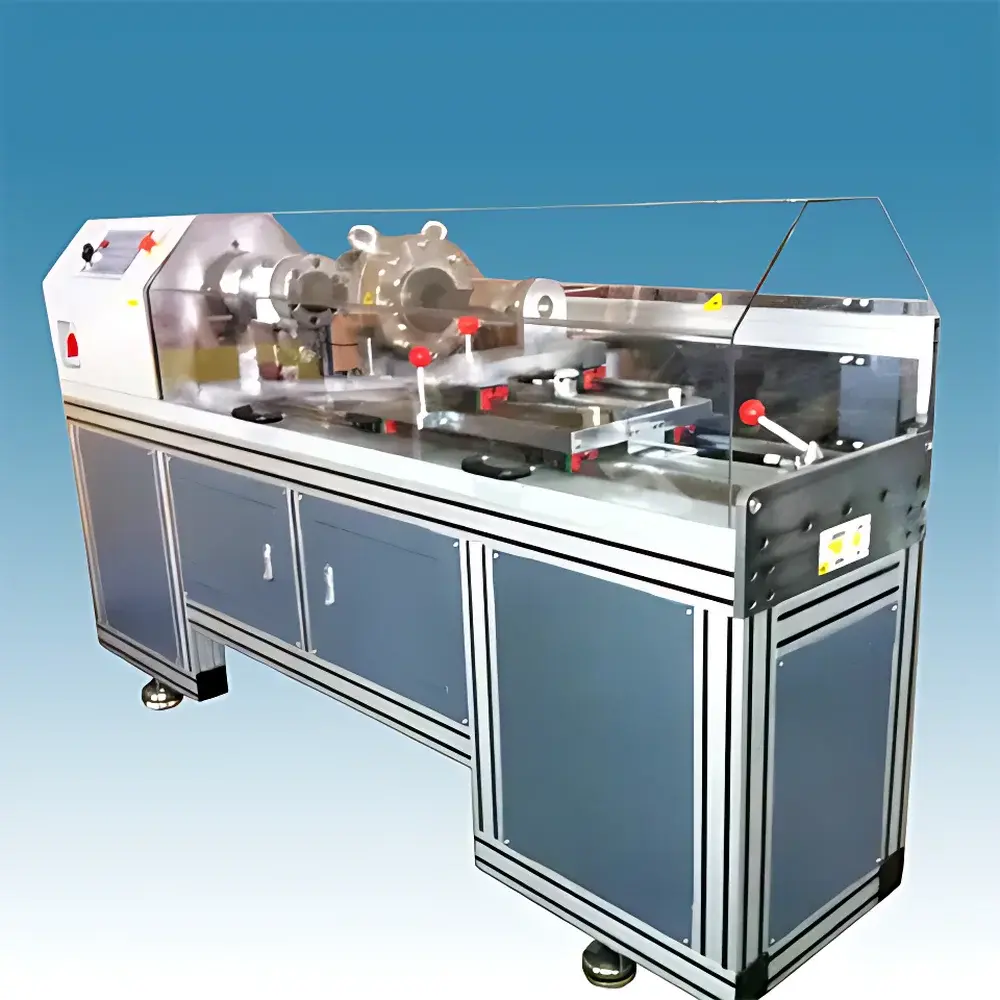
Hengyi HY-2000N·m Chromium Alloy Bolt Thread Friction Coefficient Torsion Testing Machine
| Brand | Hengyi / Hengyitest |
|---|---|
| Origin | Shanghai, China |
| Manufacturer Type | Direct Manufacturer |
| Regional Classification | Domestic (China) |
| Model | HY-2000N·m |
| Max Torque | 2000 N·m |
| Torque Measurement Range | 2–2000 N·m |
| Torque Resolution | 0.001 N·m |
| Torsion Angle Measurement Range | 0–100,000° (or continuous) |
| Motor Power | 5 kW |
Overview
The Hengyi HY-2000N·m Chromium Alloy Bolt Thread Friction Coefficient Torsion Testing Machine is an engineered precision system designed for quantitative mechanical characterization of bolted joints under controlled torsional loading. It operates on the principle of simultaneous dual-sensor torque-angle-force measurement during quasi-static tightening, enabling separation and quantification of three critical frictional contributions: total coefficient of friction (µtotal), thread friction coefficient (µthread), and bearing surface friction coefficient (µbearing). This methodology conforms to internationally recognized fastener testing protocols—specifically ISO 16047:2019 (Fasteners — Torque/clamp force testing) and GB/T 16823.3–2010 (Mechanical properties of fasteners — Part 3: Systematic evaluation of the clamping force/torque relationship)—and supports full traceability in GLP/GMP-aligned environments when integrated with audit-trail-capable software.
Key Features
- High-fidelity dual-load-path architecture: Independent high-accuracy torque transducers (±0.5% FS) for total torque and thread torque, coupled with a calibrated axial load cell (5–500 kN range, ±0.5% FS) for real-time clamp force acquisition.
- Precision electromechanical drive system: Brushless servo motor (5 kW) delivering stable rotational control from 5 to 40 rpm (extendable to 200 rpm), with minimal speed drift (<±0.5%) and no low-speed stiction or “crawling” behavior.
- Modular gripping configuration: Adjustable parallel jaw system accommodating threaded fasteners from M10 to M30; custom fixtures available for non-standard geometries including shear bolts, anchor bolts, stud bolts, and weld studs.
- Rigid structural frame: Heavy-duty welded steel base (2200 × 540 × 1250 mm) with 1000 mm maximum test zone clearance and 1800 kg operational mass, ensuring minimal deflection and high repeatability under peak 2000 N·m loading.
- Digital control core: Proprietary HYtest controller with 16-bit ADC resolution, 1 kHz sampling rate, and real-time closed-loop PID regulation for torque, angle, and axial force.
Sample Compatibility & Compliance
The HY-2000N·m is validated for testing high-strength metallic fasteners used across aerospace, wind energy, structural steel construction, and power generation sectors. Compatible specimens include chromium alloy bolts, nickel-chromium and nickel-chromium-molybdenum alloy steel bolts, hex head structural bolts per EN 14399-1:2005, twist-off type shear bolts, foundation anchor bolts, and stud-welded connectors. All measurement outputs comply with ASTM F2329 (Standard Specification for Zinc-Coated Steel Bolts), ISO 898-1:1999 (Mechanical properties of fasteners — Part 1: Bolts, screws and studs), and GB/T 3098.9–2002 (Mechanical properties of fasteners — Fatigue performance of bolts). Calibration certificates are issued per ISO/IEC 17025 requirements, with optional third-party verification available.
Software & Data Management
The HYtest universal testing software provides full IEC 62304-compliant firmware architecture and supports 21 CFR Part 11–ready operation when configured with electronic signatures, audit trails, and role-based user permissions. Real-time data visualization includes synchronized torque–angle, axial force–angle, and derived µthread/µtotal plots. Automated report generation exports results in PDF, Excel, and XML formats—including compliance statements referencing ISO 16047 Annex A calculation methodology. Raw datasets retain full timestamped metadata (operator ID, environmental conditions, calibration status) and support post-test reprocessing with adjustable filtering and curve-fitting algorithms.
Applications
- Quantitative validation of lubricant efficacy on threaded surfaces under service-relevant preload conditions.
- Comparative analysis of surface treatments (e.g., phosphate, zinc flake, PTFE coating) on frictional behavior and scatter reduction.
- Development and qualification of new high-strength alloy formulations for offshore wind tower bolting systems.
- Root-cause investigation of joint loosening or fatigue failure via correlation of µthread hysteresis with cyclic clamp force decay.
- Production line quality assurance per PPAP Level 3 documentation requirements, including Cp/Cpk statistical process control integration.
- Research into temperature-dependent friction transitions using optional environmental chamber coupling (not included).
FAQ
What standards does this machine directly support?
ISO 16047:2019, GB/T 16823.3–2010, ISO 898-1:1999, EN 14399-1:2005, EN 14399-3–6:2006, and GB/T 3098.9–2002.
Can it measure both thread and bearing surface friction independently?
Yes—via integrated coaxial torque sensors and axial load feedback, enabling real-time decomposition per ISO 16047 Annex A.
Is the system compliant with FDA 21 CFR Part 11 for regulated labs?
Yes, when deployed with HYtest v4.2+ and configured with electronic signatures, audit trail logging, and secure user access controls.
What is the minimum resolvable torque value?
0.001 N·m, supported by 24-bit torque transducer signal conditioning and digital noise suppression filters.
Does it support automated pass/fail judgment against specification limits?
Yes—software-defined acceptance criteria can trigger visual alerts, stop tests, and log non-conformances with root-cause tagging.



