
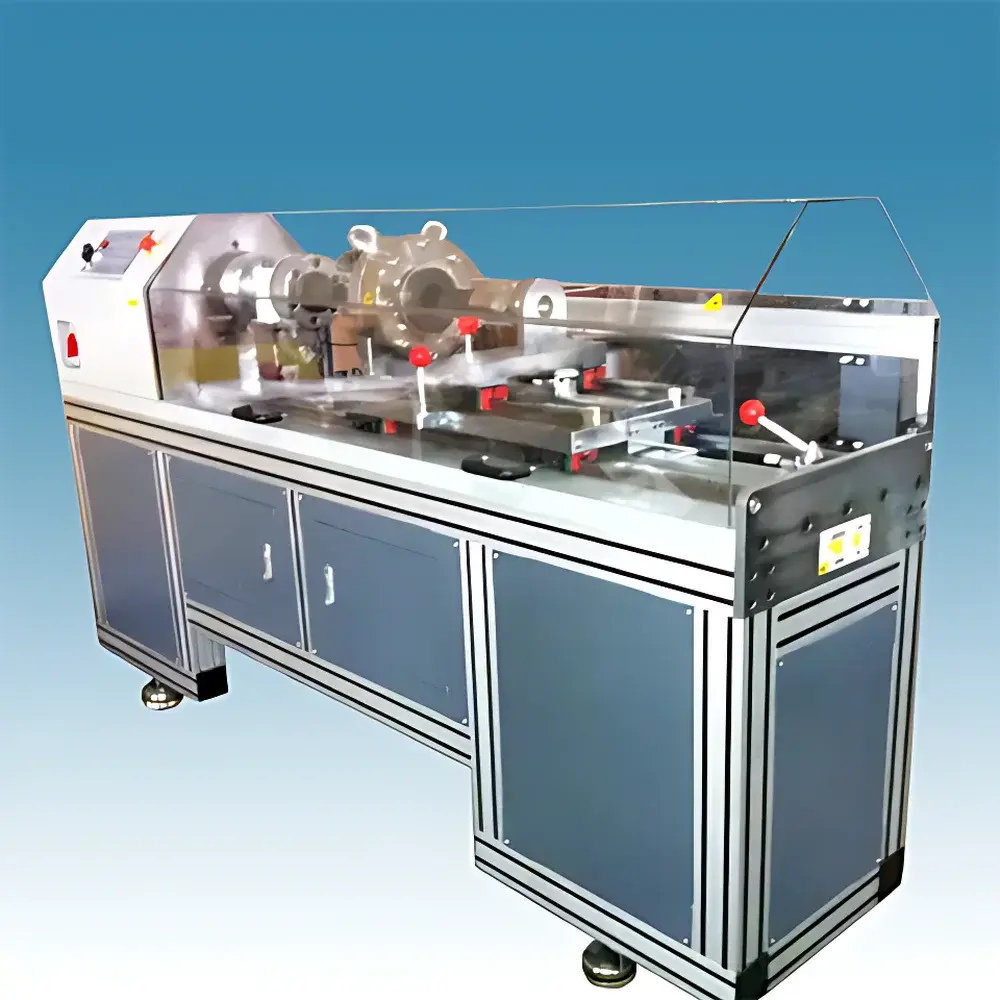
Hengyi HY-2000N·m Fastener Thread and Tightening Characteristic Testing System
| Brand | Hengyi / Hengyitest |
|---|---|
| Origin | Shanghai, China |
| Manufacturer Type | Direct Manufacturer |
| Region Category | Domestic (China) |
| Model | HY-2000N·m |
| Quotation | Upon Request |
| Max Total Torque | 2000 N·m |
| Max Thread Torque | 1000 N·m |
| Axial Force Range | 5–500 kN |
| Torque Measurement Accuracy | ±0.5% FS |
| Angular Displacement Range | 0–100,000° (or continuous) |
| Angular Accuracy | ±0.5% FS |
| Rotational Speed Range | 5–40 rpm (up to 200 rpm) |
| Max Specimen Gauge Length | 1000 mm |
| Clamping Diameter Range | M10–M30 (customizable) |
| Power Supply | Single-phase 5 kW |
| Dimensions (L×W×H) | ≈2200×540×1250 mm |
| Weight | 1800 kg |
Overview
The Hengyi HY-2000N·m Fastener Thread and Tightening Characteristic Testing System is a high-capacity, dual-sensor torsional testing platform engineered for precision evaluation of mechanical fasteners under controlled preload and dynamic tightening conditions. Based on the principle of simultaneous axial force and torque measurement during controlled angular displacement, the system implements a standardized coaxial loading architecture compliant with ISO 16047, ASTM F2268, and DIN 267-27 test methodologies. It enables full characterization of torque-tension relationships in bolt-nut assemblies, including coefficient of total friction, thread friction coefficient, bearing surface friction coefficient, yield clamping force, proof torque, angular displacement at yield, ultimate tensile load, and failure torque. Designed for industrial metrology laboratories, fastener OEM quality control departments, and R&D centers in wind energy, rail infrastructure, aerospace component supply chains, and structural steel fabrication, the system delivers traceable, repeatable data essential for process validation and regulatory documentation.
Key Features
- Dual-load-path measurement architecture: Independent high-precision load cells for axial force (5–500 kN range) and coaxial torque sensors (total torque up to 2000 N·m; thread torque up to 1000 N·m), enabling decoupled analysis of frictional contributions.
- High-stability electromechanical drive system with closed-loop speed control (5–40 rpm standard, extendable to 200 rpm), ensuring smooth low-speed ramping without stick-slip behavior—critical for accurate yield point detection.
- Modular clamping system accommodating threaded fasteners from M10 to M30; optional custom jaw sets available for non-standard geometries including anchor bolts, shear studs, and double-end studs.
- Robust structural frame with 1000 mm maximum parallel jaw spacing and 1800 kg reinforced base, minimizing deflection under peak load and ensuring long-term calibration stability.
- Integrated angular encoder with 0.01° resolution and ±0.5% full-scale accuracy across 0–100,000° range (or continuous rotation mode), supporting both static torque-angle mapping and dynamic breakaway analysis.
Sample Compatibility & Compliance
The HY-2000N·m system supports standardized and application-specific fastener specimens including alloy steel bolts (e.g., ASTM A193 B7, A320 L7), nickel-chromium-molybdenum superalloy fasteners (e.g., Inconel 718), structural bolting per EN 14399, wind turbine tower anchor bolts (IEC 61400-1 Annex D), and shear connectors per AWS D1.1. Test procedures align with ISO 16047 (torque-tension testing), ISO 898-1 (mechanical properties of fasteners), ASTM F2268 (rotary insertion testing), and DIN 267-27 (friction coefficient determination). The system’s measurement uncertainty budget meets ILAC-G8 requirements for accredited calibration labs and supports GLP-compliant audit trails when operated with validated software configurations.
Software & Data Management
Controlled by the HYtest v4.x modular test software suite running on Windows OS, the system provides real-time synchronized acquisition of torque, axial force, angle, and rotational speed at ≥1 kHz sampling rate. Software modules include automated test sequence scripting, multi-curve overlay comparison, statistical batch reporting (CPK, Cpk, X-bar/R charts), and export to CSV, XML, or PDF formats compliant with FDA 21 CFR Part 11 requirements when configured with electronic signature and audit trail activation. All raw data files are time-stamped, digitally signed, and stored with metadata including operator ID, environmental conditions (optional sensor integration), and calibration certificate references.
Applications
- Validation of tightening process parameters for automotive powertrain assembly lines.
- Friction coefficient benchmarking of lubricated vs. dry-threaded fasteners in offshore wind turbine foundations.
- Yield strength verification of high-strength anchor bolts used in seismic retrofitting of concrete structures.
- Development and qualification of new coating systems (e.g., zinc flake, PTFE-based) for corrosion-resistant fasteners.
- Third-party certification testing per EN 15048 or ASME B18.2.1 for structural bolting suppliers.
- Research into thread geometry effects (pitch, flank angle, root radius) on torque scatter in aerospace-grade titanium fasteners.
FAQ
What standards does the HY-2000N·m system support for torque-tension testing?
ISO 16047, ASTM F2268, DIN 267-27, and EN 14399-2 are natively supported through preconfigured test templates and report formats.
Can the system measure individual friction components (thread vs. bearing surface)?
Yes—via dual-torque sensing and axial force correlation, the software calculates thread friction coefficient (µth) and bearing surface friction coefficient (µb) per ISO 16047 Annex A.
Is calibration traceability provided?
All load cells and encoders are supplied with UKAS-accredited or CNAS-equivalent calibration certificates, valid for 12 months under normal operating conditions.
What is the minimum detectable axial force resolution?
At 5 kN lower limit, resolution is ≤5 N (0.1% of full scale); system noise floor is <0.05% FS RMS.
Does the system support automated pass/fail evaluation against specification limits?
Yes—user-defined acceptance criteria (e.g., torque coefficient K = 0.11–0.15, yield torque ≥90% of nominal) trigger real-time alerts and auto-classify results as Accept/Reject/Review.



