
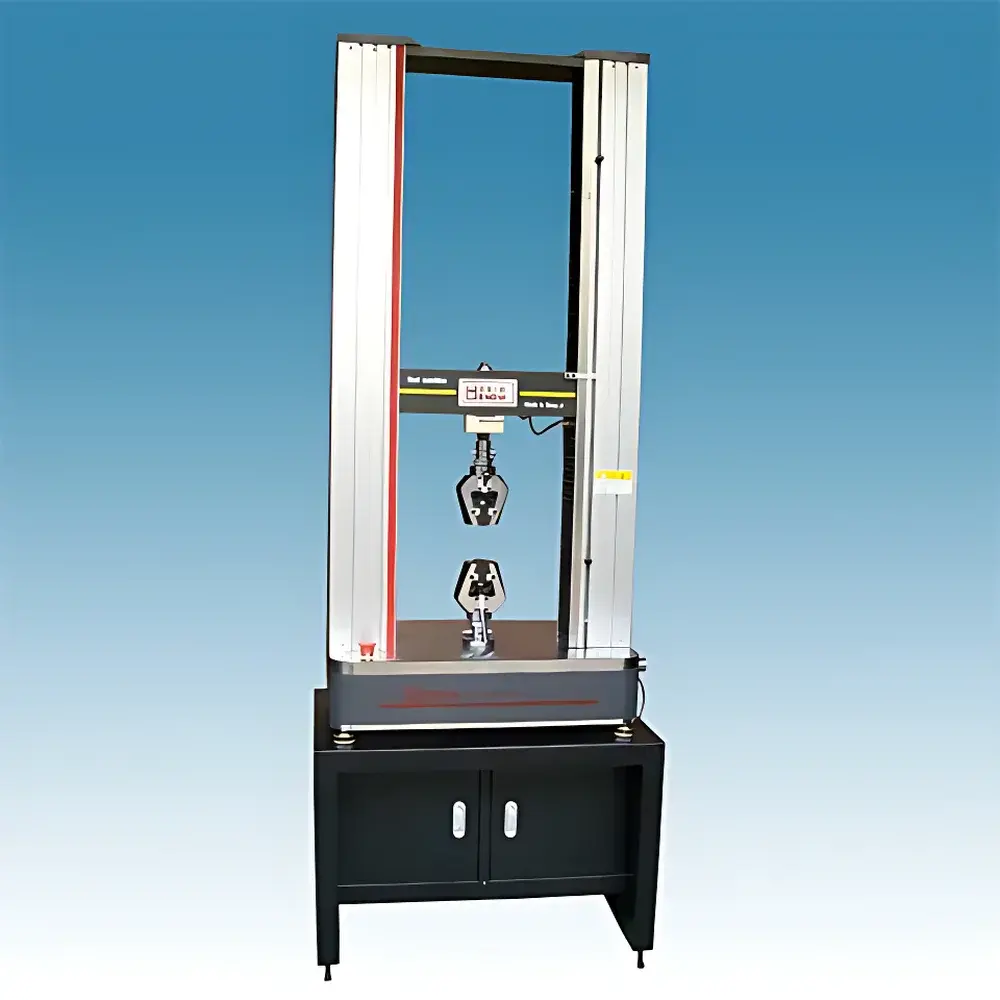
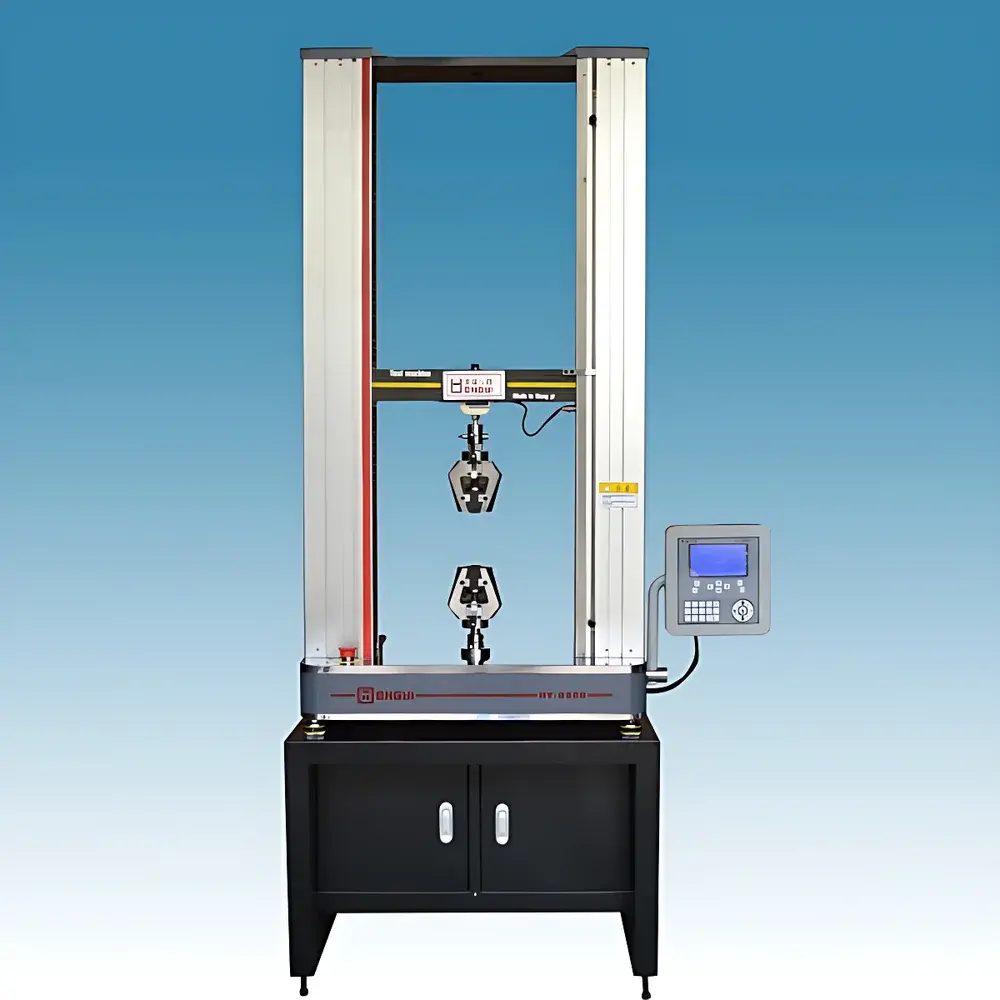
Hengyi HY-3080YUNBB Carbon Fiber Rod Tensile Testing Machine
| Brand | Hengyi |
|---|---|
| Origin | Shanghai, China |
| Manufacturer Type | Direct Manufacturer |
| Regional Category | Domestic (China) |
| Model | HY-3080YUNBB |
| Instrument Type | Electromechanical Universal Testing Machine |
| Load Capacity Options | 1 N to 30 kN (multi-range configurable) |
| Accuracy Class | ≤0.5% of full scale |
| Effective Test Width | 380 mm (expandable) |
| Effective Test Height | 800 mm (extendable) |
| Speed Range | 0.001–1000 mm/min (continuous, programmable) |
| Speed Accuracy | ±0.5% of set value |
| Force Resolution | ±500,000 counts (full-scale, no range switching) |
| Force Measurement Accuracy | ±0.5% of reading (0.1–99.999% FS) |
| Displacement Accuracy | ±0.5% of reading |
| Strain Measurement Accuracy | ±0.5% of reading |
| Stress/Strain Control Rate Range | 0.002–6% FS/s |
| Stress/Strain Control Accuracy | ±0.5% (≥0.05% FS/s), ±1–2% (lower rates) |
| Constant-Load/Displacement/Strain Range | 0.5–100% FS |
| Protection Features | Electronic limit switches, overload protection (>110% FS), real-time system diagnostics |
| Power Supply | 220 V AC, single-phase, 0.75 kW |
| Weight | 210 kg |
| Dimensions (W×D×H) | 700 × 420 × 1600 mm |
Overview
The Hengyi HY-3080YUNBB Carbon Fiber Rod Tensile Testing Machine is a high-precision electromechanical universal testing system engineered for static mechanical characterization of advanced composite rods—particularly carbon fiber-reinforced polymer (CFRP) specimens—as well as a broad spectrum of quasi-brittle, ductile, and viscoelastic materials. Based on the fundamental principles of uniaxial tensile mechanics per ASTM D3039, ISO 527-4, and GB/T 3354, the system applies controlled axial force via a dual-column rigid frame architecture, enabling accurate measurement of tensile strength, modulus, elongation at break, yield point, and stress–strain behavior under standardized loading protocols. Its modular load cell configuration (1 N to 30 kN), coupled with closed-loop digital control and high-fidelity signal conditioning, ensures traceable, repeatable, and GLP-compliant data acquisition across R&D, quality assurance, and regulatory validation workflows.
Key Features
- Robust dual-column steel frame with preloaded high-precision ball screws and maintenance-free servo motor drive—designed for long-term dimensional stability and minimal deflection under load.
- High-resolution bidirectional load cell (±500,000 internal counts, no auto-ranging required) calibrated to ≤0.5% accuracy across the full dynamic range (0.1–99.999% FS).
- Programmable test speed from 0.001 to 1000 mm/min with ±0.5% speed fidelity—enabling compliance with low-strain-rate creep tests and high-speed rupture evaluations.
- Digital controller supporting multi-language UI (English, Chinese, Spanish, German, French), SI/imperial unit conversion, and both open-loop and closed-loop operation modes.
- Integrated safety architecture: electronic travel limits, overload cutoff (>110% FS), real-time system diagnostics (overvoltage, overcurrent, thermal anomaly detection), and emergency stop circuitry compliant with IEC 61508 SIL1 requirements.
- Portable hand-held controller for intuitive jog-mode positioning, rapid setup, and operator-independent alignment verification prior to test initiation.
Sample Compatibility & Compliance
The HY-3080YUNBB accommodates diverse specimen geometries—including cylindrical carbon fiber rods (diameters 1–25 mm), thin films, metallic foils (Al/Cu), photovoltaic interconnect ribbons, biomedical sutures, polymer tubing, orthopedic fixation wires, and layered composites—within its 380 mm test width and 800 mm vertical stroke envelope. Fixture adaptability includes wedge-action grips, pneumatic clamps, and custom jaw inserts (e.g., diamond-coated, serrated, or low-slip elastomeric). The system supports method development and execution aligned with ASTM E8/E21 (metals), ISO 6892-1 (tensile testing of metallic materials), ISO 527-4 (CFRP laminates), USP (mechanical testing of pharmaceutical packaging), and EN ISO 13934-1 (textile tensile properties). All force, displacement, and strain data are timestamped and audit-trail ready—facilitating 21 CFR Part 11–compliant electronic records when paired with validated software configurations.
Software & Data Management
The embedded control platform utilizes deterministic real-time firmware with VB.NET-based post-processing logic and SQL-backed local database storage. Raw test data—including synchronized force, extension, and optional extensometer-derived strain—is recorded at ≥1 kHz sampling rate and exported in CSV, XML, or proprietary .HDT formats. Curve analysis tools support automatic yield point detection (0.2% offset method), tangent modulus calculation, area-under-curve integration (toughness), and user-defined region-of-interest extraction. Custom test methods can be saved, version-controlled, and deployed across instrument fleets. Optional PC-based software modules provide advanced statistical process control (SPC) dashboards, multi-sample comparative reporting, PDF certificate generation with digital signature fields, and integration with LIMS via HL7 or RESTful API.
Applications
This system serves as a core mechanical characterization tool in industrial QA/QC laboratories (e.g., aerospace component suppliers verifying CFRP rod tensile integrity per AMS 2750E), university materials science departments conducting failure mode analysis of hybrid composites, medical device manufacturers validating suture tensile performance to ISO 10993-12, and solar module producers certifying interconnect ribbon bond strength per IEC 61215. It is routinely deployed for mechanical screening of thermoplastic matrix composites, biodegradable polymer rods, ceramic fiber bundles, high-strength alloy wires, and structural adhesives—supporting both routine conformance testing and research-grade constitutive modeling.
FAQ
What load capacity options are available for the HY-3080YUNBB?
Standard configurations support nominal loads from 1 N to 30 kN; multiple transducers may be installed for multi-range flexibility without recalibration.
Is the system compliant with ISO/IEC 17025 calibration requirements?
Yes—the load cell and displacement encoder are supplied with NIST-traceable calibration certificates; periodic verification follows ISO/IEC 17025 Annex A.3 procedures.
Can the machine perform compression or flexural tests?
With appropriate fixtures (e.g., compression platens, three-point bend assemblies), it executes ASTM D695, D790, and ISO 604 protocols—subject to maximum compressive load limits defined by column buckling analysis.
Does the controller support automated batch testing with pass/fail logic?
Yes—programmable pass/fail thresholds (e.g., min. tensile strength ≥ 1200 MPa, max. elongation ≤ 1.8%) trigger audible alerts and auto-archiving of nonconforming results.
What environmental conditions are recommended for optimal performance?
Operate within 10–35 °C ambient temperature, ≤80% RH non-condensing, on a vibration-isolated concrete floor; avoid direct sunlight and electromagnetic interference sources.
Related Products



