
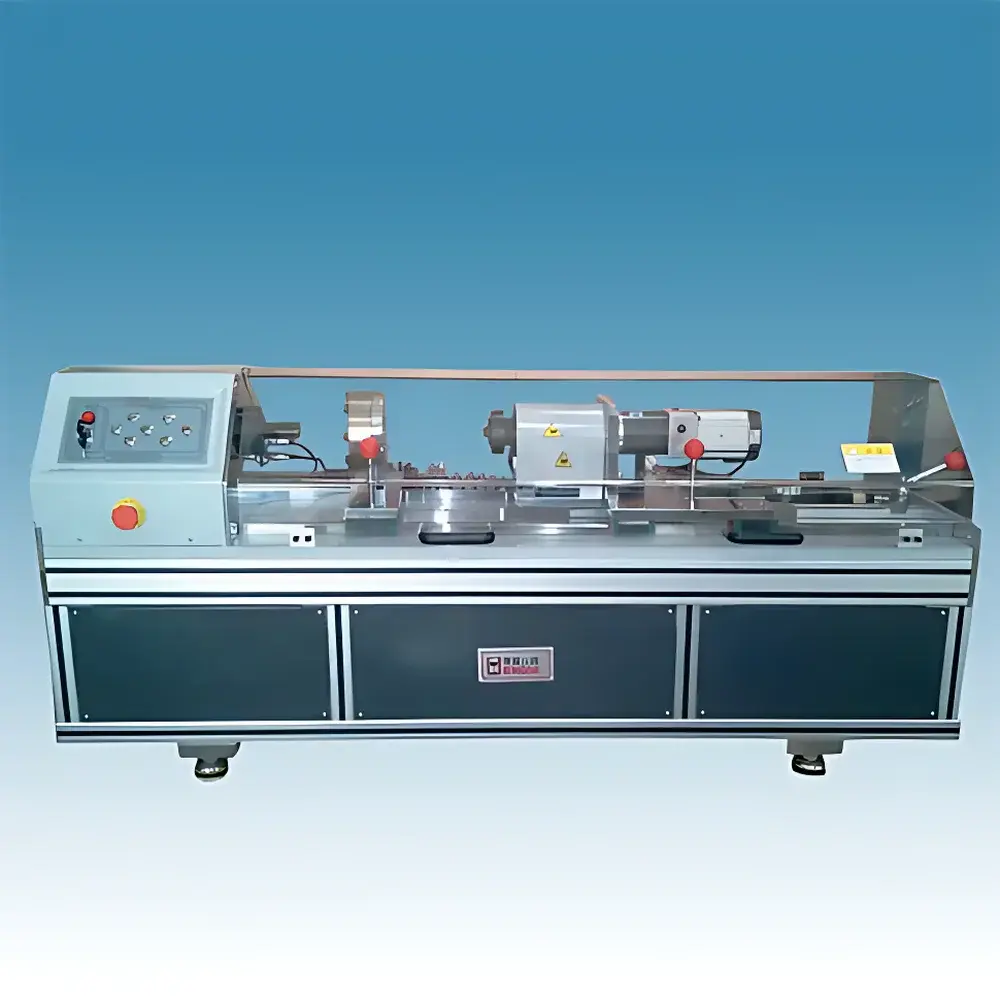
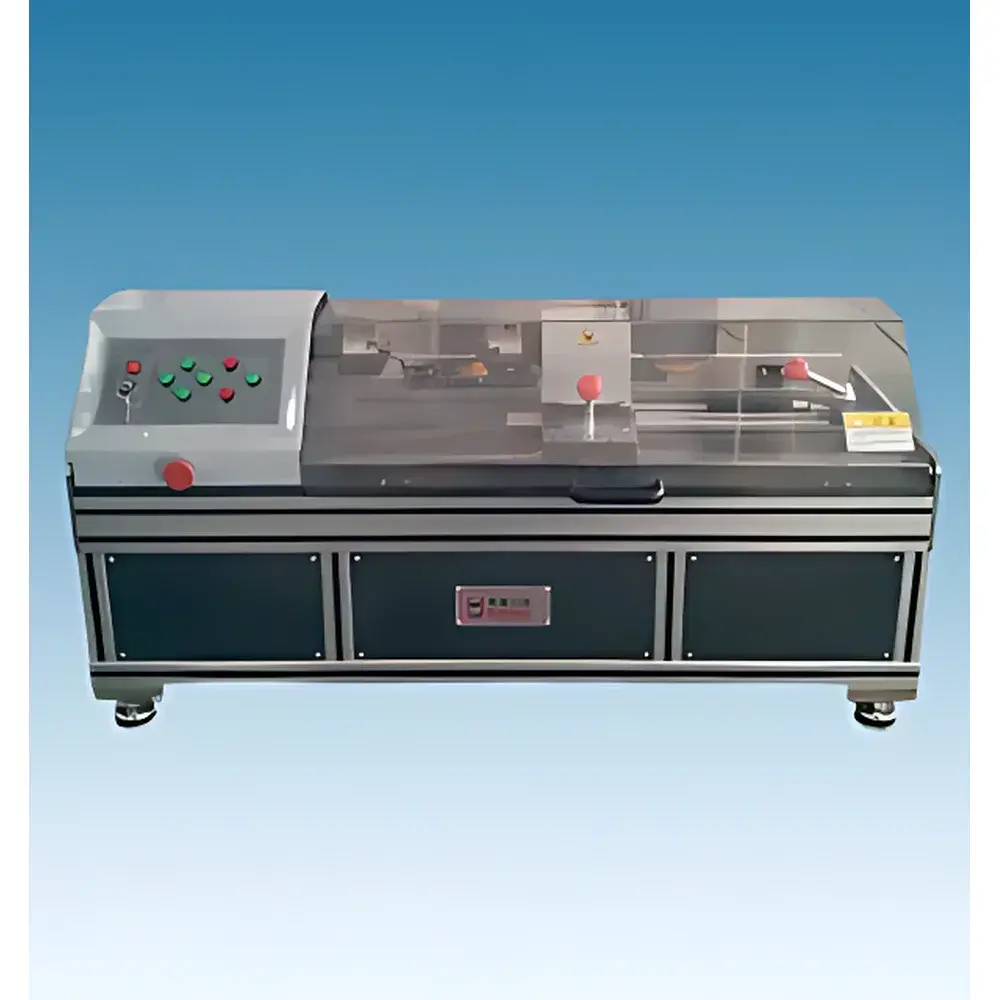
Hengyi HY-50N·m Orthopedic Bone Screw Torsion Testing Machine
| Brand | Hengyi (Hengyitest) |
|---|---|
| Origin | Shanghai, China |
| Manufacturer Type | Direct Manufacturer |
| Model | HY-50N·mYUIKK |
| Max Torque | 50 N·m |
| Torque Measurement Range | 0.1–50 N·m |
| Torque Resolution | 1/500,000 FS |
| Torsion Angle Range | 0–100,000° (or continuous rotation) |
| Motor Power | 0.4 kW |
| Torque Accuracy | ±0.5% of reading |
| Angular Accuracy | ±0.5% of reading |
| Angular Resolution | 0.0045° |
| Speed Range | 0–1000°/min |
| Specimen Grip Range | Φ1–Φ5 mm |
| Gauge Length Adjustment | Up to 200 mm (customizable) |
| Dimensions (L×W×H) | ~1000 × 420 × 500 mm |
| Weight | 200 kg |
Overview
The Hengyi HY-50N·m Orthopedic Bone Screw Torsion Testing Machine is a precision-engineered, horizontal-axis torsion testing system designed specifically for biomechanical evaluation of orthopedic implants and biological tissues. It operates on the principle of controlled angular displacement under applied torque, enabling quantification of torsional stiffness, yield torque, ultimate torsional strength, failure angle, and energy absorption capacity—critical parameters in ISO 14801:2016 (dental implant systems) and ASTM F543 (metallic medical bone screws) compliance testing. The machine integrates a high-fidelity torque transducer with a high-resolution optical encoder to deliver traceable, repeatable measurements across its full 0.1–50 N·m range. Its closed-loop servo control architecture—powered by a Panasonic AC servo motor and driven via a 32-bit ARM-based microprocessor—ensures stable torque ramping, precise angular positioning (±0.0045° resolution), and bidirectional loading capability essential for simulating physiological cyclic torsion in spinal fixation devices or intramedullary nails.
Key Features
- High-resolution torque measurement system with ±0.5% accuracy and 1/500,000 full-scale resolution, meeting ISO 7500-1 Class 0.5 requirements for force/torque metrology.
- Optical encoder-based angular measurement delivering 0.0045° resolution and ±0.5% linearity over 0–100,000° range, supporting both finite-angle and continuous-rotation test protocols.
- Full digital servo control with 1:2,000,000 speed regulation ratio, enabling ultra-low-speed torsion (e.g., 0.01°/min) and rapid reversal for fatigue-relevant waveform generation.
- Dual-mode operation: manual preset mode for quick setup and fully automated test sequences with programmable torque/angle ramps, dwell steps, and break detection triggers.
- Modular gripping system accommodating specimens from Φ1 mm to Φ5 mm; custom collet sets available for threaded fasteners, cortical bone dowels, and polymer-based bioresorbable screws.
- Robust mechanical frame with electrostatically sprayed steel enclosure, vibration-damped base, and precision-ground lead screws ensuring long-term dimensional stability during multi-hour creep or relaxation tests.
Sample Compatibility & Compliance
The HY-50N·m platform supports standardized mechanical testing of orthopedic hardware including cortical and cancellous bone screws (titanium alloy, stainless steel, Mg-based resorbables), spinal pedicle screws, intramedullary locking bolts, and bio-composite fixation plates. It is routinely deployed in laboratories performing conformance testing per ASTM F543-23 (Standard Specification and Test Methods for Metallic Medical Bone Screws), ISO 14801:2016 (Dental implants — Dynamic fatigue test for endosseous dental implants), and ISO 6474-2:2021 (Ceramic implants — Mechanical testing of ceramic components). Optional micro-angle measurement add-ons enable calculation of shear modulus (G) and non-proportional shear stress (τp) per ASTM E143-22, supporting material characterization workflows required by FDA 510(k) submissions and EU MDR Annex I essential requirements.
Software & Data Management
The embedded Hengyi TorsionTest v3.2 software—developed on a deterministic real-time OS—acquires data at 100 Hz with synchronized timestamping and supports simultaneous display of torque–time, angle–time, torque–angle, and torque–rotation curves. All raw data are stored in ASCII-compatible .csv format with metadata headers compliant with ALCOA+ principles (Attributable, Legible, Contemporaneous, Original, Accurate, Complete, Consistent, Enduring, Available). Audit trail functionality logs user actions, method changes, calibration events, and result modifications—meeting FDA 21 CFR Part 11 electronic record/electronic signature requirements when configured with role-based access control and digital certificate authentication. Export modules support direct integration with LIMS platforms via TCP/IP or USB mass storage protocols.
Applications
- Static torsional failure analysis of orthopedic bone screws under simulated insertion and functional loading conditions.
- Cyclic torsional fatigue testing of spinal instrumentation systems per ASTM F1717-22 (Standard Test Methods for Spinal Implant Constructs in a Vertebrectomy Model).
- Shear modulus determination of cortical bone specimens using small-angle torsion methodology aligned with ASTM E143-22.
- Validation of torque–tension relationships in self-tapping and non-self-tapping screw designs per ISO 13485 production process verification protocols.
- Comparative mechanical screening of novel biodegradable screw materials (e.g., PLLA, Mg-Zn-Ca alloys) against legacy metallic benchmarks.
- Research-grade torsional characterization of synthetic bone analogs (e.g., Sawbones®) used in surgical training and device preclinical evaluation.
FAQ
What international standards does this tester support out-of-the-box?
It natively supports test method templates for ASTM F543, ISO 14801, ISO 6474-2, and ISO 7500-1. Custom protocol development is supported via scriptable test sequence editor.
Can the system perform torsional creep or stress-relaxation tests?
Yes—using the time-controlled hold function with automatic torque/angle compensation, it enables ISO 899-1 creep testing and ASTM D2990 stress-relaxation protocols for polymeric orthopedic materials.
Is GLP/GMP audit readiness included in the software package?
With optional validation package (IQ/OQ/PQ documentation, electronic signature module, and audit trail export), the system meets GLP (OECD 1998) and GMP (ISO 13485:2016 Clause 7.6) requirements for regulated lab environments.
What is the maximum specimen length accommodated without modification?
Standard gauge length is adjustable up to 200 mm between chucks; extended configurations (up to 500 mm) are available as factory-installed options.
Does the system offer third-party calibration certification?
Yes—NIST-traceable calibration certificates (torque and angular axes) are provided with each unit; annual recalibration services include ISO/IEC 17025-accredited reports.



