
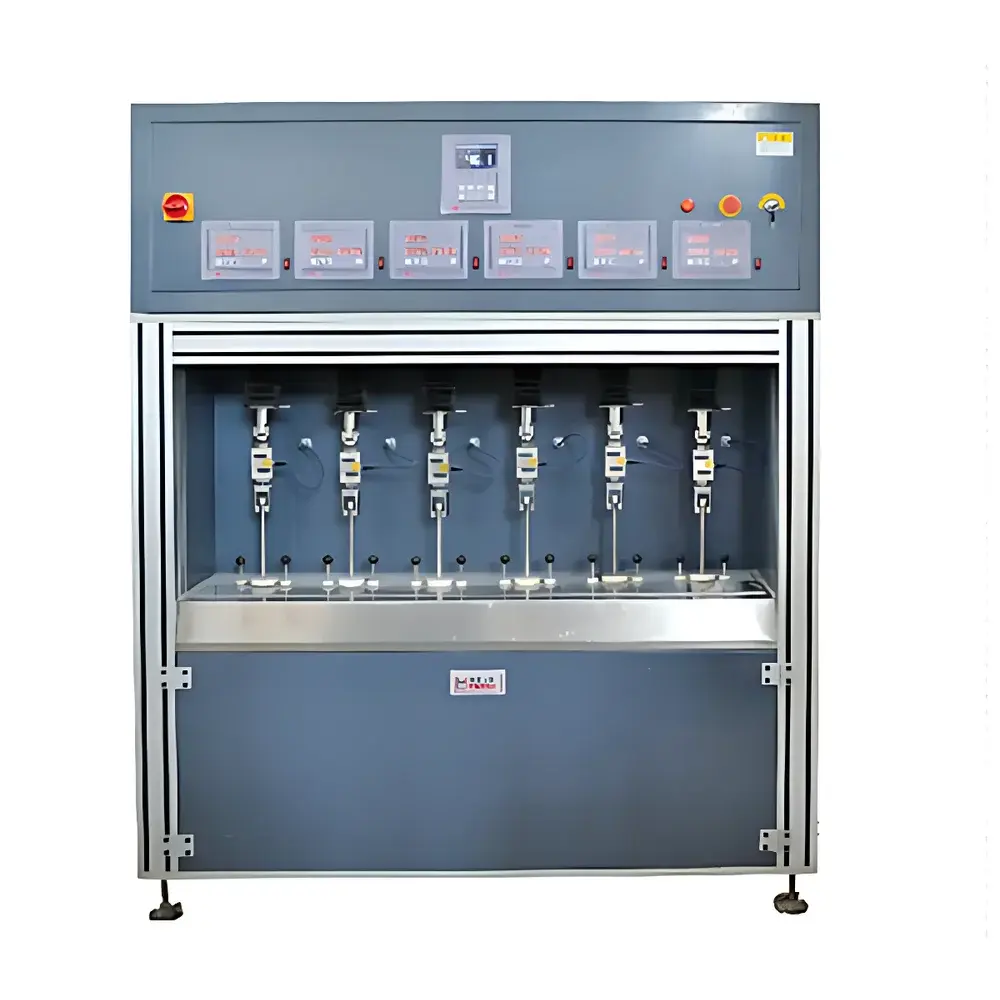
Hengyi HY-QKRB Six-Station Full-Notch Creep Testing System
| Brand | Hengyi / Hengyitest |
|---|---|
| Origin | Shanghai, China |
| Manufacturer Type | Direct Manufacturer |
| Region Category | Domestic (China) |
| Model | HY-QKRBRTGG |
| Pricing | Upon Request |
| Load Capacity | 2000 N (interchangeable load cells available below 2000 N) |
| Effective Force Range | 0.4–99.999% of full scale |
| Test Width | 120 mm |
| Test Height | 200 mm |
| Speed Range | 0.001–100 mm/min (adjustable) |
| Speed Accuracy | ±1% of indicated value |
| Displacement & Strain Measurement Accuracy | ±1% of indicated value |
| Number of Test Stations | 6 (independently controlled) |
| Temperature Control Range | Ambient to 95 °C |
| Temperature Stability | ±0.5 °C |
| Control Interface | PC-based software (bilingual: English/Chinese) |
| Power Requirement | 220 V, 10 kW |
| Unit Dimensions | 1620 × 850 × 1750 mm |
| Net Weight | 850 kg |
| Compliance Standards | GB/T 15820–1995, GB/T 11546, GB/T 32682–2016, ISO 899-1, ISO 16770, ISO 3501 |
Overview
The Hengyi HY-QKRB Six-Station Full-Notch Creep Testing System is a purpose-engineered instrument for evaluating time-dependent mechanical deformation and failure behavior of thermoplastic polymers—particularly polyethylene (PE) and PE-based composites—under sustained static tensile loading in controlled thermal and chemical environments. It operates on the principle of full-notch creep testing (FNCT), a standardized method that introduces a defined surface notch into the specimen to accelerate environmental stress cracking (ESC) under combined mechanical and chemical exposure. This system enables precise quantification of time-to-failure (rupture time) at constant load and temperature, supporting critical performance assessment for pressure pipe systems, geosynthetic membranes, and structural polymer components exposed to aggressive media such as surfactant solutions or industrial fluids.
Key Features
- Six fully independent test stations, each equipped with electromechanical loading actuators and real-time force feedback control—eliminating cross-talk between units and ensuring statistical robustness across replicate tests.
- Modular elastic support architecture isolates mechanical vibration and thermal drift between stations, maintaining measurement integrity over extended test durations (up to 10,000 hours).
- Integrated high-stability thermostatic bath with PID-controlled circulation, covering ambient to 95 °C at ±0.5 °C uniformity—compatible with aqueous, glycol, or detergent-based test media per ISO 16770 and GB/T 32682–2016 protocols.
- Interchangeable load cells (standard 2000 N; optional lower-range transducers) enable high-resolution force measurement across wide dynamic ranges, with calibration traceable to national metrology institutes.
- Bilingual (English/Chinese) Windows-based control software provides automated test sequencing, real-time data acquisition (force, displacement, time), and post-processing functions including rupture time interpolation, logarithmic stress–time curve fitting, and ASTM/ISO-compliant reporting templates.
- Comprehensive safety architecture includes over-travel limit switches, thermal runaway protection, emergency stop interlocks, and automatic fault logging compliant with IEC 61000-6-2 EMC requirements.
Sample Compatibility & Compliance
The HY-QKRB accommodates standard FNCT specimens per ISO 16770 (10 × 4 × 4 mm rectangular bars with 1-mm full-depth notch) and ASTM D1693-type geometries. It also supports tensile creep (ISO 899-1), pull-out testing of pipe fittings (GB/T 15820), and multi-point stress relaxation profiling. All mechanical and thermal subsystems are validated against GB/T 11546 (plastics—creep determination), ISO 899-1 (tensile creep), and ISO 3501 (environmental stress cracking resistance). The system’s firmware and software architecture support audit-ready data integrity: all raw measurements are timestamped, digitally signed, and stored with immutable metadata—enabling compliance with GLP, GMP, and ISO/IEC 17025 laboratory accreditation requirements.
Software & Data Management
The embedded PC control suite implements role-based access control (administrator/operator), electronic signature workflows, and 21 CFR Part 11–aligned audit trails—including user actions, parameter changes, calibration events, and data export logs. Raw data files (.csv and proprietary .hyc format) retain native resolution without interpolation. Curve-fitting modules apply least-squares regression to generate master curves using time–temperature superposition (TTS) principles. Export options include PDF test reports with embedded graphs, Excel-compatible datasets, and XML schemas compatible with LIMS integration. All software updates are digitally signed and delivered via secure HTTPS channels.
Applications
- Accelerated evaluation of polyethylene pipe materials for municipal water and gas distribution systems.
- Qualification of HDPE geomembranes used in landfill liners and containment structures.
- Comparative ESC resistance screening of polymer blends, nanocomposites, and stabilizer formulations.
- Validation of joint integrity in electrofusion and butt-fusion welded PE pipe assemblies (per GB/T 15820).
- Long-term reliability modeling for medical tubing, cable jacketing, and automotive fluid-handling components.
- Supporting ISO 16770-compliant certification for PE resins supplied to infrastructure OEMs.
FAQ
What standards does the HY-QKRB explicitly support?
It is fully configured for GB/T 15820–1995, GB/T 11546, GB/T 32682–2016, ISO 899-1, ISO 16770, and ISO 3501—covering FNCT, tensile creep, and pull-out testing protocols.
Can the system operate unattended for extended durations?
Yes—designed for continuous operation up to 10,000 hours with redundant thermal monitoring, power-fail recovery, and automatic shutdown upon anomaly detection.
Is third-party calibration documentation provided?
Each unit ships with factory calibration certificates traceable to CNAS-accredited standards; on-site verification and ISO/IEC 17025 calibration services are available upon request.
How is data integrity ensured during regulatory audits?
All measurements are cryptographically hashed and logged with operator ID, timestamp, and system state—meeting ALCOA+ (Attributable, Legible, Contemporaneous, Original, Accurate, Complete, Consistent, Enduring, Available) data governance criteria.
Does the system support custom test profiles beyond standard methods?
Yes—the scripting interface allows definition of multi-step load ramps, dwell periods, temperature gradients, and conditional termination logic—fully programmable via Python API extension.



