
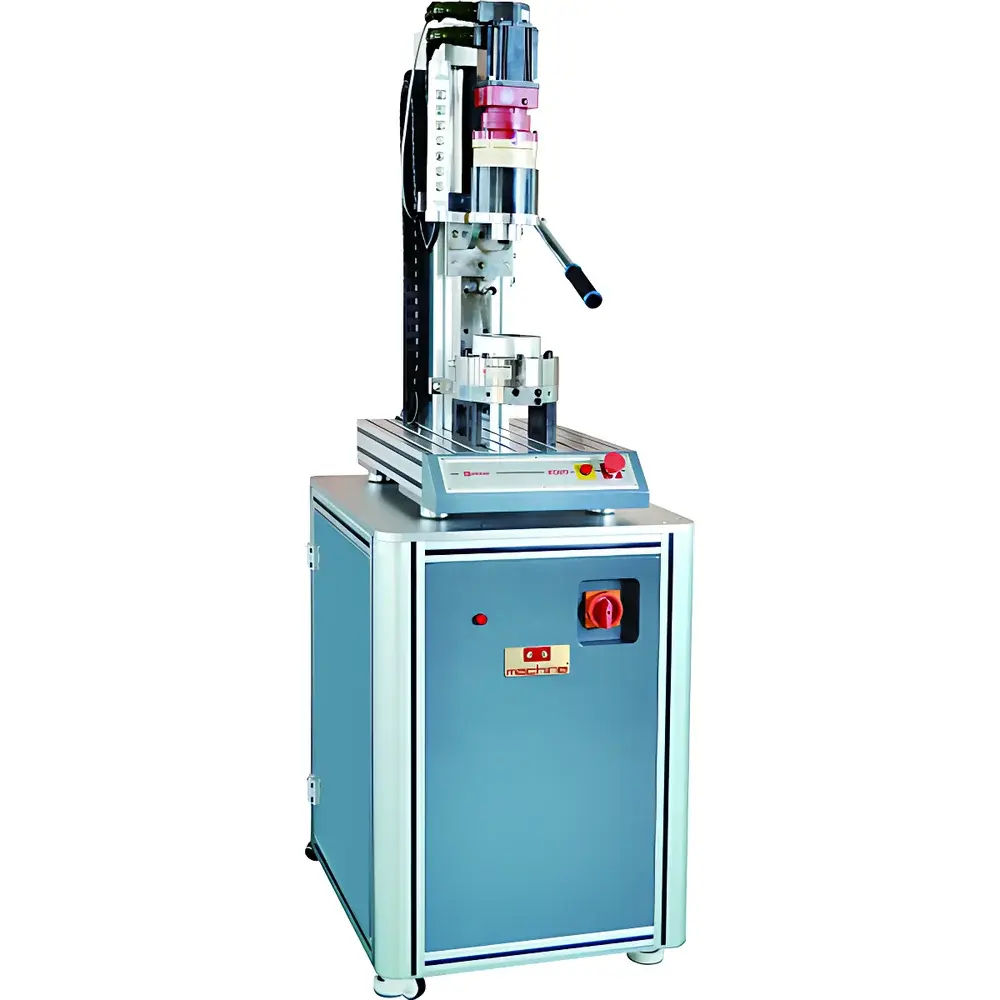
Hengyi HY200N·m Vertical High-Strength Bolt Friction Coefficient Testing Machine
| Brand | Hengyi |
|---|---|
| Origin | Shanghai, China |
| Manufacturer Type | Direct Manufacturer |
| Country of Origin | China |
| Model | HY200N·m |
| Torque Range (Total) | 0–200 N·m |
| Thread Torque Range | 0–100 N·m |
| Axial Force Range | 0.3–30 kN |
| Torque Measurement Accuracy | ±1% FS |
| Twist Angle Range | 0–100,000° |
| Twist Angle Accuracy | ±1% FS |
| Rotational Speed Range | 0–30 rpm |
| Speed Accuracy | ±0.5% FS |
| Max Spacing Between Chucks | 200 mm |
| Specimen Thread Size | M2–M6 (customizable) |
| Power Supply | Single-phase 1.5 kW |
| Dimensions (W×D×H) | ~600 × 700 × 1800 mm |
| Weight | 200 kg |
| Drive System | Panasonic Servo Motor |
| Torque Sensor | High-Precision Strain-Gauge Type |
| Enclosure | Powder-Coated Steel Cabinet |
| Mobility | Integrated Castor-Mounted Trolley |
| Power Options | AC Mains or Optional Li-ion Battery Pack |
Overview
The Hengyi HY200N·m Vertical High-Strength Bolt Friction Coefficient Testing Machine is an engineered solution for quantifying frictional behavior in bolted joints under controlled torque and axial load conditions. It operates on the principle of simultaneous, synchronized measurement of applied torque and induced axial force during tightening—enabling precise derivation of thread friction coefficient (μt), bearing surface friction coefficient (μb), and total system friction coefficient (μtot) per ISO 16047 and ASTM F2329 standards. Unlike conventional horizontal bolt testers, its vertical architecture minimizes floor footprint while maintaining structural rigidity and dynamic stability—critical for high-reproducibility measurements across aerospace fasteners, wind turbine tower bolts, rail vehicle suspension assemblies, and automotive powertrain components. The system integrates closed-loop servo control with real-time dual-channel acquisition (torque + axial force), ensuring traceable, repeatable data generation compliant with GLP and internal quality audit requirements.
Key Features
- Vertical modular design with integrated mobility: Four heavy-duty locking castors enable rapid repositioning within production floors, QC labs, or field service environments—no permanent anchoring required.
- Dual-sensor measurement architecture: High-stability strain-gauge torque transducer (±1% FS accuracy) coupled with a calibrated axial load cell (0.3–30 kN range, ±1% FS) enables concurrent capture of torque-angle and force-angle curves.
- Panasonic AC servo drive system: Delivers smooth, programmable rotational speeds from 0.1 to 30 rpm with ±0.5% speed regulation—essential for simulating both assembly-line tightening and slow-rate qualification tests.
- Modular chuck system: Standardized collet-based fixtures accommodate M2–M6 threaded specimens; optional custom chucks support larger diameters (M8–M24) upon request.
- Flexible power configuration: Operates from standard single-phase 220 V AC supply (1.5 kW); optional integrated lithium-ion battery pack permits cordless operation at remote assembly stations or outdoor turbine sites.
- Rugged industrial enclosure: Powder-coated steel housing (600 × 700 × 1800 mm) provides EMI shielding, mechanical protection, and operator safety—certified to IP20 environmental rating.
Sample Compatibility & Compliance
The HY200N·m supports standardized test specimens per ISO 898-1, ASTM A325/A490, DIN 267-4, and GB/T 3098.1. Its 200 mm maximum chuck spacing accommodates common bolt lengths used in structural joint validation. All measurement outputs—including μt, μb, and K-factor—are calculated using algorithms aligned with ISO 16047 Annex A and VDI 2230 Part 1 methodologies. Data logs include timestamped metadata (operator ID, calibration certificate number, environmental temperature/humidity if externally monitored), satisfying traceability requirements for AS9100 Rev D, IATF 16949, and EN 1090-2 compliance audits. The system’s mechanical and electrical design conforms to CE machinery directive 2006/42/EC and EMC directive 2014/30/EU.
Software & Data Management
The embedded control interface runs proprietary firmware supporting pre-defined test profiles (constant-torque, constant-angle, cyclic torque-angle sequences) and real-time parameter adjustment. Raw sensor data (1 kHz sampling rate) is streamed to onboard storage or exported via USB 3.0 to CSV or XML formats. Optional PC software provides advanced post-processing: automatic friction coefficient calculation per ISO 16047 equations, statistical analysis (Cp/Cpk, GR&R), and PDF report generation with digital signature fields. Audit trail functionality records all user actions—including method edits, calibration events, and result exports—in accordance with FDA 21 CFR Part 11 requirements when configured with role-based access control and electronic signatures.
Applications
- Aerospace: Validation of shear-critical fasteners in wing spar joints, engine mounts, and composite panel retention systems.
- Wind Energy: Torque-friction correlation testing for M30–M48 anchor bolts in turbine tower flanges under variable thermal and humidity conditions.
- Rail Transportation: Verification of preload consistency in bogie suspension bolts subjected to high-cycle vibration exposure.
- Automotive: Development and release testing of wheel hub, brake caliper, and cylinder head fasteners under simulated production torque tools.
- Fastener Manufacturing: In-process QA for plating thickness effects (e.g., zinc-nickel vs. Geomet) on μt scatter and lubricant efficacy screening.
FAQ
What standards does this machine comply with for friction coefficient calculation?
It implements calculation methods defined in ISO 16047:2015 and ASTM F2329-18, including the standard torsional–axial relationship for μt and μb derivation.
Can the system be calibrated in-house, or is third-party certification required?
Internal verification using traceable reference standards is supported; however, annual accredited calibration by ISO/IEC 17025-certified laboratories is recommended for regulatory submissions.
Is the battery option compatible with continuous operation during extended test cycles?
The optional Li-ion pack supports up to 4 hours of uninterrupted testing at ≤15 rpm; external AC supply is advised for >8-hour qualification runs.
Does the software support multi-user permissions and electronic signatures for regulated environments?
Yes—the optional PC software module includes configurable roles (Operator, Supervisor, Administrator), audit log export, and 21 CFR Part 11-compliant electronic signature workflows.
What maintenance intervals are recommended for the servo drive and torque sensor?
Panasonic servo motor requires no routine maintenance; torque sensor zero-point verification is recommended before each shift, with full recalibration every 6 months or after 5,000 test cycles.



