
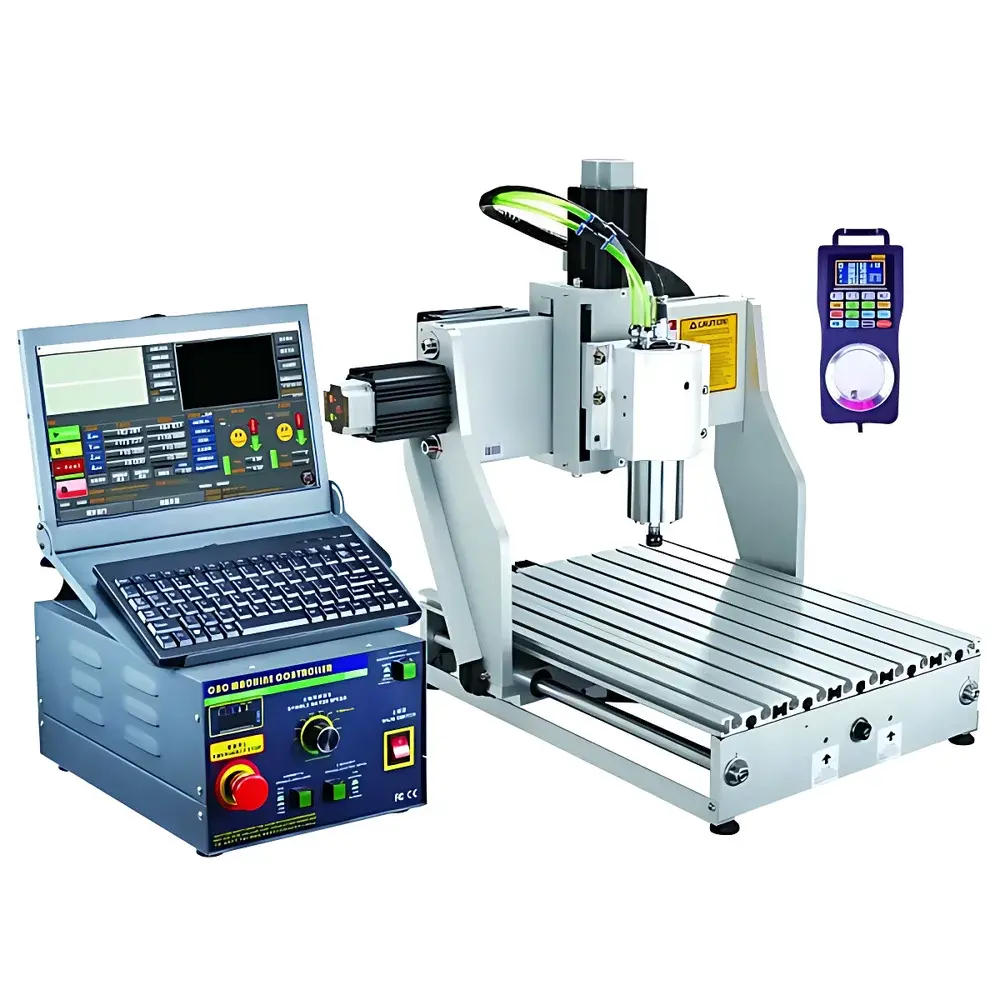
Hengyi HY(DK) Non-Metallic Material Specimen Preparation Machine
| Brand | Hengyi (Hengyitest) |
|---|---|
| Origin | Shanghai, China |
| Manufacturer Type | Direct Manufacturer |
| Country of Origin | China |
| Model | HY(DK)YJKJK |
| Quotation | Upon Request |
| Spindle Speed | 24,000 rpm |
| Feed Rate | 0–500 mm/min |
| Cutting Depth | 2–20 mm |
| Compatible Pipe Diameter | 50–250 mm |
| Max. Workpiece Length (Pipe/Sheet) | 260 mm |
| X-Axis Travel | 280 mm |
| Y-Axis Travel | 310 mm |
| Z-Axis Travel | 70 mm |
| Frame Material | Aluminum Alloy |
| Stepper Motor & Drivers | 3 units |
| High-Speed Variable-Frequency Spindle Motor | 1 unit |
| Precision Linear Guide Rods | 6 units |
| Precision Ball Screws | 3 units |
| Standard Vise | 1 set |
| Specimen Dimensional Accuracy | Compliant with GB/T 1043, GB/T 1843, GB/T 1040, GB/T 8804.2, ISO 8004-2, and ISO 179 |
| Tooling Options | Cylindrical End Mill, 20° Flat-Bottom Cutter, Slitting Blade, 45° Chamfering Cutter |
| Tool Diameters | Φ3 mm, Φ4 mm, Φ6 mm |
| Max. Machining Envelope | 300 mm × 150 mm × 100 mm |
| Power Supply | 220 V AC |
| Total Power Consumption | 1500 W |
| Net Weight | 45 kg |
Overview
The Hengyi HY(DK) Non-Metallic Material Specimen Preparation Machine is a precision CNC-based specimen fabrication system engineered for the standardized preparation of test specimens from thermoplastics, thermosets, composites, fiberglass-reinforced polymers, acrylic sheets, and other non-metallic structural materials. Designed in strict accordance with international mechanical testing standards—including ISO 179 (Charpy impact), ISO 8004-2 (tensile specimens for plastics), GB/T 1040 (tensile properties), GB/T 1043 (Izod impact), GB/T 1843 (notched impact), and GB/T 8804.2 (polyethylene and polypropylene tensile testing)—the HY(DK) ensures dimensional repeatability and geometric fidelity required for accredited mechanical property evaluation. Its modular CNC architecture integrates high-speed spindle dynamics (24,000 rpm), synchronized three-axis motion control (X/Y/Z), and rigid aluminum alloy frame construction to deliver consistent cutting performance across heterogeneous material classes without manual intervention or operator-dependent variability.
Key Features
- Three-axis CNC motion system with stepper motor-driven ball screws (3 units) and high-precision linear guide rods (6 units) ensuring positional accuracy ≤ ±0.02 mm over full travel ranges (X: 280 mm, Y: 310 mm, Z: 70 mm)
- High-frequency variable-frequency spindle motor delivering stable rotational speed up to 24,000 rpm—optimized for low-vibration milling of brittle and fiber-reinforced polymers
- Dedicated tooling set including cylindrical end mills (Φ3/Φ4/Φ6 mm), 20° flat-bottom cutters for precise notch geometry, slitting blades for ASTM D638-type dog-bone blanks, and 45° chamfering tools for edge conditioning per ISO 179-1 Annex A
- Adjustable feed rate (0–500 mm/min) and programmable cutting depth (2–20 mm) enable controlled material removal for both thin-section laminates and thick-walled pipe segments (50–250 mm diameter)
- Integrated standard vise with T-slot base and clamping force calibration—designed to minimize workpiece deformation during machining of low-modulus thermoplastics such as PVC, PP, and ABS
- Compact footprint (300 mm × 150 mm × 100 mm max. work envelope) and lightweight aluminum frame (45 kg net weight) facilitate integration into QC laboratories, metrology rooms, and university materials testing facilities
Sample Compatibility & Compliance
The HY(DK) accommodates a broad spectrum of non-metallic substrates: unreinforced and glass-fiber-reinforced thermoplastics (e.g., PA6, PC, POM), thermosetting resins (epoxy, phenolic), cellular foams, acrylic (PMMA), rubber compounds, and polymer-matrix composites. It produces specimens conforming to ISO/IEC 17025-compliant test protocols when operated under documented SOPs. All machined geometries—including ISO 179 Charpy notched bars (80 × 10 × 4 mm), ISO 527-2 Type 1A dumbbells, and GB/T 8804.2 pipe ring tensile coupons—are traceable to national metrological standards via built-in tool offset compensation and repeatable zero-point referencing. The machine supports GLP-aligned operation through secure user access levels and audit-ready machining logs (when paired with optional external logging software).
Software & Data Management
While the HY(DK) operates via embedded CNC controller with intuitive jog-and-teach pendant interface, it supports G-code import (ISO 6983 compliant) for offline programming using industry-standard CAM platforms (e.g., Fusion 360, Mastercam). Machining parameters—including spindle RPM, feed rate, depth of cut, and tool path sequence—are stored in non-volatile memory with timestamped revision history. Optional RS-232 or USB-to-serial connectivity enables integration with laboratory information management systems (LIMS) for automated job dispatch and specimen ID linkage. For regulated environments, the system can be validated per FDA 21 CFR Part 11 requirements when deployed with electronic signature-enabled host software and controlled change management procedures.
Applications
- Preparation of standardized impact test specimens (notched/unnotched) for ISO 179, ISO 180, and ASTM D256 compliance
- Machining of tensile test bars (ISO 527-2, GB/T 1040, ASTM D638) from extruded profiles, injection-molded plaques, and filament-wound composite tubes
- Generation of compression and flexural test coupons per ISO 604 and ISO 178 from sheet stock and laminated panels
- Production of pipe-ring specimens per GB/T 8804.2 and ISO 1167 for hydrostatic pressure endurance assessment
- Rapid prototyping of custom geometry specimens for R&D validation, failure analysis, and interlaboratory round-robin studies
- Supporting ISO/IEC 17025 accreditation audits by providing documented evidence of specimen dimensional conformity and process reproducibility
FAQ
Does the HY(DK) support automated tool changing?
No—the HY(DK) uses manual tool change via standardized ER collet chucks; however, its quick-release vise and calibrated tool offset tables minimize setup time between specimen types.
Can it process carbon fiber reinforced polymer (CFRP) laminates?
Yes, with appropriate diamond-coated or solid carbide tooling and reduced feed rates; recommended maximum thickness per pass is 3 mm for unidirectional CFRP to prevent delamination.
Is electrical safety certification provided for EU markets?
The base configuration meets CE marking requirements per EN 60204-1 (electrical equipment of machines); optional CE+EMC+RoHS documentation packages are available upon request.
What maintenance intervals are recommended?
Lubrication of ball screws and linear guides every 200 operational hours; spindle bearing inspection every 1,500 hours; annual calibration of axis positioning accuracy using certified gauge blocks.
Is technical support available outside China?
Yes—Hengyi provides remote diagnostics, English-language operation manuals, and application engineering consultation via authorized regional partners in North America, Europe, and Southeast Asia.



