
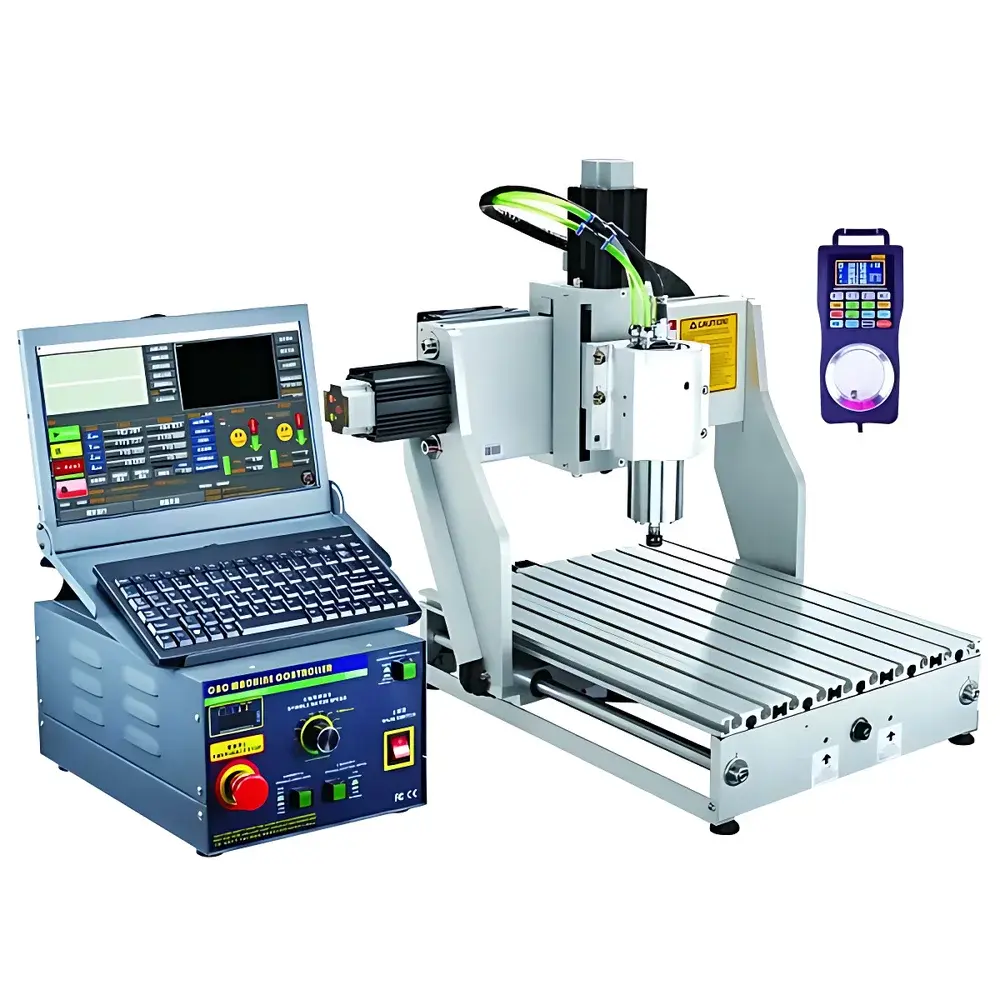
Hengyi HY(DK)TBUUI Computer-Controlled Specimen Preparation System for Metallic and Polymeric Materials
| Brand | Hengyi / Hengyitest |
|---|---|
| Origin | Shanghai, China |
| Manufacturer Type | Direct Manufacturer |
| Regional Category | Domestic (China) |
| Model | HY(DK)TBUUI |
| Quotation | Available Upon Request |
| Spindle Speed | 24,000 rpm |
| Feed Rate | 0–500 mm/min |
| Cutting Depth | 2–20 mm |
| Compatible Pipe Diameter | 50–250 mm |
| Max. Workpiece Length (Pipe/Sheet) | 260 mm |
| X-Axis Travel | 280 mm |
| Y-Axis Travel | 310 mm |
| Z-Axis Travel | 70 mm |
| Frame Material | Aluminum Alloy |
| Stepper Motor & Driver Sets | 3 |
| High-Speed Variable-Frequency Spindle Motor | 1 |
| Precision Linear Guide Rods | 6 |
| Precision Ball Screws | 3 |
| Standard Vise | 1 set |
| Specimen Dimensional Accuracy | Compliant with GB/T 1043, GB/T 1843, GB/T 1040, GB/T 8804.2, ISO 8004.2, and ISO 179 |
| Tooling Options | Cylindrical End Mills, 20° Flat-End Cutters, Slitting Blades, 45° Chamfer Cutters |
| Tool Diameters | Φ3 mm, Φ4 mm, Φ6 mm |
| Max. Machining Envelope | 300 mm × 150 mm × 100 mm |
| Power Supply | AC 220 V |
| Total Power Consumption | 1500 W |
| Net Weight | 45 kg |
Overview
The Hengyi HY(DK)TBUUI Computer-Controlled Specimen Preparation System is an industrial-grade CNC machining platform engineered specifically for the precise, repeatable fabrication of standardized test specimens from metallic, polymeric, composite, and thermoset materials. Unlike general-purpose milling equipment, this system integrates motion control, toolpath optimization, and metrological traceability to meet stringent requirements defined in international mechanical testing standards—including ASTM D638, ISO 527 (tensile), ISO 179/ISO 180 (impact), and ISO 14125 (flexural). Its core architecture employs a rigid aluminum alloy frame, high-resolution ball screw-driven linear axes (X/Y/Z), and a 24,000 rpm variable-frequency spindle—enabling consistent surface finish, dimensional repeatability, and edge integrity critical for accredited laboratory testing workflows. Designed for integration into QC/QA laboratories, national metrology institutes, and third-party certification bodies, the HY(DK)TBUUI ensures specimen geometry conforms to nominal tolerances specified in GB/T and ISO frameworks without manual intervention or post-machining calibration.
Key Features
- Three-axis CNC motion control with stepper motor-driven X (280 mm), Y (310 mm), and Z (70 mm) travel—optimized for batch processing of standardized dumbbell, notched Izod/Charpy, and flexural bar geometries.
- High-speed spindle (24,000 rpm) with integrated variable-frequency drive for stable torque delivery across cutting depths of 2–20 mm—minimizing thermal distortion in heat-sensitive polymers such as PVC, PP, and PMMA.
- Dedicated tooling library including Φ3 mm, Φ4 mm, and Φ6 mm cylindrical end mills; 20° flat-bottom cutters for tensile specimen shoulders; slitting blades for sectioning; and 45° chamfer tools for ISO 179 notch preparation.
- Modular vise system with adjustable clamping force and parallelism compensation—ensuring zero slippage during machining of round pipes (50–250 mm OD) and flat sheets up to 260 mm in length.
- Industrial-grade linear guidance via six precision-ground chrome-plated guide rods and preloaded ball screws—delivering positional repeatability better than ±0.02 mm over full axis travel.
- Embedded safety interlocks, emergency stop circuitry, and dust extraction interface compliant with IEC 60204-1 machinery safety directives.
Sample Compatibility & Compliance
The HY(DK)TBUUI accommodates diverse substrate forms: seamless and welded metal tubes, extruded polymer pipes (PVC-U, PE, PPR), fiber-reinforced composites, acrylic sheets, and glass-fiber laminates. It supports specimen types mandated by ISO 179-1 (notched impact bars), ISO 527-2 (Type 1A dumbbells), ISO 14125 (three-point bending specimens), and GB/T 8804.2 (polyethylene pipe tensile samples). All machined dimensions—including notch root radius (0.25 ± 0.05 mm per ISO 179), gauge length tolerance (±0.2 mm), and thickness consistency (±0.05 mm)—are validated against certified reference artifacts traceable to NIM (National Institute of Metrology, China) and NIST SRMs. The system’s output meets GLP documentation requirements when paired with audit-ready software logs (see Software & Data Management).
Software & Data Management
Control firmware operates on a real-time Linux-based embedded OS with G-code interpreter compliant with ISO 6983-1. Preloaded specimen templates include ISO 179, ISO 180, GB/T 1043, and ASTM D256 configurations—each parameterized for material-specific feed/speed combinations. All machining cycles are timestamped, user-ID logged, and exportable as CSV or XML for LIMS integration. Optional FDA 21 CFR Part 11-compliant module provides electronic signatures, audit trails, and role-based access control—supporting GMP-regulated environments such as medical device component validation labs.
Applications
- Preparation of notched Izod/Charpy specimens for impact energy evaluation per ISO 179 and ASTM D256.
- Fabrication of Type 1A dumbbell specimens for tensile property measurement (Young’s modulus, yield strength, elongation at break) per ISO 527 and GB/T 1040.
- Machining of rectangular flexural bars (ISO 14125) and compression cylinders (ISO 604) from thermoplastic and thermoset stock.
- Standardized sectioning of plastic pipes (e.g., HDPE gas distribution pipes) for ring tensile and hydrostatic pressure testing per ISO 1167.
- Production of calibration reference specimens for instrumented impact testers and universal testing machines.
FAQ
Does the HY(DK)TBUUI support automated tool change?
No—it uses manual tool presetting with dedicated collet chucks for each cutter type. Tool changes are performed during scheduled maintenance intervals to ensure runout < 0.01 mm.
Can it process stainless steel tubing?
Yes—when equipped with carbide-tipped cutters and reduced feed rates (≤200 mm/min); maximum recommended wall thickness is 8 mm for 304/316 grades.
Is ISO/IEC 17025 accreditation support available?
Yes—Hengyi provides a full metrological validation package including as-built drawings, axis linearity reports, spindle runout certificates, and traceable calibration records aligned with ILAC-MRA requirements.
What file formats does the controller accept?
Standard G-code (ISO 6983), DXF import for custom profiles, and native template files (.hysp) editable via included Windows configuration utility.
Is remote diagnostics supported?
Yes—the embedded controller features Ethernet port with Modbus TCP and optional VPN-enabled secure remote access for firmware updates and troubleshooting.



