
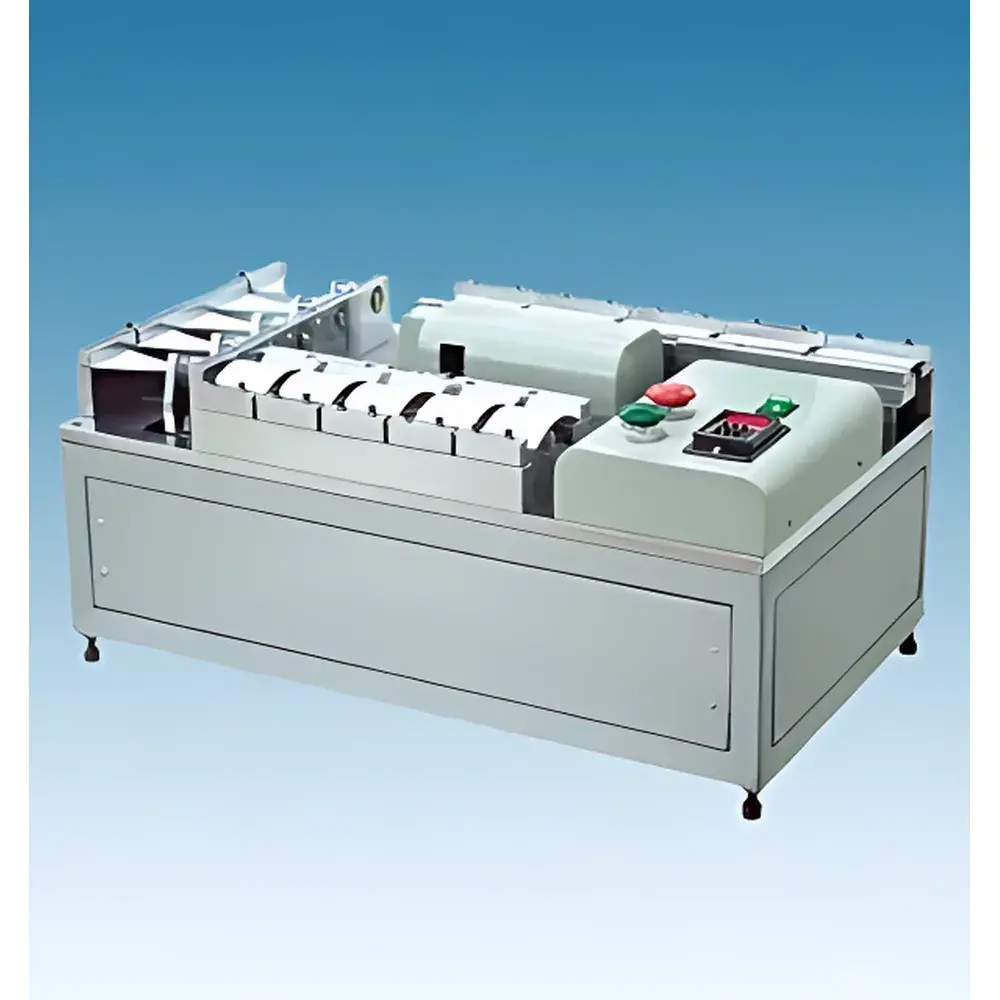
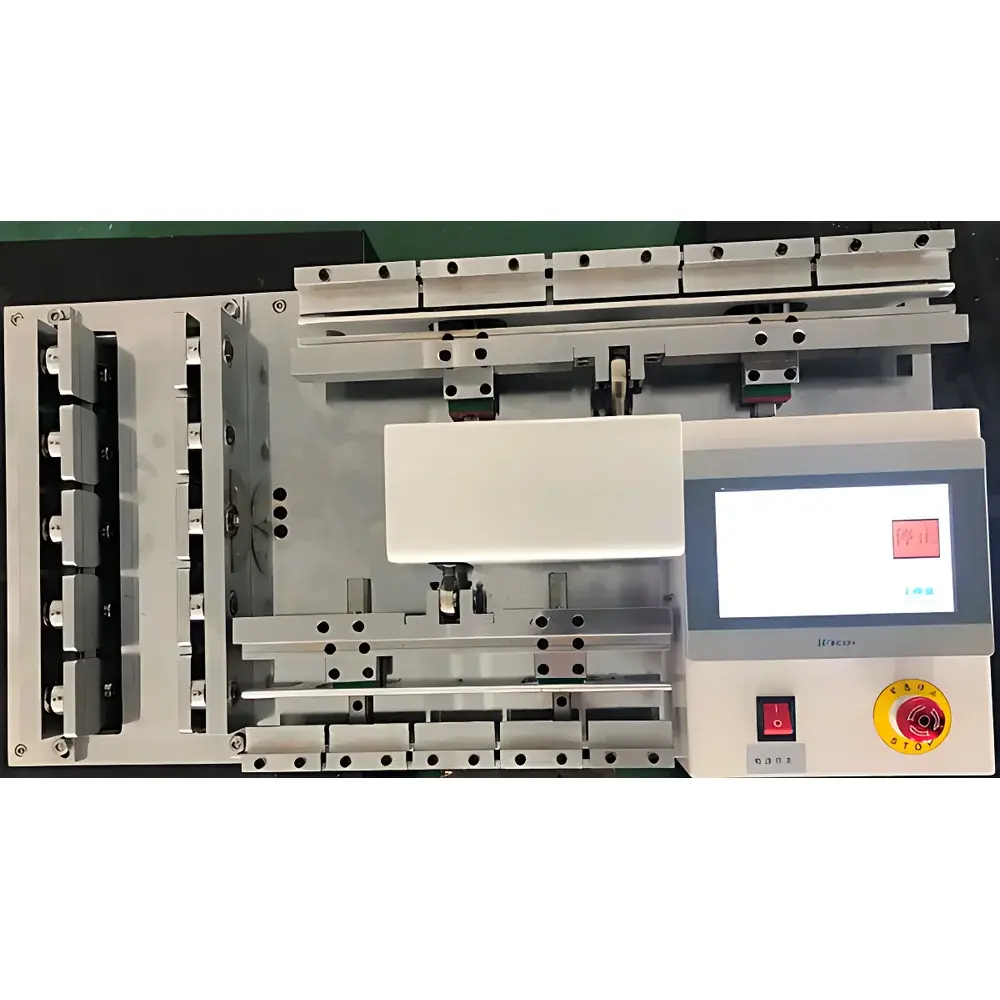
Hengyi HY(IC) Intelligent Dual Bending-Torsion Tester for Smart Cards
| Brand | Hengyi / Hengyitest |
|---|---|
| Origin | Shanghai, China |
| Manufacturer Type | Direct Manufacturer |
| Country of Origin | China |
| Model | HY(IC) JKKL |
| Pricing | Upon Request |
| Test Stations | 15 (5 long-edge bending, 5 short-edge bending, 5 torsion) |
| Cycle Count Range | 1–9999 |
| Counting Method | Non-contact photoelectric counting |
| Max Bending Displacement (long edge) | 20 mm (−1.0 mm tolerance) |
| Min Bending Displacement (long edge) | 2 mm ±0.5 mm |
| Max Bending Displacement (short edge) | 10 mm (−1.0 mm tolerance) |
| Min Bending Displacement (short edge) | 1 mm ±0.5 mm |
| Torsion Angle | ±15° ±1° (bidirectional, d = 86 mm |
| Test Speed | 30 rpm or 0.5 Hz (bending & torsion) |
| Dimensions (L×W×H) | 670 × 380 × 220 mm |
| Weight | 70 kg |
| Power Supply | AC 220 V ±5% |
| Power Consumption | 35 W |
| Compliance | GB/T 16649.1, GB/T 17554.1–2006, ISO/IEC 10373, ISO/IEC 7816–1998 |
Overview
The Hengyi HY(IC) Intelligent Dual Bending-Torsion Tester is a precision-engineered mechanical endurance testing system designed specifically for evaluating the structural integrity and fatigue resistance of contact and contactless smart cards under standardized dynamic loading conditions. Based on the fundamental principles of controlled cyclic mechanical deformation—comprising repetitive bending about orthogonal axes and torsional twisting about the card’s central longitudinal axis—the instrument replicates real-world handling stresses encountered during insertion, ejection, pocket carry, and manual flexing. Its architecture implements dual-actuation kinematics: independent servo-controlled motion profiles for long-edge bending, short-edge bending, and bidirectional torsion, each governed by traceable displacement and angular resolution. The system operates in strict alignment with internationally recognized test protocols—including ISO/IEC 7816–1998 (Identification cards — Integrated circuit(s) cards), ISO/IEC 10373 (Test methods for identification cards), GB/T 16649.1 (Integrated circuit cards — Part 1: Physical characteristics), and GB/T 17554.1–2006 (Identification cards — Test methods — Part 1: Mechanical characteristics)—ensuring metrological consistency across global certification laboratories and quality assurance departments.
Key Features
- Fifteen independent test stations: five dedicated to long-edge bending, five to short-edge bending, and five to torsional deformation—enabling concurrent multi-parameter evaluation without cross-interference.
- Non-contact photoelectric counting system with 9999-cycle capacity, eliminating mechanical switch wear and reducing mean time between failures (MTBF) to near-zero under continuous operation.
- Precision-adjustable displacement control: long-edge bending range 2–20 mm (±0.5 mm resolution); short-edge bending 1–10 mm (±0.5 mm); torsion angle ±15° ±1°, with symmetric reversal about the 86 mm diameter reference circle.
- STK AC variable-speed motor coupled with high-ratio gear reduction delivers stable 0.5 Hz (30 rpm) oscillation frequency—optimized for fatigue life assessment per ISO/IEC 10373-1 Annex D.
- Fixture geometry strictly conforms to ISO/IEC 7816–1 dimensional templates, ensuring repeatable clamping force distribution and minimizing edge slippage or localized stress concentration.
- Low-power design (35 W nominal) supports unattended overnight testing while maintaining thermal stability (<0.5 °C drift over 8 h).
Sample Compatibility & Compliance
The HY(IC) tester accommodates standard ID-1 format cards (85.6 × 53.98 × 0.76 mm) including magnetic stripe cards, contact-based IC cards (e.g., EMV-compliant payment cards), contactless RFID cards (13.56 MHz), and hybrid dual-interface cards. All test routines are fully traceable to clause-specific requirements in ISO/IEC 7816–1 (Clause 4.2: Bending test; Clause 4.3: Torsion test), ISO/IEC 10373–1 (Clause 6.2: Mechanical bending; Clause 6.3: Torsional strength), and national standards GB/T 16649.1 and GB/T 17554.1–2006. Fixture mounting dimensions, support span lengths, and actuator stroke profiles are calibrated against certified reference artifacts prior to shipment. The system supports GLP-compliant audit trails when integrated with external data loggers meeting IEC 61000-4-3 immunity specifications.
Software & Data Management
While the HY(IC) operates as a standalone electromechanical tester with front-panel digital cycle counter and manual start/stop controls, it is engineered for seamless integration into laboratory information management systems (LIMS). Analog voltage outputs (0–5 V DC) correspond linearly to real-time displacement and angular position signals, enabling synchronization with third-party DAQ hardware (e.g., National Instruments USB-6211). Cycle completion triggers TTL-level pulses for automated pass/fail flagging in statistical process control (SPC) workflows. All mechanical parameters—including total cycles, station-specific failure timestamps, and cumulative displacement deviation—are logged to non-volatile memory and exportable via USB-C interface in CSV format. For regulated environments, optional firmware upgrade supports 21 CFR Part 11–compliant electronic signatures and audit trail generation through companion PC software (sold separately).
Applications
- Pre-certification validation of smart cards prior to submission to accredited bodies (e.g., UL, Bureau Veritas, CCID Lab).
- Comparative fatigue analysis of substrate materials (PVC, PETG, polycarbonate) and embedded antenna geometries under repeated flexural stress.
- Process validation for lamination bonding strength in multi-layer card construction.
- Root cause analysis of delamination, chip detachment, or antenna fracture following accelerated life testing.
- Quality conformance screening in high-volume card personalization facilities operating under ISO 9001 or ISO/IEC 27001 frameworks.
- Research into mechanical reliability modeling of flexible electronics, particularly for NFC-enabled wearable credentials and transit fare cards.
FAQ
Does the HY(IC) comply with ISO/IEC 10373-1:2016 edition?
Yes—the mechanical actuation profiles, fixture tolerances, and counting methodology meet all normative requirements specified in Clauses 6.2 and 6.3 of ISO/IEC 10373-1:2016.
Can the tester accommodate cards thicker than 0.76 mm?
No—it is dimensionally constrained to ID-1 profile compliance; deviations beyond ±0.1 mm thickness require custom fixture adaptation (available upon engineering review).
Is calibration documentation provided with shipment?
Each unit ships with a factory calibration certificate referencing NIST-traceable displacement transducers and angular encoders, valid for 12 months from date of issue.
What maintenance intervals are recommended for the gear reduction system?
Lubrication-free operation is guaranteed for 10,000 cycles; biannual visual inspection of belt tension and encoder alignment is advised per maintenance log template included in the operator manual.
Is remote diagnostic support available?
Yes—Hengyi provides secure remote access capability via TeamViewer QuickSupport (ISO/IEC 27001-certified session protocol) for firmware updates and real-time parameter diagnostics.



