
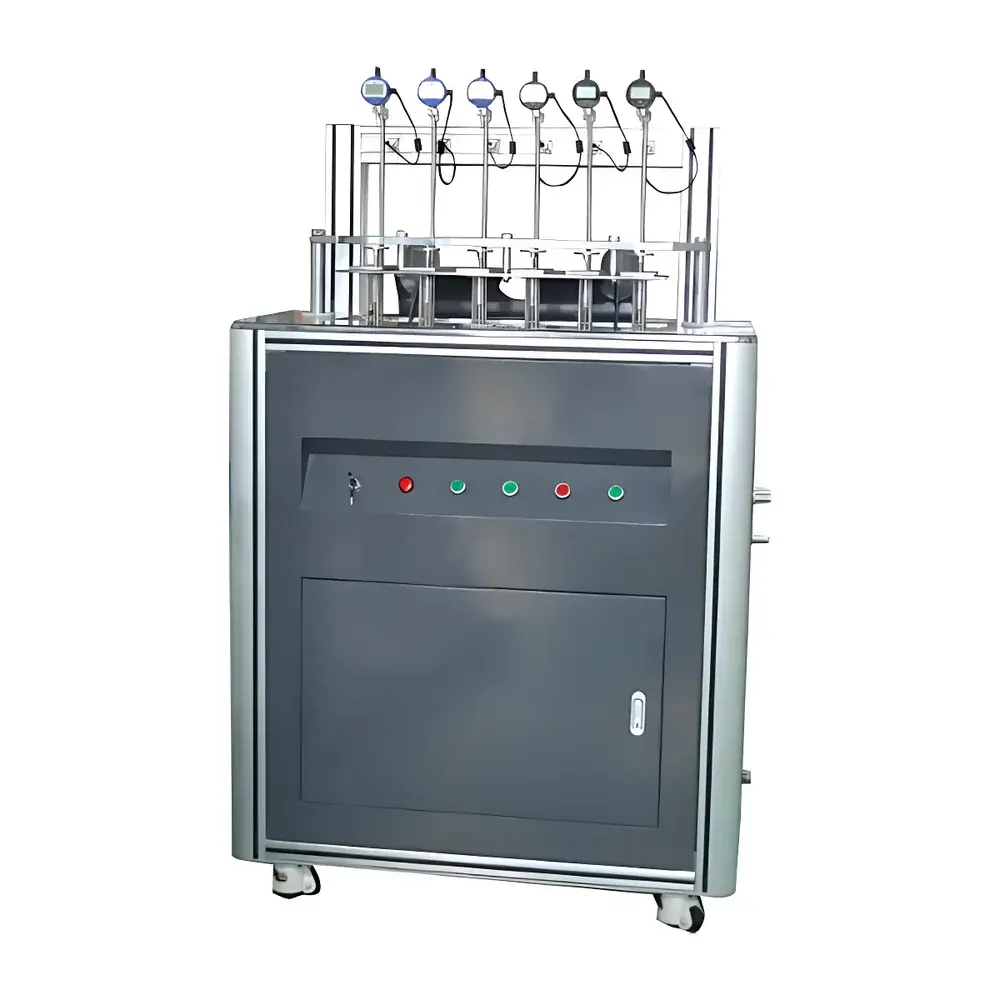
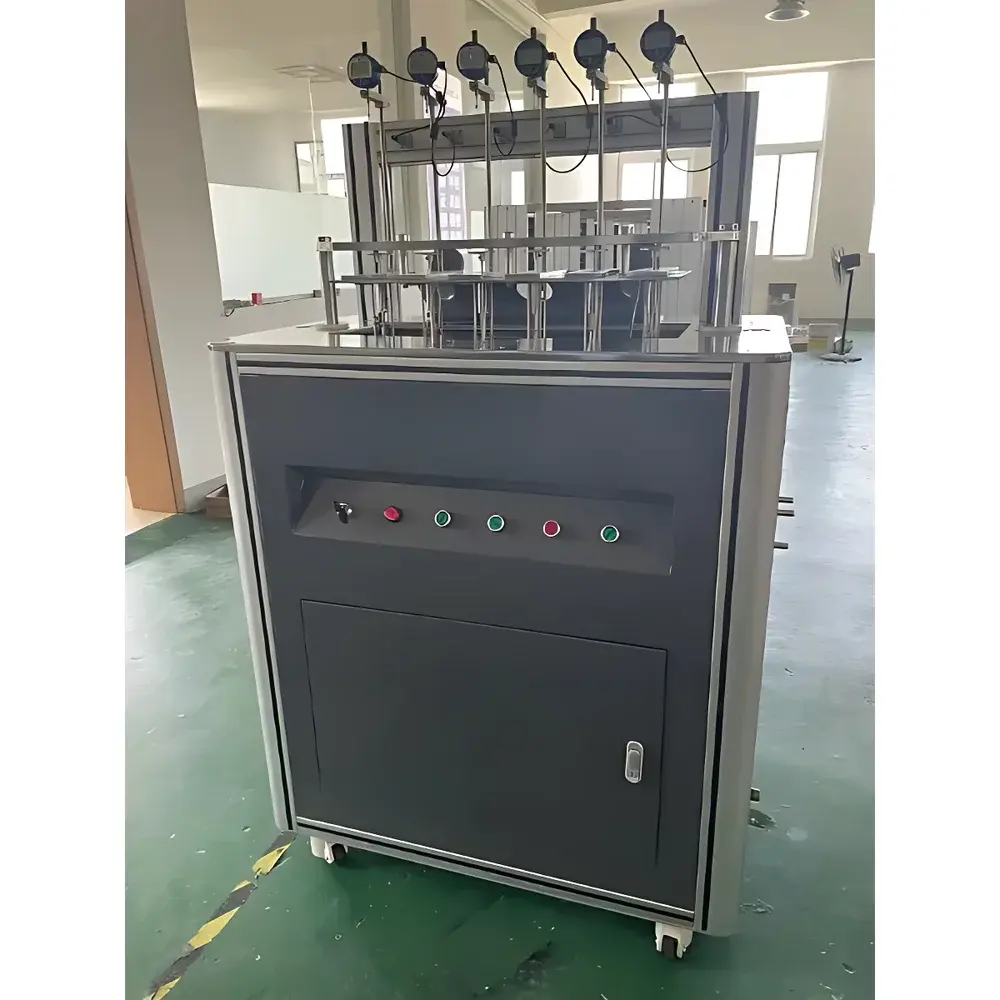
Hengyi HY(RW)-300HB Heat Deflection Temperature (HDT) and Vicat Softening Temperature (VST) Tester
| Brand | Hengyi |
|---|---|
| Origin | Shanghai, China |
| Manufacturer Type | Direct Manufacturer |
| Model | HY(RW)-300HB |
| Temperature Range | Ambient to 300 °C |
| Heating Rate Options | (120±10) °C/h, (12±1) °C/6 min, (50±5) °C/h, (5±0.5) °C/6 min |
| Temperature Accuracy | ±0.5 °C |
| Temperature Resolution | 0.1 °C |
| Deflection Measurement Range | 0–5 mm |
| Deflection Resolution | ±0.001 mm |
| Specimen Stations | 3 |
| Load Rod & Platter Mass | 68 g |
| Standard Weights | Included Set |
| Heat Transfer Medium | Methyl Silicone Oil (200 cSt) or Transformer Oil |
| Cooling Method | Natural cooling above 150 °C |
| Heating Power | 4 kW |
| Power Supply | 220 V, 50 Hz |
| Dimensions | 528 mm × 545 mm × 850 mm |
| Weight | 150 kg |
Overview
The Hengyi HY(RW)-300HB Heat Deflection Temperature (HDT) and Vicat Softening Temperature (VST) Tester is a precision thermal-mechanical testing instrument engineered for standardized evaluation of thermoplastic and thermosetting polymer behavior under controlled thermal load. It operates on two internationally recognized test principles: the heat deflection test (ASTM D648 / ISO 75) measures the temperature at which a standardized plastic specimen deforms under a specified flexural stress, while the Vicat softening test (ASTM D1525 / ISO 306) determines the temperature at which a flat-ended needle penetrates the material surface to a defined depth under constant load. Both methods rely on precise thermal ramping, high-stability mechanical loading, and real-time displacement monitoring—enabling quantitative assessment of dimensional stability, service temperature limits, and comparative thermal resistance across polymer grades.
Key Features
- Triple-specimen station design enables parallel testing of up to three samples per cycle, improving throughput without compromising inter-test repeatability.
- PLC-based temperature control system integrated with second-generation ARM Cortex-M3 microcontroller (120 MHz operation frequency), delivering deterministic real-time response, low-latency PID regulation, and robust thermal stability (±0.5 °C control accuracy).
- High-resolution displacement measurement via calibrated dial indicator module with ±0.001 mm resolution and 0–5 mm full-scale range, traceable to national metrological standards.
- Four programmable heating rate profiles—including (120±10) °C/h and (5±0.5) °C/6 min—to accommodate diverse standard requirements (e.g., ISO 75-2, ISO 306, GB/T 1633, GB/T 1634).
- Dual cooling strategy: passive natural convection above 150 °C; optional water-cooling circuit activation below 150 °C for accelerated thermal recovery between tests.
- Integrated thermal safety architecture with over-temperature cutoff, dry-run protection, and CRC-verified sensor communication to ensure operational integrity and data fidelity.
Sample Compatibility & Compliance
The HY(RW)-300HB supports rigid and semi-crystalline non-metallic materials including polypropylene (PP), polycarbonate (PC), polyamide (PA6/PA66), polyethylene terephthalate (PET), polyoxymethylene (POM), epoxy resins, and electrically insulating thermosets. Specimens conform to ISO 75 and ISO 306 dimensional tolerances (e.g., 80 mm × 10 mm × 4 mm for HDT; 10 mm × 10 mm × ∼3–5 mm for VST). The system complies with ISO 75-1:2013, ISO 75-2:2013, ISO 306:2013, ASTM D648–22, ASTM D1525–21, GB/T 1633–2020, GB/T 1634.2–2019, and GB/T 8802–2001. All calibration procedures follow traceable reference standards aligned with ISO/IEC 17025 requirements for testing laboratories.
Software & Data Management
The embedded controller logs temperature and deflection data at configurable intervals (default: 1 s) and transmits time-synchronized datasets to host PC software via RS-485 with CRC-protected protocol. The Windows-based application provides real-time graphical display of thermal ramp curves and deformation trajectories, automated endpoint detection per standard criteria (e.g., 0.34 mm deflection for HDT, 1 mm penetration for VST), and export functionality for CSV, PDF, and XML formats. Audit trails record operator ID, test parameters, calibration timestamps, and system events—supporting GLP/GMP-aligned documentation practices. Data files retain digital signatures and are compatible with LIMS integration via ODBC drivers.
Applications
- Quality assurance of injection-molded components in automotive interiors and under-hood applications.
- R&D screening of polymer blends and filled composites for elevated-temperature structural performance.
- Regulatory submission support for medical device housings (ISO 10993-12) and electrical insulation systems (IEC 60695-10-2).
- Supplier qualification testing against OEM material specifications requiring HDT/VST certification.
- Academic research on crystallinity–softening relationships in semi-crystalline thermoplastics.
- Failure analysis of thermally induced warpage in printed circuit board substrates and encapsulants.
FAQ
What standards does the HY(RW)-300HB fully support?
It meets ISO 75-1/2:2013, ISO 306:2013, ASTM D648–22, ASTM D1525–21, GB/T 1633–2020, GB/T 1634.2–2019, and GB/T 8802–2001.
Can the system operate with alternative heat transfer media?
Yes—methyl silicone oil (200 cSt) is recommended for full 300 °C range; transformer oil may be used up to ~180 °C, subject to flash point verification.
Is the displacement sensor calibrated and traceable?
Yes—the dial indicator module is factory-calibrated against NIST-traceable gauge blocks; annual recalibration is recommended per ISO/IEC 17025.
Does the system support 21 CFR Part 11 compliance?
The PC software includes user access controls, electronic signatures, and immutable audit logs—enabling configuration for FDA-regulated environments when deployed with validated IT infrastructure.
What maintenance is required for long-term thermal stability?
Routine checks include silicone oil level and clarity, heater element continuity, and load rod alignment; annual verification of temperature uniformity across bath volume is advised.



