
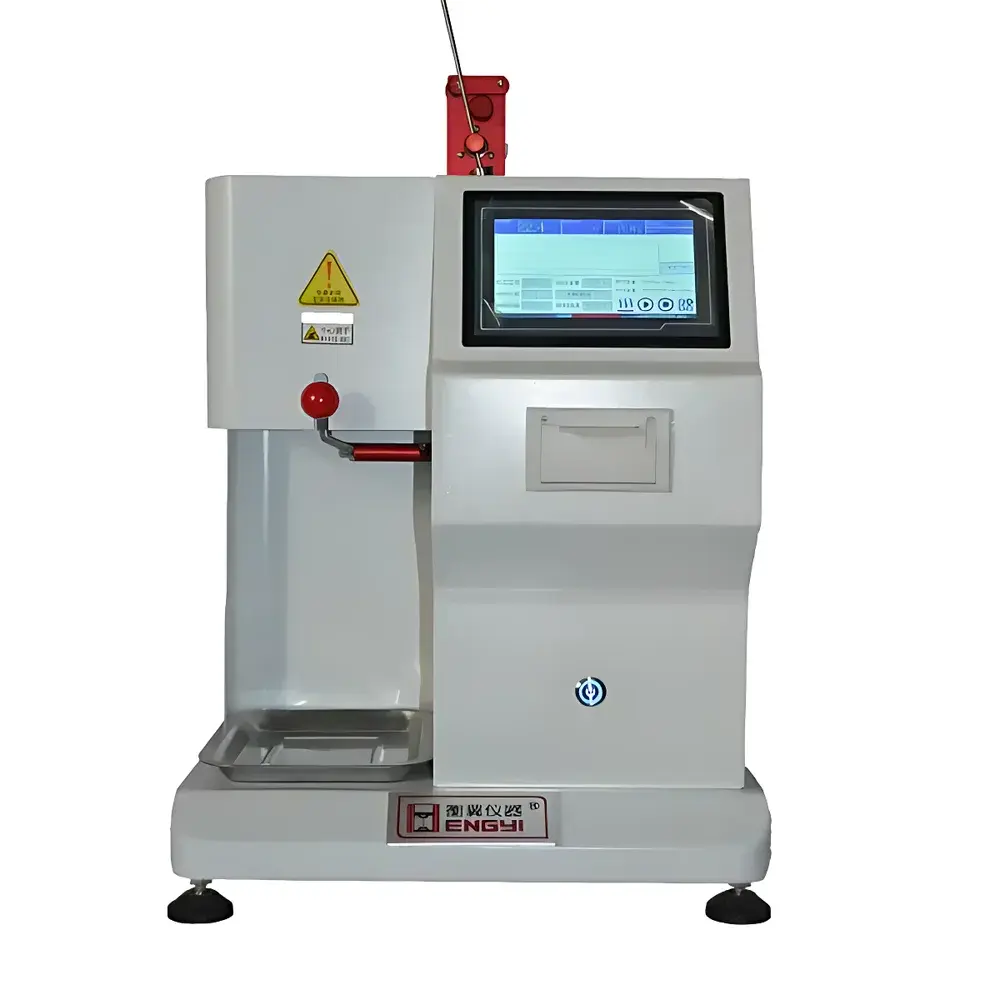
Hengyi HY(RZ) RGGH Automated Melt Flow Rate Tester
| Brand | Hengyi |
|---|---|
| Origin | Shanghai, China |
| Manufacturer Type | Manufacturer |
| Country of Origin | Domestic (China) |
| Model | HY(RZ) RGGH |
| Quotation | Upon Request |
| Standards Compliance | GB/T 3682–2018, JB/T 5456–2005 |
| Max Operating Temperature | ≥400 °C |
| Temperature Control Accuracy | ≤±0.2 °C |
| Temperature Stabilization Time (to max temp) | ≤30 min |
| Temperature Recovery Time (after loading) | 2–4 min |
| Timing Resolution | ≥0.1 s |
| Piston Displacement Resolution | ≥0.01 mm |
| Load Sets | 8 standard weights (0.325–21.600 kg |
| Die Dimensions | Ø2.095±0.005 mm × 8.000±0.025 mm |
| Barrel ID | Ø9.550±0.025 mm, L=152±0.1 mm |
| Piston Head | Ø9.475±0.015 mm × 6.350±0.100 mm |
| Test Methods | Mass Flow Rate (MFR) and Volume Flow Rate (MVR) |
| User Interface | Full-color PLC touchscreen |
| Safety | Thermal insulation & anti-scald protection for hot zones |
| Packaging/Transport | Compliant with GB/T 13384, GB/T 191, GB/T 6388 |
Overview
The Hengyi HY(RZ) RGGH Automated Melt Flow Rate Tester is an industrial-grade instrument engineered for precise, repeatable determination of melt flow rate (MFR) and melt volume rate (MVR) of thermoplastic polymers under standardized load and temperature conditions. Based on the principle of extrusion rheometry—where molten polymer is forced through a precisely dimensioned capillary die under controlled gravitational or applied load—the system quantifies flow behavior as a function of shear stress, temperature, and material viscosity. This method aligns with internationally recognized test protocols including ISO 1133-1 (equivalent to GB/T 3682–2018) and ASTM D1238, enabling direct comparability of results across global laboratories and production facilities. Designed for routine quality control in polymer manufacturing, compounding, and R&D, the HY(RZ) RGGH delivers traceable, operator-independent measurements essential for raw material acceptance, process validation, and regulatory documentation.
Key Features
- Automated dual-mode operation supporting both mass-based (MFR, g/10 min) and volume-based (MVR, cm³/10 min) calculations per ISO 1133-1 and GB/T 3682–2018.
- High-stability temperature control system with ±0.2 °C accuracy over a 40–400 °C operating range; achieves full-setpoint stabilization in ≤30 minutes and recovers thermal equilibrium within 2–4 minutes after sample loading.
- Eight calibrated weight sets (0.325–21.600 kg; corresponding to nominal forces from 3.187 N to 211.82 N), each traceable to national metrological standards and configured to meet ISO 1133 Annex A requirements.
- Precision-machined die assembly: capillary diameter Ø2.095 ±0.005 mm, length 8.000 ±0.025 mm; barrel internal diameter Ø9.550 ±0.025 mm, length 152 ±0.1 mm; piston head Ø9.475 ±0.015 mm, length 6.350 ±0.100 mm—all conforming to dimensional tolerances specified in ISO 1133-2.
- Full-color PLC-based human-machine interface (HMI) with intuitive touchscreen navigation for parameter setup, real-time temperature curve visualization, automatic cut-off timing, and immediate display of MFR/MVR results.
- Integrated safety architecture: all heated surfaces incorporate certified thermal insulation and anti-scald shielding; critical wear components—including die, barrel liner, and piston—are designed for rapid field replacement without specialized tools.
Sample Compatibility & Compliance
The HY(RZ) RGGH supports a broad spectrum of thermoplastic resins, including polyethylene (PE), polypropylene (PP), polystyrene (PS), polyoxymethylene (POM), acrylonitrile-butadiene-styrene (ABS), polycarbonate (PC), nylon (PA6, PA66), and fluoropolymers (e.g., PTFE, PVDF). Its mechanical and thermal design complies with JB/T 5456–2005 technical specifications for melt flow indexers and satisfies structural and performance criteria outlined in ISO/IEC 17025 for testing laboratory equipment validation. All calibration procedures follow documented metrological traceability paths to CNAS-accredited reference standards. The instrument’s construction and operational safeguards adhere to GB/T 13384 (packaging), GB/T 191 (handling symbols), and GB/T 6388 (transportation classification), ensuring robustness during international shipment and installation.
Software & Data Management
The embedded control software enables full test lifecycle management: pre-test parameter configuration (temperature setpoint, load selection, cut interval, dwell time), real-time monitoring of barrel temperature gradients, automated trigger-based sample cutting, and synchronized data logging of piston displacement, elapsed time, and mass/volume outputs. Results are timestamped and stored locally with optional USB export in CSV format for integration into LIMS or ERP systems. While not natively 21 CFR Part 11 compliant, the system supports GLP/GMP-aligned workflows through user-defined access controls, audit trail documentation (via external logging), and manual signature verification for report finalization. Firmware updates are delivered via secure offline channels to maintain system integrity in regulated environments.
Applications
- Quality assurance of incoming polymer pellets and regrind materials against supplier specifications and internal release criteria.
- Batch-to-batch consistency monitoring during extrusion, injection molding, and blow molding process development.
- Thermal degradation assessment via sequential MFR measurements at fixed intervals under isothermal conditions.
- Correlation studies between melt flow behavior and molecular weight distribution (MWD) for routine QC where GPC analysis is impractical.
- Validation of stabilizer package efficacy in high-temperature processing applications.
- Supporting technical documentation for ISO 9001, IATF 16949, and AS9100 audits through standardized, repeatable test records.
FAQ
What standards does the HY(RZ) RGGH comply with?
It conforms to GB/T 3682–2018 (identical to ISO 1133–1:2011), JB/T 5456–2005, and supports test execution per ASTM D1238 and ISO 1133–2 for die and barrel geometry verification.
Can the instrument perform both MFR and MVR tests without hardware modification?
Yes—dual-mode capability is fully integrated; switching between mass and volume calculation requires only software selection and appropriate calibration inputs.
Is the temperature recovery time verified per ISO 1133?
Yes; the ≤4-minute recovery window after loading meets the ISO 1133-1 requirement for thermal equilibration stability prior to extrusion initiation.
Are the weights certified and traceable?
All eight weight sets are factory-calibrated and supplied with traceable certificates aligned with national mass standards (e.g., NIM, China Metrology Institute).
What maintenance intervals are recommended for routine operation?
Die and barrel cleaning after each test series; full visual inspection of piston surface and die orifice every 50 cycles; annual recalibration of temperature sensor and timing circuit recommended per ISO/IEC 17025 guidelines.
Related Products



