
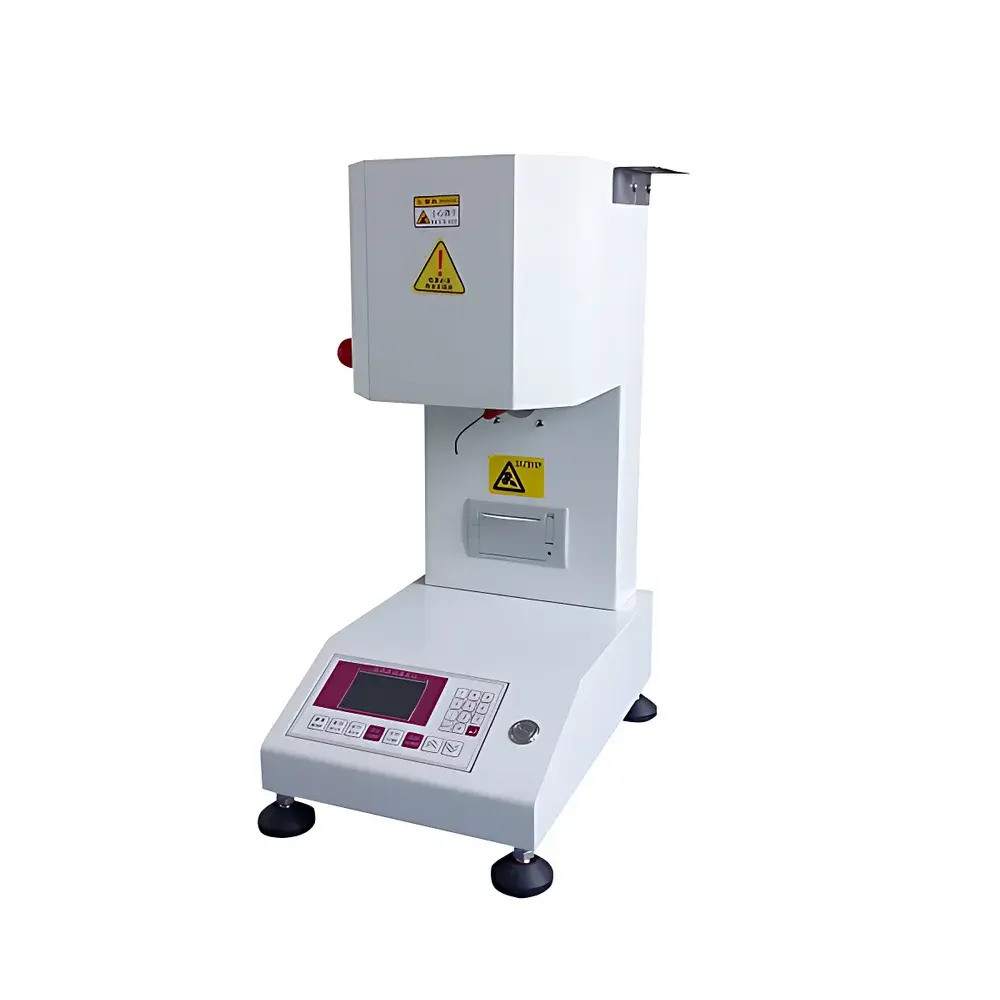
Hengyi HY(RZ) TYBJ Melt Flow Indexer
| Brand | Hengyi |
|---|---|
| Origin | Shanghai, China |
| Manufacturer Type | Manufacturer |
| Country of Origin | Domestic (China) |
| Model | HY(RZ) TYBJ |
| Quotation | Upon Request |
| Standard Compliance | GB/T 3682–2018, JB/T 5456–2005 |
| Max Operating Temperature | ≥400 °C |
| Temperature Control Accuracy | ≤±0.2 °C |
| Temperature Stabilization Time (to max temp) | ≤30 min |
| Temperature Recovery Time (after loading) | 2–4 min |
| Timing Resolution | ≥0.1 s |
| Piston Displacement Resolution | ≥0.01 mm |
| Load Sets | 8 standard weights (0.325–21.600 kg |
| Die Dimensions | Ø2.095±0.005 mm × 8.000±0.025 mm |
| Barrel Dimensions | Ø9.550±0.025 mm × 152.0±0.1 mm |
| Piston Head | Ø9.475±0.015 mm × 6.350±0.100 mm |
| Test Methods | Mass Flow Rate (MFR) and Volume Flow Rate (MVR) |
| Control Interface | Full-color PLC touchscreen |
| Data Output | Real-time temperature curve, MFR/MVR results, calibration logging |
| Packaging & Transport Compliance | GB/T 13384, GB/T 191, GB/T 6388 |
Overview
The Hengyi HY(RZ) TYBJ Melt Flow Indexer is a precision-engineered instrument designed for the standardized determination of melt mass flow rate (MFR) and melt volume flow rate (MVR) of thermoplastic polymers under controlled temperature and load conditions. It operates on the principle of extrusion rheometry—measuring the mass or volume of polymer melt extruded through a standardized capillary die under defined thermal and mechanical conditions. This method conforms to internationally recognized test protocols, including GB/T 3682–2018 (equivalent in scope to ISO 1133–1 and ASTM D1238) and JB/T 5456–2005, ensuring compatibility with quality assurance frameworks used across global polymer manufacturing, R&D laboratories, and regulatory-compliant production environments.
Key Features
- High-temperature capability up to 400 °C with ±0.2 °C thermal stability, enabling testing of high-melting-point engineering resins such as polyetheretherketone (PEEK), polyphenylene sulfide (PPS), and fluoropolymers.
- Dual-mode measurement: simultaneous support for both mass-based (MFR, g/10 min) and volume-based (MVR, cm³/10 min) calculations, facilitating material comparisons independent of density variations.
- Eight calibrated load configurations (0.325–21.600 kg; 3.187–211.82 N), covering the full spectrum of common test conditions specified in ISO 1133 and ASTM D1238, including low-load applications for ultra-high molecular weight polyethylene (UHMWPE).
- Automated cutting mechanism synchronized with real-time timer and piston displacement tracking, minimizing operator intervention and improving inter-laboratory reproducibility.
- Full-color PLC-based touchscreen interface with embedded control software for parameter setup, PID temperature regulation, automatic timing, calibration verification, and graphical display of temperature profiles and flow results.
- Thermally insulated hot-zone design with anti-scald shielding for all surfaces exceeding 60 °C, meeting occupational safety requirements per IEC 61000-6-2 and local industrial hygiene standards.
- Modular mechanical architecture: wear-prone components—including die, barrel, and piston head—are manufactured to strict dimensional tolerances (e.g., die: Ø2.095±0.005 mm × 8.000±0.025 mm; barrel: Ø9.550±0.025 mm × 152.0±0.1 mm) and supplied with documented replacement part numbers for traceable maintenance.
Sample Compatibility & Compliance
The HY(RZ) TYBJ supports a broad range of thermoplastic materials, including but not limited to polyethylene (PE), polypropylene (PP), polystyrene (PS), polyoxymethylene (POM), acrylonitrile-butadiene-styrene (ABS), polycarbonate (PC), nylon (PA6, PA66), and fluoropolymers (PTFE, PVDF). Its mechanical and thermal specifications align with the dimensional and metrological requirements of GB/T 3682–2018, which references ISO 1133–1:2011 and incorporates equivalency clauses for ASTM D1238–22. The system’s temperature recovery time (2–4 min post-loading) and stabilization performance (<30 min to 400 °C) meet the repeatability criteria outlined in ISO 1133 Annex B. All structural components comply with GB/T 13384 (packaging) and GB/T 191 / GB/T 6388 (transportation marking and handling), supporting international logistics and customs clearance.
Software & Data Management
The embedded control software provides full audit trail functionality, recording timestamped events—including temperature setpoint changes, load application, cut initiation, mass/volume entry, and calibration actions. While not certified for FDA 21 CFR Part 11 out-of-the-box, the system supports manual generation of CSV-exported reports compatible with LIMS integration and GLP/GMP documentation workflows. Calibration parameters (e.g., die constant, piston geometry, temperature sensor offset) are user-accessible and editable only via password-protected administrator mode. Real-time temperature curves and MFR/MVR trend plots are rendered directly on the touchscreen, with optional USB export for offline analysis. Firmware updates are delivered via secure SD card protocol, preserving configuration integrity across revisions.
Applications
- Quality control of incoming raw polymer pellets and regrind feedstock in extrusion and injection molding facilities.
- Routine batch release testing in compliance with internal specifications aligned with ISO 9001:2015 Clause 8.6.
- Research into thermal degradation kinetics—by comparing MFR shifts after multiple extrusion passes or controlled residence time experiments.
- Correlation studies between melt flow behavior and mechanical properties (e.g., tensile strength, impact resistance) during formulation development.
- Validation of process parameters for twin-screw compounding lines, where MFR serves as an indirect indicator of shear history and residence distribution.
- Supporting technical documentation for regulatory submissions involving polymer-based medical devices (per ISO 10993–12) or food-contact packaging (per EU Regulation No. 10/2011).
FAQ
Does the HY(RZ) TYBJ comply with ISO 1133 or ASTM D1238?
Yes—it implements the core physical geometry, thermal control, and load application requirements of both standards. While certified to GB/T 3682–2018, its die dimensions, barrel specifications, and temperature accuracy fall within the permissible ranges defined in ISO 1133–1:2011 and ASTM D1238–22.
Can the instrument be used for testing filled or reinforced polymers?
It is suitable for homogeneous thermoplastics. Highly abrasive filled compounds (e.g., >30 wt% glass fiber or mineral fillers) may accelerate die wear; users should monitor die bore geometry periodically using optical micrometry and replace dies per scheduled maintenance intervals.
Is external PC connectivity supported for data export?
The unit features a USB port for exporting test logs, temperature histories, and result summaries in CSV format. No Ethernet or RS-232 interface is included in the base configuration.
What maintenance is required to ensure long-term accuracy?
Recommended practices include quarterly verification of temperature sensor calibration using a NIST-traceable reference thermometer, annual dimensional inspection of the die and barrel with certified plug gauges, and biannual lubrication of the piston guide assembly with high-temperature ceramic grease.
Are spare parts and calibration tools available globally?
Hengyi maintains an authorized distributor network across APAC, EMEA, and LATAM regions. Critical spares—including dies, barrels, piston assemblies, and certified weight sets—are stocked by regional partners and shipped with material certification and dimensional inspection reports.



