
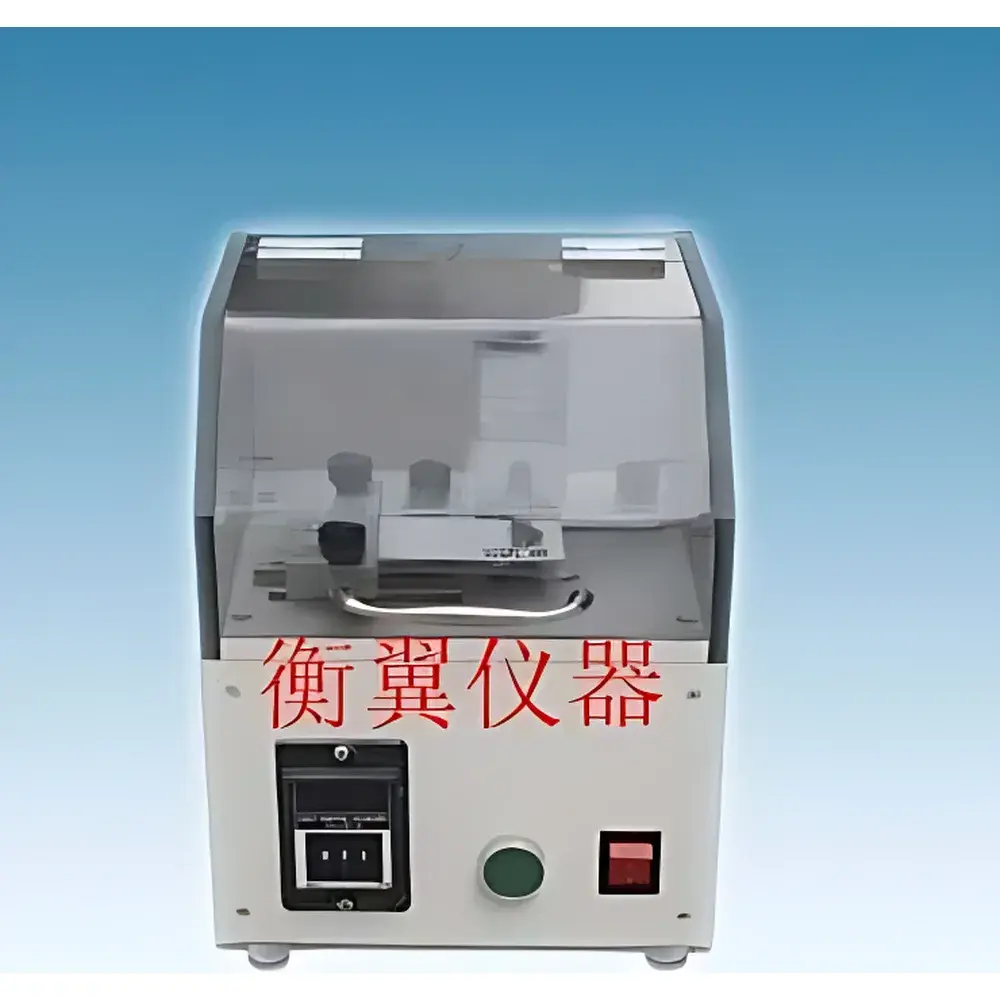
Hengyi HY(SL) YUHJ Smart Card Roller Compression Tester
| Brand | Hengyi / Hengyitest |
|---|---|
| Origin | Shanghai, China |
| Manufacturer Type | Direct Manufacturer |
| Country of Origin | China |
| Model | HY(SL)YUHJ |
| Power Supply | 110–220 V, 50/60 Hz |
| Compliance Standard | GB/T 17554.3–2006 |
| Reference Standards | ISO/IEC 7816-3 (ICC contact testing), CQM P-22, CQM 6.1.11–12.1.5.2 & 16.1.18.2, MCD4, Test Method 10.3.22 |
| Cycle Frequency | 0.5 Hz |
| Applied Load | 8 N (standard), optional 15 N weight supplied |
| Total Cycles | 100 (50 forward over chip front, 50 reverse over chip rear) |
| Test Mode | Bidirectional roller compression with controlled dwell and force application |
Overview
The Hengyi HY(SL)YUHJ Smart Card Roller Compression Tester is an electromechanical test system engineered for the standardized mechanical validation of integrated circuit (IC) contact cards—commonly referred to as ICCs or EMV-compliant smart cards. It implements a precisely controlled bidirectional roller compression protocol aligned with global industry specifications including ISO/IEC 7816-3, the Mastercard CQM (Contact Quality Monitoring) framework (P-22 and sections 6.1.11–12.1.5.2 and 16.1.18.2), and the MCD4 specification. The instrument subjects the card’s metallic contact zone to 100 total cycles of rolling compression at 0.5 Hz: 50 cycles with the roller traversing the front side of the embedded chip (i.e., toward the contact pad array), followed by 50 cycles over the rear side. A constant normal force of 8 N is applied during all cycles via calibrated pneumatic or spring-loaded actuation; a supplementary 15 N weight is included for extended CQM-recommended stress evaluation. Designed in accordance with GB/T 17554.3–2006—the Chinese national standard for identification cards’ mechanical endurance testing—the HY(SL)YUHJ ensures repeatable, traceable, and auditable execution of contact interface durability assessment under laboratory or QC production-line conditions.
Key Features
- Programmable dual-phase roller motion: independent control of forward (chip front) and reverse (chip rear) compression sequences, each configurable for exact cycle count (default: 50 per phase)
- Force-controlled loading mechanism: maintains stable 8 N compressive load across full stroke; optional 15 N mass provided for higher-stress CQM compliance verification
- Fixed-frequency drive: precision stepper-motor-driven roller assembly operating at 0.5 Hz ±0.02 Hz, synchronized with real-time position feedback
- Modular test bed: accommodates standard ID-1 format cards (85.6 × 53.98 mm) with adjustable card holder to ensure consistent lateral alignment and minimal skew
- Robust industrial enclosure: powder-coated steel frame with transparent polycarbonate safety shield, CE-compliant electrical architecture, and EMI-suppressed motor control
- Manual and semi-automated operation modes: enables operator-initiated start/stop and emergency halt with physical push-button and optical sensor interlock
Sample Compatibility & Compliance
The HY(SL)YUHJ is validated for use with ISO/IEC 7816-1/2/3 compliant contact smart cards—including banking cards, SIM cards, government ID cards, and transit fare media—regardless of substrate (PVC, PETG, or polycarbonate) or chip embedding method (laminate, pocket, or direct bonding). It does not support contactless (RFID/NFC) or dual-interface cards unless operated in contact-only mode with antenna shielding. All test procedures conform to GB/T 17554.3–2006 Clause 6 (mechanical strength of contact areas) and are cross-referenced to internationally accepted protocols: CQM P-22 Section 4.2 (roller compression acceptance criteria), ISO/IEC 7816-3 Annex B (contact resistance stability post-mechanical stress), and USP guidance for functional reliability of electronic medical device interfaces where applicable. The system supports GLP-aligned documentation when paired with external lab notebooks or LIMS-integrated reporting workflows.
Software & Data Management
The HY(SL)YUHJ operates in standalone mode without embedded firmware or proprietary software—ensuring long-term operational continuity and eliminating licensing dependencies. Cycle count, elapsed time, and actuation status are displayed on a high-contrast LED panel with non-volatile memory retention. For traceability, users may log test parameters (load value, cycle distribution, date/time, operator ID) manually into QA forms compliant with ISO 9001:2015 Clause 8.5.2 (identification and traceability) or FDA 21 CFR Part 11 (when used in regulated medical device manufacturing environments). Optional RS-232 or USB-to-serial interface modules (sold separately) enable integration with custom Python- or LabVIEW-based data acquisition scripts for automated pass/fail flagging based on external electrical continuity measurements.
Applications
- Pre-release mechanical qualification of ICCs prior to personalization and issuance
- Root-cause analysis of contact failure modes in field-return investigations
- Supplier audit testing for Tier-1 card manufacturers verifying subcontractor process capability
- Validation of adhesive bond strength between chip module and card substrate under cyclic shear loading
- Comparative benchmarking of contact metallization systems (e.g., Au vs. NiPdAu plating) under standardized mechanical stress
- Supporting ISO/IEC 17025-accredited testing laboratories performing accredited mechanical endurance assessments per CNAS-CL01
FAQ
Does the HY(SL)YUHJ comply with Mastercard CQM requirements for roller compression?
Yes—it implements the exact sequence, force (8 N), frequency (0.5 Hz), and cycle distribution (50 front + 50 rear) specified in CQM P-22 and CQM 6.1.11–12.1.5.2. The included 15 N weight satisfies CQM’s optional high-load verification clause.
Can the instrument test cards with embossed characters or magnetic stripes?
Yes—provided the embossing height does not exceed 0.15 mm and the stripe remains outside the defined roller path (±2 mm from centerline of contact area), mechanical interference is avoided. Stripe integrity is not assessed by this system.
Is calibration certification available?
Hengyi provides factory calibration verification against NIST-traceable force and timing standards. Full ISO/IEC 17025 calibration services are available through authorized third-party metrology labs upon request.
What maintenance is required?
Biannual inspection of roller surface finish (Ra ≤ 0.4 µm), lubrication of linear guide rails with ISO VG 32 synthetic oil, and verification of load-cell zero offset using certified deadweight standards.
Is the test fixture compatible with automated handling systems?
The base plate includes four M4 threaded mounting holes (ISO metric thread, 20 mm pitch) for integration into pick-and-place or robotic end-of-arm tooling; custom adapter plates are available on request.



