
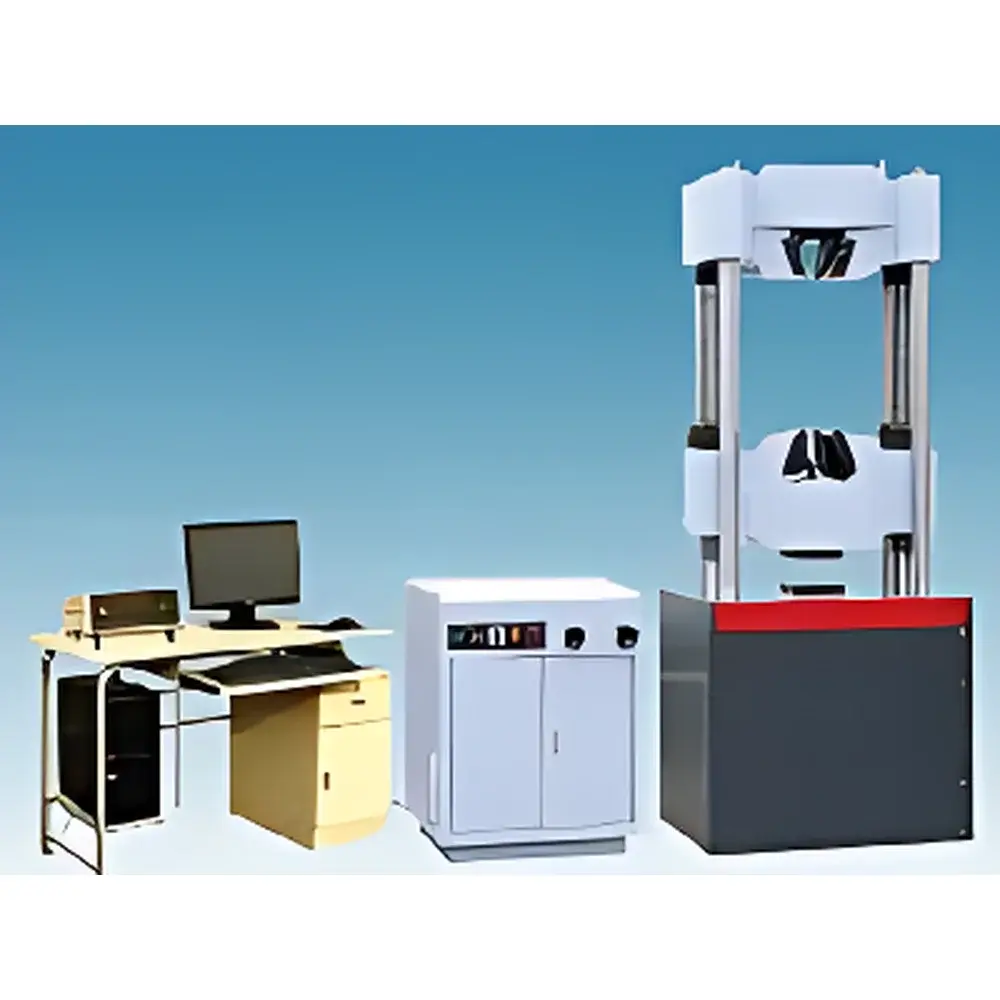
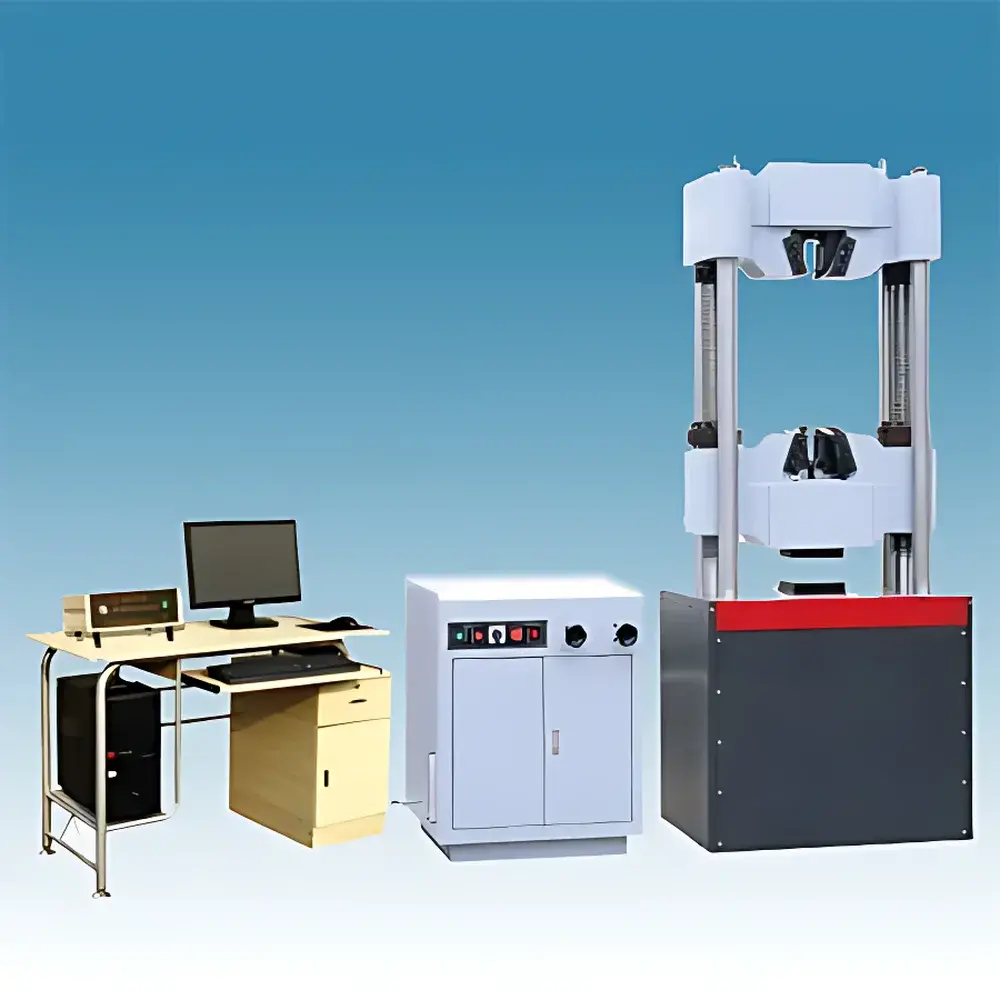
Hengyi HY(WE)100060-1000KN Microcomputer-Controlled Electro-Hydraulic Servo Universal Testing Machine
| Brand | Hengyi |
|---|---|
| Origin | Shanghai, China |
| Manufacturer Type | Direct Manufacturer |
| Equipment Type | Hydraulic Tensile Testing Machine |
| Model | HY(WE)100060-1000KN |
| Load Capacity | 0–1000 kN |
| Force Accuracy | ±1% of reading |
| Force Resolution | ≤0.5% of full scale |
| Compression Space | 600 mm |
| Tensile Space | 600 mm |
| Round Specimen Grip Range | Φ20–60 mm |
| Flat Specimen Grip Range | 0–40 mm |
| Piston Stroke | 150 mm |
| Maximum Bend Span | 100–600 mm |
| Shear Specimen Diameter | Φ10 mm |
| Deformation Accuracy | ±0.5% of reading |
| Displacement Accuracy | ±0.5% of reading |
| Stress Rate Control Range | 1–60 N/mm²/s |
| Strain Rate Control Range | 0.00025–0.0025 s⁻¹ |
| Closed-Loop Control Accuracy (Force/Displacement/Deformation) | ±1% of setpoint |
| Dimensions (W×D×H) | 880 × 580 × 2260 mm |
| Motor Power | 1.5 kW, 3-phase |
| Weight | 3500 kg |
Overview
The Hengyi HY(WE)100060-1000KN is a microcomputer-controlled electro-hydraulic servo universal testing machine engineered for high-precision mechanical property evaluation of metallic and non-metallic materials under static loading conditions. It operates on the principle of hydraulic force generation combined with real-time digital closed-loop control, enabling accurate application and regulation of tensile, compressive, flexural, and shear loads in accordance with standardized test protocols. Designed for structural integrity verification and material qualification in R&D laboratories, quality control departments, and third-party certification facilities, this system meets the functional and metrological requirements of ISO 6892-1, ASTM E4, ASTM E8/E8M, and GB/T 228.1–2021 for metallic tensile testing. Its oil-cylinder-underneath configuration provides an adjustable test zone optimized for specimen handling and multi-axis fixture integration, while the rigid frame architecture ensures minimal deflection and high reproducibility across repeated load cycles.
Key Features
- Electro-hydraulic servo actuation with high-stability pressure regulation and low-hysteresis response for consistent load fidelity
- Digital closed-loop control system supporting simultaneous or independent regulation of force, displacement, and strain at user-defined rates
- Imported high-accuracy load cell (±1% FS) and linear variable differential transformer (LVDT)-based displacement sensor (±0.5% FS)
- Adjustable test space: 600 mm vertical clearance for both tension and compression, accommodating specimens up to 600 mm in length
- Multi-purpose gripping system: Hydraulic wedge-type clamps for round specimens (Φ20–60 mm), flat specimens (up to 40 mm thick), and dedicated fixtures for bending (span adjustable 100–600 mm) and shear (Φ10 mm)
- Integrated safety interlocks including overload protection, emergency stop circuitry, and software-based upper/lower limit enforcement
- Real-time data acquisition at ≥1 kHz sampling rate, synchronized with dynamic curve plotting and event-triggered logging
Sample Compatibility & Compliance
This universal testing machine accommodates a broad spectrum of standardized and custom specimens, including but not limited to hot-rolled and cold-drawn high-carbon steel wires (e.g., ASTM A586, ISO 15630-3), structural steel bars, welded joints, cast iron coupons, concrete cylinders, and cementitious composites. Fixture geometry and alignment conform to ISO 6892-1 Annex B (tensile axis alignment tolerance ≤0.2°) and ASTM E1012 (load train verification). The system supports full traceability per ISO/IEC 17025:2017 requirements and enables audit-ready reporting compliant with GLP and GMP documentation standards. All calibration procedures follow ISO 7500-1 Class 1 verification criteria, with certificate-of-calibration traceable to national metrology institutes.
Software & Data Management
The proprietary Hengyi Metal Testing Software (English-localized version available upon request) delivers comprehensive test lifecycle management. It supports automated test method templates aligned with GB/T 228.1, GB/T 232, GB/T 5224, ASTM E8, and ISO 6892-1. Features include real-time stress–strain curve overlay, yield point detection via 0.2% offset and automatic plateau methods, modulus calculation using linear regression over user-specified strain ranges, and post-test data annotation with metadata tagging (operator ID, environmental conditions, specimen ID). Export formats include CSV, XML, PDF, and image (PNG/SVG). Data integrity is maintained through role-based access control, electronic signatures, and 21 CFR Part 11–compliant audit trails—including timestamped records of parameter changes, manual interventions, and report generation events.
Applications
- Tensile characterization of high-carbon steel wire (e.g., piano wire, tire cord, spring steel) including ultimate tensile strength (UTS), yield strength (Rp0.2), elongation at break, and reduction in area
- Compression testing of ductile and brittle metallic components per ASTM E9
- Three-point and four-point bending evaluation of rods, plates, and welded assemblies in accordance with ISO 7438 and ASTM E290
- Shear strength determination of riveted or bolted joints using standardized Φ10 mm shear specimens
- Creep and relaxation studies under constant load via extended-duration hold functionality
- Validation of heat treatment efficacy and cold-drawing process consistency in wire manufacturing QA/QC workflows
FAQ
What standards does this machine support for high-carbon steel wire testing?
It fully complies with GB/T 228.1–2021, ISO 6892-1:2019, and ASTM A586 for tensile testing of high-carbon steel wire, including requirements for grip design, strain measurement, and result reporting.
Can the system perform strain-controlled cyclic tests?
No — this model is configured for static monotonic and ramp-hold testing only; it does not support dynamic or fatigue testing modes.
Is third-party calibration certification included with delivery?
Yes — each unit ships with a factory calibration certificate traceable to CNAS-accredited standards; optional ISO/IEC 17025 calibration services are available upon installation.
What operating system is required for the control software?
Windows 10 Pro (64-bit) or Windows 11 Pro (64-bit); legacy support for Windows 7 SP1 is discontinued as of firmware v3.2.1.
How is mechanical alignment verified during routine maintenance?
Alignment verification follows ISO 6892-1 Annex B using certified optical alignment tools and load train deflection checks at 10%, 50%, and 100% of full-scale capacity.



