
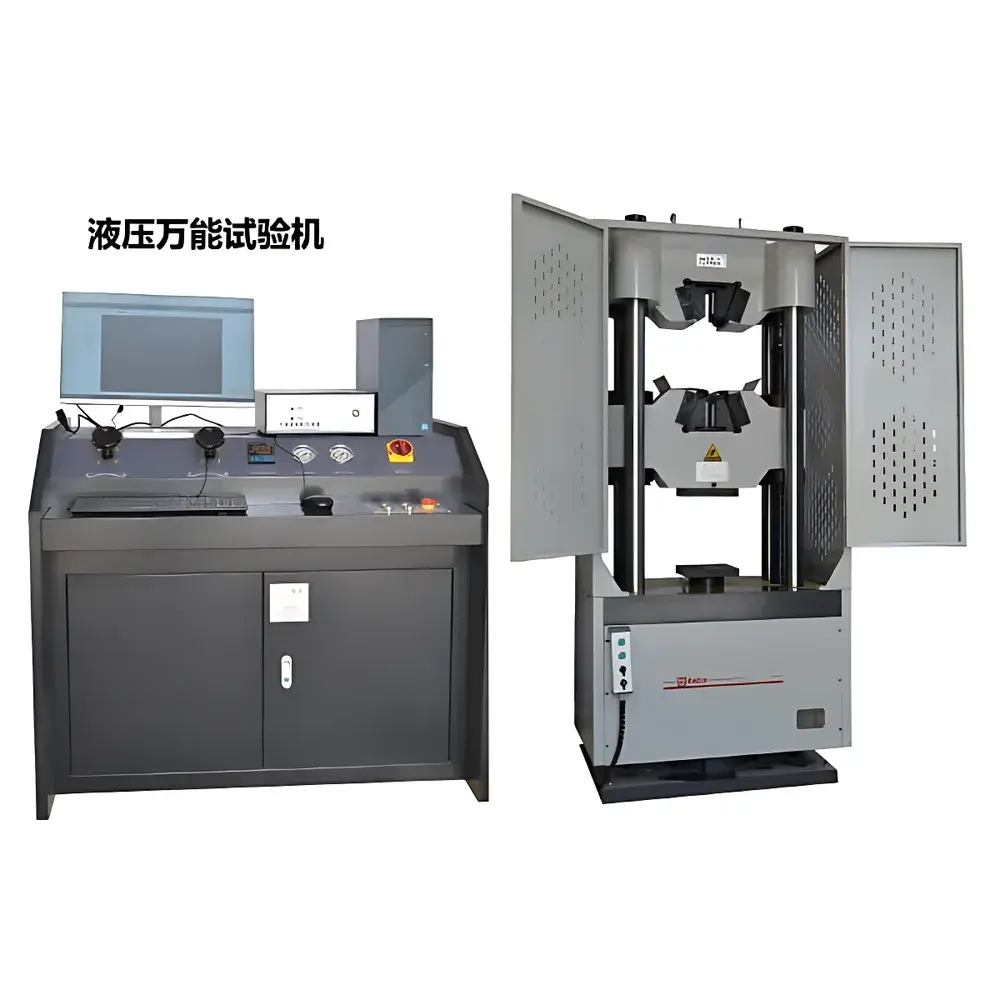
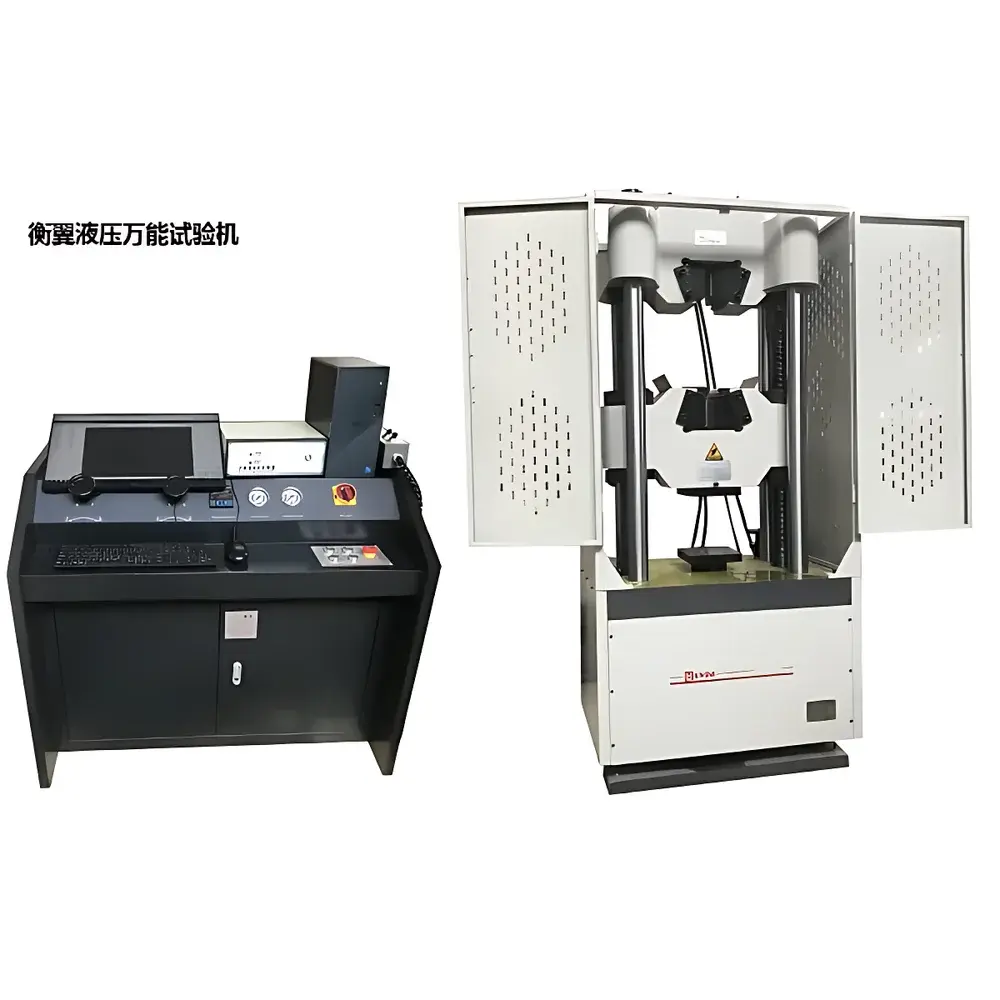
Hengyi HY(WE)30060444 Hydraulic Universal Testing Machine
| Brand | Hengyi |
|---|---|
| Origin | Shanghai, China |
| Manufacturer Type | Direct Manufacturer |
| Equipment Type | Hydraulic Universal Testing Machine |
| Model | HY(WE)30060444 |
| Load Capacity | 300 N – 300 kN |
| Load Accuracy | ±0.5% |
| Force Measurement Range | 4–100% of Full Scale |
| Force Indication Error | ±1% of reading |
| Speed Accuracy | ±5% of set value |
| Max. Distance Between Compression Platens | 600 mm |
| Max. Distance Between Tensile Jaws | 600 mm |
| Bend Support Span Adjustment Range | 30–460 mm |
| Round Specimen Clamping Diameter | 10–32 mm |
| Flat Specimen Clamping Thickness | 0–20 mm |
| Flat Specimen Clamping Width | ≤60 mm |
| Shear Specimen Diameter | 0–10 mm |
| Effective Column Spacing | 435 mm |
| Piston Stroke | 200 mm |
| Motor Power | 2 kW |
| Mainframe Dimensions (W×D×H) | 740 × 460 × 1965 mm |
| Control Cabinet Dimensions (W×D×H) | 1080 × 650 × 1200 mm |
| Approx. Weight | 1700 kg |
Overview
The Hengyi HY(WE)30060444 Hydraulic Universal Testing Machine is a robust, load-frame-based mechanical testing system engineered for high-force static mechanical characterization of metallic and non-metallic materials in accordance with internationally recognized standards—including GB/T 228.1–2021 (equivalent to ISO 6892-1), ASTM E8/E8M, and EN 10002-1. Utilizing a servo-controlled hydraulic actuation system, this machine delivers stable, high-fidelity force application across tension, compression, bending, and shear loading modes. Its dual-column rigid frame architecture ensures minimal deflection under maximum rated load (300 kN), supporting consistent alignment and long-term repeatability in structural and quality assurance laboratories. The system operates via manual hydraulic valve control with real-time force and displacement data acquisition through an integrated PC-based interface—designed for environments where deterministic control, traceable calibration, and compliance-ready documentation are required.
Key Features
- Hydraulic actuation with dual-cylinder configuration for balanced load distribution and reduced eccentricity during high-force testing
- Manual proportional pressure control with fine-tuned flow regulation, enabling precise strain-rate management per ASTM E2309 guidelines
- High-rigidity cast-iron base and hardened steel columns ensure dimensional stability over extended operational cycles
- Interchangeable grip systems: wedge-action tensile jaws (10–32 mm round / 0–20 mm flat), compression platens (150 mm diameter), and three-point bend fixtures with adjustable support spans (30–460 mm)
- Dual-range load cell with automatic range switching between 4% and 100% of full scale (300 kN), maintaining ±0.5% load accuracy across the entire measurement envelope
- Integrated displacement measurement via piston-mounted linear variable differential transformer (LVDT), calibrated to ±0.5% of reading
- Oil temperature stabilization circuit and filtration system minimize viscosity drift and extend hydraulic fluid service life
Sample Compatibility & Compliance
This testing machine accommodates standardized specimens per ISO 6892-1 (tensile bars), ISO 7438 (bend), ISO 3785 (compression cylinders), and ASTM D695 (rigid plastics). It supports round, flat, and tubular geometries up to 32 mm diameter or 20 mm thickness, as well as shear punch specimens up to 10 mm diameter. All mechanical components comply with CE machinery directive (2006/42/EC) safety requirements. Calibration procedures follow ISO/IEC 17025:2017 principles, and force verification is traceable to national metrology institutes via accredited third-party certificates. The system meets functional requirements for GLP-compliant material qualification workflows and supports audit-ready documentation when paired with validated data acquisition software.
Software & Data Management
Data acquisition is performed using Hengyi’s proprietary Windows-based software suite, compatible with Windows 10/11 (64-bit). The software enables real-time plotting of stress–strain, load–displacement, and time-based curves; automatic yield point detection (0.2% offset method); and export of raw channel data in CSV and XML formats. All test parameters—including operator ID, sample ID, environmental notes, and calibration timestamps—are embedded in metadata. Audit trail functionality logs user actions, parameter changes, and report generation events—supporting basic 21 CFR Part 11 readiness when deployed on domain-joined, password-protected lab networks. Raw data files are digitally signed and stored with SHA-256 checksums to ensure integrity and prevent post-test modification.
Applications
- Mechanical property validation of structural steels, aluminum alloys, titanium grades, and high-strength composites per aerospace (AMS, NADCAP) and automotive (VDA 268) specifications
- Quality control of welded joints, castings, and forged components in heavy equipment manufacturing
- Compression testing of concrete cylinders, ceramic tiles, and polymer foams under controlled displacement rates
- Bending modulus and fracture toughness evaluation of laminated composites and fiber-reinforced polymers
- Shear strength assessment of adhesives, riveted assemblies, and fastener interfaces in assembly line QA
- Calibration reference use for secondary force standards in metrology labs operating under ISO/IEC 17025 scope
FAQ
What standards does this machine comply with for tensile testing?
It conforms to GB/T 228.1–2021, ISO 6892-1:2019, ASTM E8/E8M, and EN ISO 6892-1, including requirements for extensometer integration, strain rate control, and yield strength determination.
Is the system suitable for cyclic or fatigue testing?
No—this is a static-load-only hydraulic universal tester. It is not equipped with servo-hydraulic controllers or waveform generation capability required for dynamic or low-cycle fatigue applications.
Can third-party software such as Bluehill or TestXpert be used?
The machine outputs analog ±10 V signals for force and displacement; however, native driver support is limited to Hengyi’s software. Custom DAQ integration is possible via NI LabVIEW or MATLAB with appropriate signal conditioning and scaling configuration.
What maintenance intervals are recommended for hydraulic oil and filters?
Hengyi recommends oil analysis every 1,000 operating hours or annually—whichever occurs first—with full replacement and filter change if viscosity deviation exceeds ±10% or particle count exceeds ISO 4406 class 18/16/13.
Does the system include calibration certification?
Yes—a factory-issued calibration certificate traceable to CNAS-accredited standards is provided at shipment, covering force (300 kN), displacement (200 mm), and speed (0.01–100 mm/min) channels.
Related Products



