
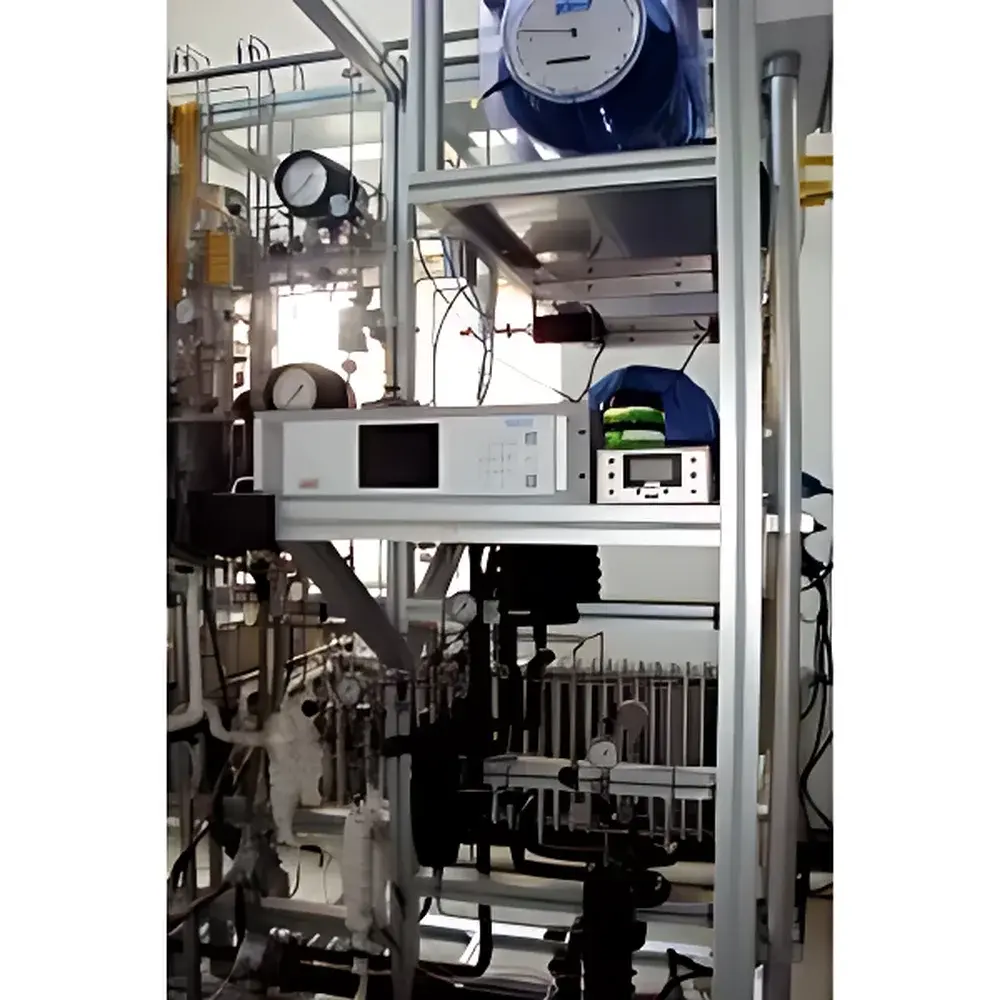
Henven 2HJ Dual-Mode Hydrogenation Catalyst Evaluation System
| Brand | Henven |
|---|---|
| Origin | Beijing, China |
| Manufacturer Type | Direct Manufacturer |
| Model | 2HJ |
| Reactor Configuration | Dual independent reactors (configurable in series/parallel) |
| Temperature Range | 350–500 °C |
| Linear Ramp Rate | 0.1–40 °C/min |
| Isothermal Stability | ±0.1 °C |
| Operating Pressure | 2.5–10 MPa |
| Gas Flow Range | 0–20 L/min |
| Gas Flow Accuracy | ±0.1% FS |
| Liquid Flow Range | 0–20 mL/min |
| Liquid Flow Accuracy | ±0.1 mL/min |
| Level Measurement Accuracy | ±2 mm |
| Catalyst Bed Volume | 0–100 mL (customizable) |
Overview
The Henven 2HJ Dual-Mode Hydrogenation Catalyst Evaluation System is an engineered bench-scale platform designed for rigorous kinetic, selectivity, and stability assessment of heterogeneous catalysts under high-pressure hydrogenation conditions. Built upon Couette-type fixed-bed reactor architecture with dual independent reaction zones, the system supports three operational configurations—standalone, series, and parallel—enabling comparative studies of catalyst aging, intermediate product inhibition, or staged conversion pathways. Its core measurement principle relies on real-time, synchronized acquisition of thermodynamic (temperature gradients across catalyst bed), hydrodynamic (mass flow rates of H₂ and liquid feed), and mechanical (pressure differentials, liquid level dynamics) parameters to reconstruct reaction progress and mass balance. The system is explicitly calibrated for coal-derived liquids and light diesel fractions, meeting ASTM D7213 and ISO 18609 requirements for hydrotreating catalyst screening under simulated refinery conditions.
Key Features
- Dual-reactor modular design with fully independent thermal, pressure, and flow control—enabling simultaneous testing of two catalyst formulations or sequential reaction staging
- Integrated high-fidelity sensor suite: Pt100 RTD arrays (±0.05 °C accuracy) at multiple axial positions per reactor; piezoresistive pressure transducers (0.05% FS) rated to 15 MPa; Coriolis-based liquid flow meters (±0.1 mL/min); thermal-mass gas flow controllers (±0.1% FS)
- Proprietary Renmai Fluidized-Bed Control Module (FBCM) — interprets real-time bed expansion signals and differential pressure to auto-adjust gas velocity, ensuring stable fluidization state during dynamic operation
- Liquid crystal touch interface with embedded PLC logic—supports full automation via preloaded temperature/pressure/flow ramp-and-hold profiles, with user-defined interlocks and safety shutdown sequences
- Robust structural assembly: 316L stainless steel monocoque frame with IP54-rated front panel; all wetted parts conform to ASME B31.3 process piping standards
- Dedicated fault detection layer monitors 12 critical nodes—including reactor wall temperature outliers, pressure transient spikes (>2 MPa/s), and liquid overflow thresholds—triggering audible alarm, valve isolation, and data logging freeze
Sample Compatibility & Compliance
The 2HJ system accommodates solid catalysts in pellet, extrudate, or powder form (mesh range: 20–60), with customizable reactor liners for corrosive feeds (e.g., high-sulfur diesel). It supports liquid-phase feeds up to 300 cSt viscosity and gaseous reagents including H₂, H₂S, NH₃, and syngas mixtures. All operational protocols comply with GLP documentation requirements per OECD Series 125 and are traceable to NIST-traceable calibration certificates for flow and temperature sensors. Pressure vessel certification follows GB/T 150.1–2011 (equivalent to ASME Section VIII Div. 1), with third-party inspection reports available upon request. Data integrity meets FDA 21 CFR Part 11 Annex 11 expectations through audit-trail-enabled software logging and electronic signature support.
Software & Data Management
Control and acquisition are managed by Henven’s proprietary CatalystView™ v3.2 software, running on a Windows 10 IoT Enterprise OS with deterministic real-time scheduling. The software provides synchronized multi-channel logging at 10 Hz resolution, time-stamped with NTP-synced UTC timestamps. Raw datasets export natively to HDF5 format for MATLAB/Python post-processing, with optional CSV and Excel templates compliant with ASTM E2500-21 reporting conventions. Batch-level metadata—including catalyst lot ID, feedstock sulfur content, and regeneration cycle count—is embedded into each dataset header. Remote monitoring is supported via TLS-encrypted OPC UA server (port 4840), enabling integration into centralized LIMS or MES platforms without middleware.
Applications
- Kinetic modeling of hydrodesulfurization (HDS) and hydrodenitrogenation (HDN) over CoMo/Al₂O₃ and NiMo/Al₂O₃ catalysts
- Accelerated deactivation studies under cyclic sulfidation/oxidation stress conditions
- Diffusion-limited reaction analysis using radial temperature profiling across catalyst beds
- Validation of microkinetic models against industrially relevant space velocities (LHSV 0.5–4.0 h⁻¹)
- Process intensification evaluation for tandem catalysis—e.g., hydrodeoxygenation followed by alkylation in biomass-derived feedstocks
FAQ
Can the system operate under true continuous-flow steady-state conditions?
Yes—the dual-reactor architecture allows one unit to stabilize while the other undergoes parameter sweeps, enabling uninterrupted long-duration runs (>168 h) with automated feed replenishment and effluent sampling.
Is third-party validation data available for catalyst lifetime prediction accuracy?
Henven provides benchmark datasets from collaborative studies with Tsinghua University and SINOPEC Research Institute, correlating 2HJ-derived deactivation rates with pilot-plant performance (R² > 0.92 for MoS₂-based systems).
What maintenance intervals are recommended for high-pressure seals and flow sensors?
Gas-phase fittings require helium leak testing every 500 operating hours; liquid flow meters are factory-calibrated annually and include on-board zero-check routines prior to each run.
Does the system support reactive gas blending (e.g., H₂ + H₂S) with independent partial pressure control?
Yes—via dual MFC-controlled gas lines feeding into a static mixer upstream of the reactor inlet, with real-time composition verification via integrated thermal conductivity detector (TCD) module (optional).
Are reactor internals compatible with ex-situ catalyst characterization post-run?
Each reactor features quick-release flanges and removable quartz liner sleeves, preserving catalyst morphology for subsequent XRD, BET, or TEM analysis without cross-contamination.



