
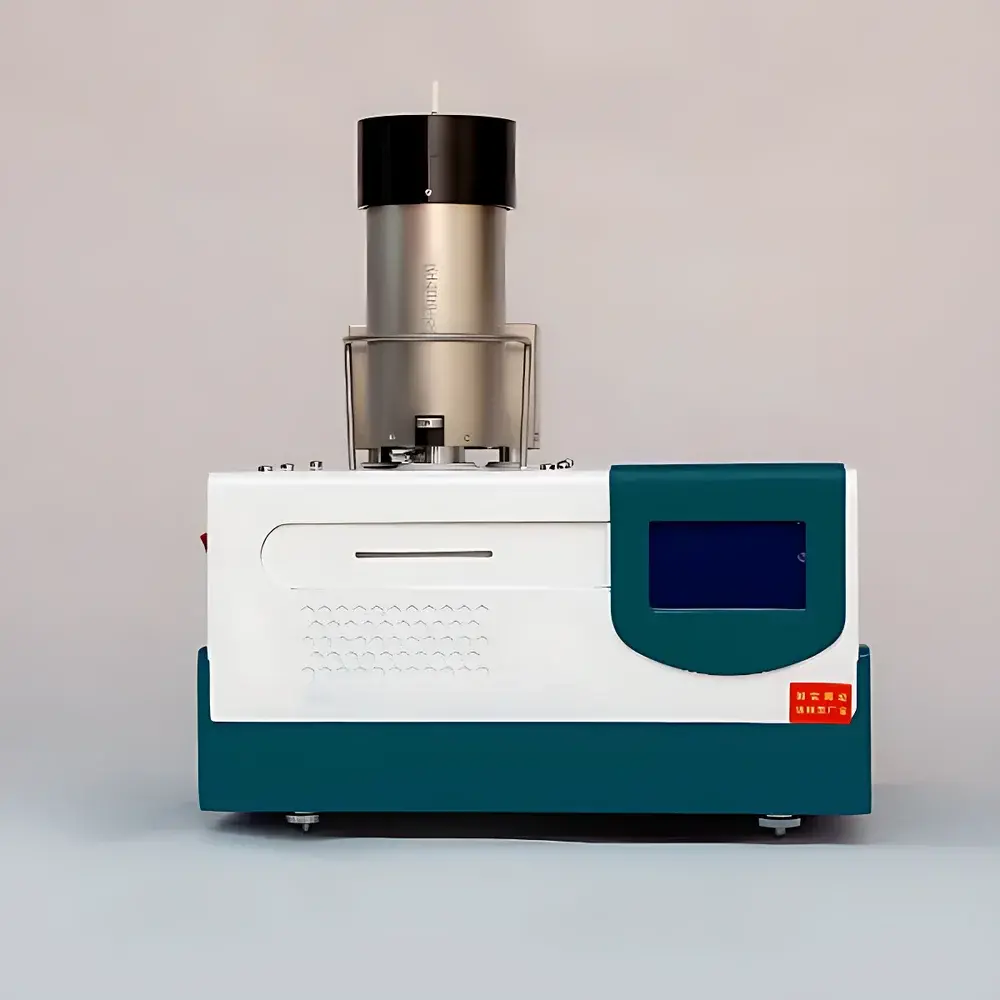
Henven HCT-3 Simultaneous Thermal Analyzer
| Brand | Henven |
|---|---|
| Origin | Beijing, China |
| Manufacturer Type | Direct Manufacturer |
| Model | HCT-3 |
| Temperature Range | Ambient to 1450 °C |
| Heating Rate | 0.1–100 °C/min (user-definable) |
| Temperature Stability | ±0.1 °C |
| Max Sample Mass | 5 g |
| Atmosphere Control | Dual-channel mass flow controller (MFC) |
| DSC Range | ±1 mW to ±500 mW |
| DSC Sensitivity | ±0.1 μW |
| TG Measurement Range | 1–200 mg |
| TG Resolution | 0.1 μg |
| TG Noise | <0.1 μg |
| Vacuum Capability | 2.5×10⁻² Pa (with optional vacuum pump) |
| DTA Range | ±10 μV to ±2000 μV |
| DTA Resolution | 0.01 μV |
| Crucible Options | Al₂O₃ (0.06 mL / 0.12 mL), Al, graphite, quartz, Pt |
Overview
The Henven HCT-3 Simultaneous Thermal Analyzer is an integrated thermogravimetric (TG) and differential thermal analysis (DTA) or differential scanning calorimetry (DSC) instrument engineered for high-precision, real-time characterization of thermal behavior in solid and powdered materials. Operating on the principle of simultaneous measurement—where mass change (TG) and heat flow (DTA/DSC) are recorded from a single sample under identical thermal and atmospheric conditions—the HCT-3 eliminates inter-sample variability and enables direct correlation between mass loss events (e.g., dehydration, decomposition, oxidation) and corresponding thermal transitions (e.g., melting, crystallization, glass transition, phase transformation). Its temperature range extends from ambient to 1450 °C, supporting high-temperature applications in metallurgy, ceramics, advanced composites, and catalyst development. The system employs a dual thermocouple configuration: one continuously monitors furnace temperature (active or idle), while the second measures actual sample temperature during operation—ensuring traceable thermal calibration and minimizing thermal lag artifacts.
Key Features
- Simultaneous TG-DTA/DSC acquisition with synchronized data timestamps and shared thermal history
- High-resolution microbalance with 0.1 μg resolution and <0.1 μg noise floor, calibrated across 1–200 mg dynamic range
- Programmable heating rates from 0.1 to 100 °C/min, with stepwise isothermal holds up to 72 hours at any temperature within the operating range
- Dual independent mass flow controllers (MFCs) enabling precise, automated switching between two gas streams (e.g., N₂/air, Ar/O₂) with repeatability ≤±0.5% of full scale
- Modular crucible support system accommodating standard 0.06 mL and 0.12 mL alumina crucibles; optional compatibility with aluminum, graphite, quartz, and platinum crucibles for corrosive or high-reactivity environments
- Real-time dual-channel display (LCD) showing furnace temperature, sample temperature, instantaneous mass, gas flow status, and system diagnostics
- Auto-ranging signal amplification and on-the-fly scaling—ensuring optimal signal-to-noise ratio across wide dynamic ranges of DTA (±10 μV to ±2000 μV) and DSC (±1 mW to ±500 mW)
- Optional vacuum interface (2.5×10⁻² Pa with external pump) and heated transfer lines (up to 200 °C) for coupling to GC or MS systems without condensation or adsorption losses
Sample Compatibility & Compliance
The HCT-3 accommodates samples ranging from sub-milligram research specimens to 5 g industrial batches via interchangeable support rods and crucible configurations. It supports inert, oxidative, reducing, and reactive atmospheres—including custom-engineered MFC-based delivery systems for HCl, HF, SO₂, NH₃, and other aggressive gases (material compatibility verified per ASTM G154 and ISO 9223). All thermal calibrations (temperature, enthalpy, mass) are traceable to NIST-certified reference materials (e.g., In, Sn, Zn, Al₂O₃, CaC₂O₄·H₂O). Software includes audit trail functionality compliant with GLP and 21 CFR Part 11 requirements when configured with user authentication, electronic signatures, and immutable data logging. Instrument design adheres to IEC 61010-1 safety standards for laboratory electrical equipment.
Software & Data Management
The proprietary HCT-3 control and analysis suite provides full automation—from method definition and instrument initialization to real-time plotting and post-run processing. Supported output formats include CSV, TXT, and universal .qdt for third-party thermal kinetics platforms. Built-in algorithms enable quantitative analysis of: peak deconvolution (Gaussian/Lorentzian fitting), kinetic modeling (Kissinger, Ozawa-Flynn-Wall, Friedman), activation energy mapping, crystallization half-time (t₁/₂) calculation, specific heat determination (via comparative method), and oxidation induction time (OIT) per ASTM D3895. Users may define custom equations for derived parameters (e.g., reaction conversion α, Arrhenius pre-exponential factor A), and Henven’s engineering team provides validated script integration upon request. All raw data files embed metadata (operator ID, timestamp, instrument serial, calibration status) and support version-controlled archiving.
Applications
- Thermal stability assessment of polymers, pharmaceuticals, and battery cathode materials under air/N₂/O₂
- Decomposition kinetics and residue composition analysis in coal, biomass, and municipal waste
- Phase diagram validation for metal alloys and ceramic precursors (e.g., spinel formation, perovskite crystallization)
- Hydration/dehydration pathways in zeolites, MOFs, and layered double hydroxides
- Reaction enthalpy quantification for solid-state synthesis (e.g., mechanochemical reactions, sol-gel transitions)
- Quality control of inorganic pigments, catalysts, and refractory additives per ISO 11358 and ASTM E1131
- Gas-surface interaction studies using coupled TG-GC/MS for evolved gas analysis (EGA)
FAQ
What calibration standards are recommended for routine verification?
NIST-traceable metals (In, Sn, Pb, Zn) for temperature; certified CaC₂O₄·H₂O for mass loss steps; sapphire for specific heat calibration.
Can the HCT-3 operate under vacuum without external pumping?
No—the base configuration includes vacuum-sealed construction, but achieving 2.5×10⁻² Pa requires optional rotary vane or turbomolecular vacuum pump integration.
Is DSC mode available as a software-upgradable option on all HCT-3 units?
Yes—DSC functionality is enabled via firmware license key; hardware (heat-flux sensor, symmetric furnace design) is factory-installed on all HCT-3 models.
How is baseline drift corrected during long-duration isotherms?
The system applies dynamic baseline subtraction using pre- and post-isotherm reference segments, with optional polynomial fitting (1st–3rd order) and manual anchor-point adjustment.
Does the software support automated ASTM/ISO-compliant reporting?
Yes—templates for ASTM E1131 (TG), E1269 (DSC), and ISO 11358 are embedded; reports include uncertainty propagation, statistical confidence intervals, and compliance statements.



