
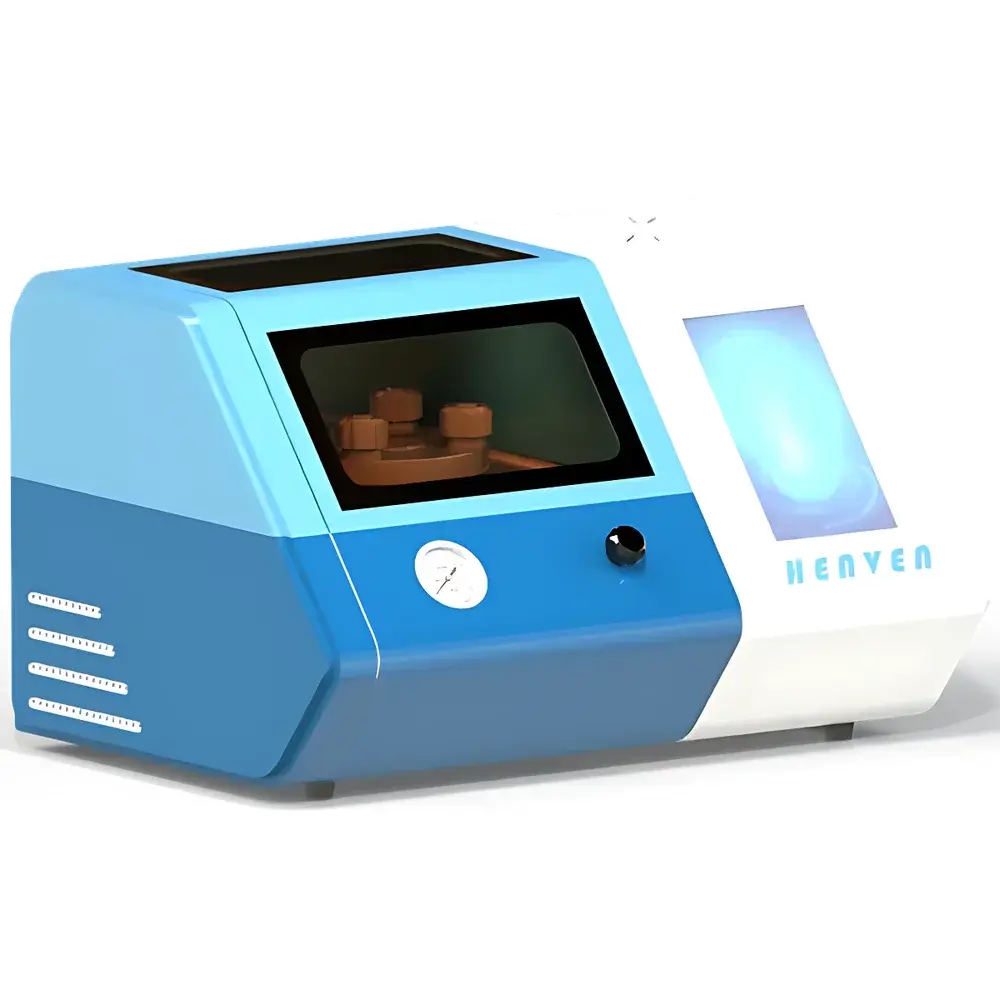
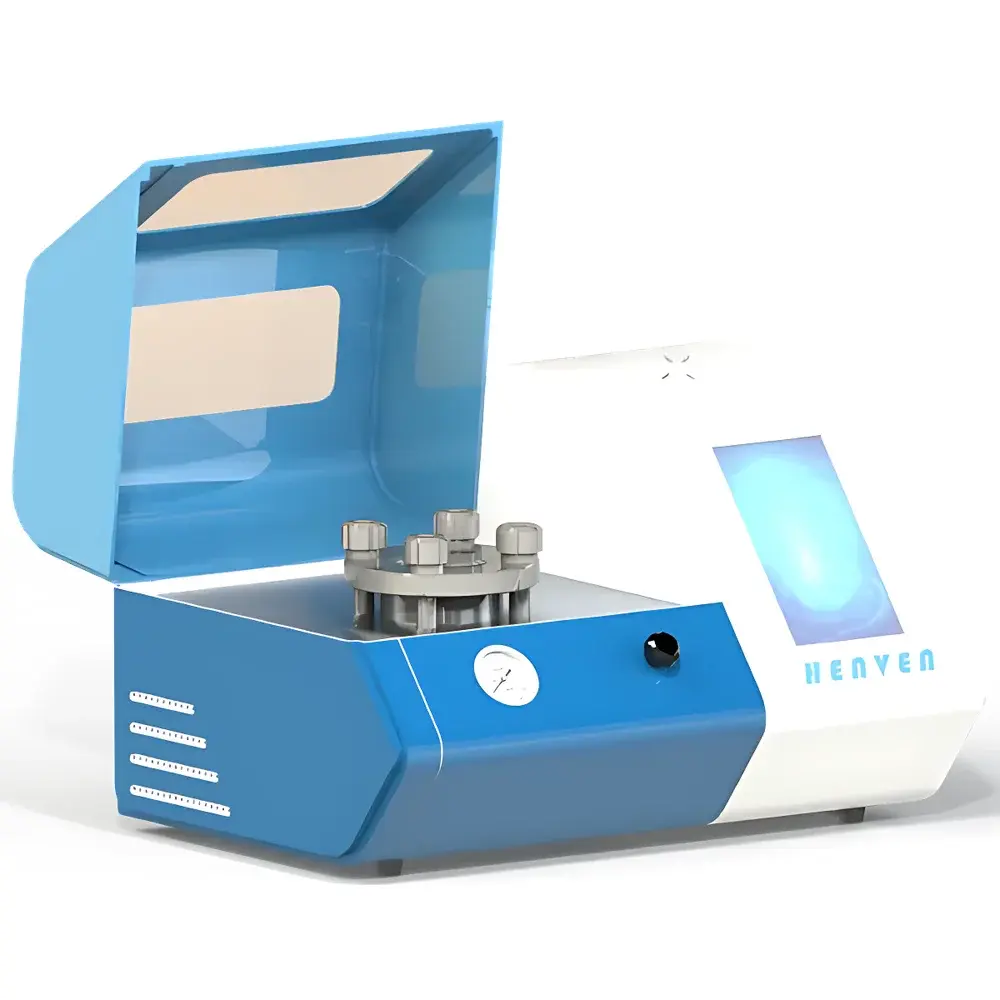
Henven HPC-DSC High-Pressure Differential Scanning Calorimeter
| Brand | Henven |
|---|---|
| Origin | Beijing, China |
| Manufacturer Type | Direct Manufacturer |
| Instrument Type | DSC |
| Temperature Range | −150 °C to 680 °C (with liquid nitrogen cooling) |
| Programmable Thermal Control | Heating, Isothermal Hold, Cooling |
| Temperature Accuracy | ±0.1 °C |
| Heating/Cooling Rate | 0.1–50 K/min (user-definable) |
| Temperature Precision | ±0.1 °C |
| DSC Signal Range | ±500 mW |
| Temperature Stability (Drift) | ≤0.1 °C |
| Pressure Range | 0.1–10.0 MPa |
| Pressure Accuracy | ±0.002 MPa |
| Pressure Control Mode | Dynamic Real-Time Regulation |
| Calibration | Multi-Point Nonlinear Temperature & Enthalpy Calibration |
| Atmosphere Options | Oxidizing, Reducing, Inert, Steam |
| Software | Windows-based Dual-Language (EN/CN) Control & Analysis Suite |
| Compliance | ASTM E793, ASTM E1269, ISO 11357-1 to -7, USP <1159>, GLP-Ready Audit Trail |
Overview
The Henven HPC-DSC High-Pressure Differential Scanning Calorimeter is an engineered thermal analysis platform designed for quantitative measurement of heat flow differences between a sample and reference under controlled temperature, pressure, and atmospheric conditions. It operates on the principle of power-compensated DSC, where independent heating circuits maintain equal temperatures in sample and reference crucibles while measuring the differential power required to sustain thermal equilibrium. This architecture enables high-resolution detection of endothermic and exothermic transitions—including glass transitions (Tg), crystallization (Tc), melting (Tm), decomposition, oxidative induction time (OIT), and reaction enthalpies—under elevated pressures up to 10.0 MPa. The instrument supports three distinct thermal operating domains: cryogenic (−150 °C to 680 °C with LN2 cooling), mid-range (RT to 1150 °C), and ultra-high-temperature (RT to 1550 °C), making it suitable for advanced materials development, safety evaluation of energetic compounds, and process-relevant thermal stability studies under simulated industrial conditions.
Key Features
- Triple-range furnace architecture with integrated liquid nitrogen cooling, resistive high-temperature heating, and radiation-assisted ultra-high-temperature modules—enabling seamless transition across −150 °C to 1550 °C
- Dynamic pressure control system with real-time feedback regulation, achieving ±0.002 MPa accuracy across 0.1–10.0 MPa range; compatible with gas dosing, steam injection, and reactive atmospheres
- Modular sensor design: interchangeable thermocouple-based and thermopile-based DSC sensors optimized for low-signal fidelity at cryogenic temperatures or high-temperature signal linearity
- Thermally stabilized furnace core featuring directional airflow channels and multi-layered isothermal blocks to suppress convective disturbances and ensure spatial temperature uniformity ≤±0.2 °C across 5 mm sample zone
- Multi-point nonlinear calibration protocol compliant with ASTM E793 and ISO 11357-2, covering temperature, enthalpy, and baseline drift correction across full operational range
- Intelligent PID + feedforward thermal control algorithm supporting user-defined ramp/hold/cool profiles with rate resolution down to 0.01 K/min and repeatability ≤0.1 K/min
- Gas flow stabilization module with laminar-flow conditioning and pre-heated delivery path, minimizing mechanical displacement of static samples during pressurized gas exposure
Sample Compatibility & Compliance
The HPC-DSC accommodates solid powders, pellets, thin films, fibers, and encapsulated liquids in standard alumina, platinum, or gold crucibles (hermetic or vented). Sample mass range: 0.1–50 mg. Pressure-rated sample pans are certified to 15 MPa burst pressure. The system meets regulatory requirements for GxP environments: software includes ALCOA+ compliant audit trail, electronic signatures (21 CFR Part 11 ready), and configurable user access levels. Full traceability is maintained for calibration records, method parameters, raw data files (.dsc), and report exports (PDF, CSV, XML). All thermal protocols align with ISO 11357 series standards for plastics, ASTM E1269 for heat capacity, and USP for pharmaceutical thermal stability assessment.
Software & Data Management
HenvenThermo v4.2 software provides dual-language (English/Chinese) interface on Windows 10/11 platforms. It supports method-driven acquisition, real-time baseline subtraction, peak deconvolution (Gaussian/Lorentzian fitting), kinetic modeling (Ozawa-Flynn-Wall, Kissinger), and comparative overlay of multiple pressure-temperature datasets. Raw data are stored in vendor-neutral HDF5 format with embedded metadata (instrument ID, operator, timestamp, pressure log, gas composition). Batch processing workflows enable automated reporting per ICH Q5C or ASTM E2070 guidelines. Export options include ASTM E1461-compliant .txt, Excel-ready .csv, and publication-quality vector graphics (.svg, .emf).
Applications
- Thermal stability screening of lithium-ion battery cathode/anode materials under inert and oxygen-pressurized conditions
- Oxidative degradation kinetics of polymers and elastomers at elevated O2 partial pressures
- Phase behavior mapping of hydrocarbon mixtures and CO2-soluble additives in enhanced oil recovery formulations
- Decomposition onset and enthalpy quantification of nitrocellulose, ammonium perchlorate, and other energetic formulations (UN Class 1 hazard testing)
- Crystallization thermodynamics of amorphous pharmaceuticals under controlled humidity and pressure gradients
- High-temperature sintering enthalpy and phase transformation analysis in ceramic precursors and refractory composites
FAQ
What pressure media are supported for high-pressure DSC measurements?
Nitrogen, argon, oxygen, helium, hydrogen, carbon dioxide, and saturated water vapor are fully supported. Custom gas blends (e.g., 4% O2/96% N2) can be delivered via mass flow controllers with ±0.5% full-scale accuracy.
Can the system perform simultaneous TGA-DSC coupling?
No—the HPC-DSC is a dedicated DSC platform. For concurrent mass-loss and heat-flow analysis, Henven offers the HPC-TGA-DSC hybrid configuration as a separate model with synchronized vacuum-tight coupling.
Is calibration traceable to national standards?
Yes—temperature calibration uses NIST-traceable indium, zinc, tin, and silver standards; pressure calibration is performed using a Fluke 7050 deadweight tester (Class 0.01% FS) certified annually by CNAS-accredited metrology lab.
How is data integrity ensured during long-duration isothermal holds at extreme temperatures?
The system logs all environmental parameters (furnace zone temps, pressure, gas flow, DSC voltage) at 10 Hz with CRC-32 checksum validation. Power-fail recovery resumes from last stable checkpoint without data loss.
Does the software support automated compliance reporting for FDA submissions?
Yes—preconfigured templates generate 21 CFR Part 11–compliant reports including raw data archives, analyst sign-off, instrument qualification summary, and deviation logs—all exportable in eCTD-compatible folder structure.



