
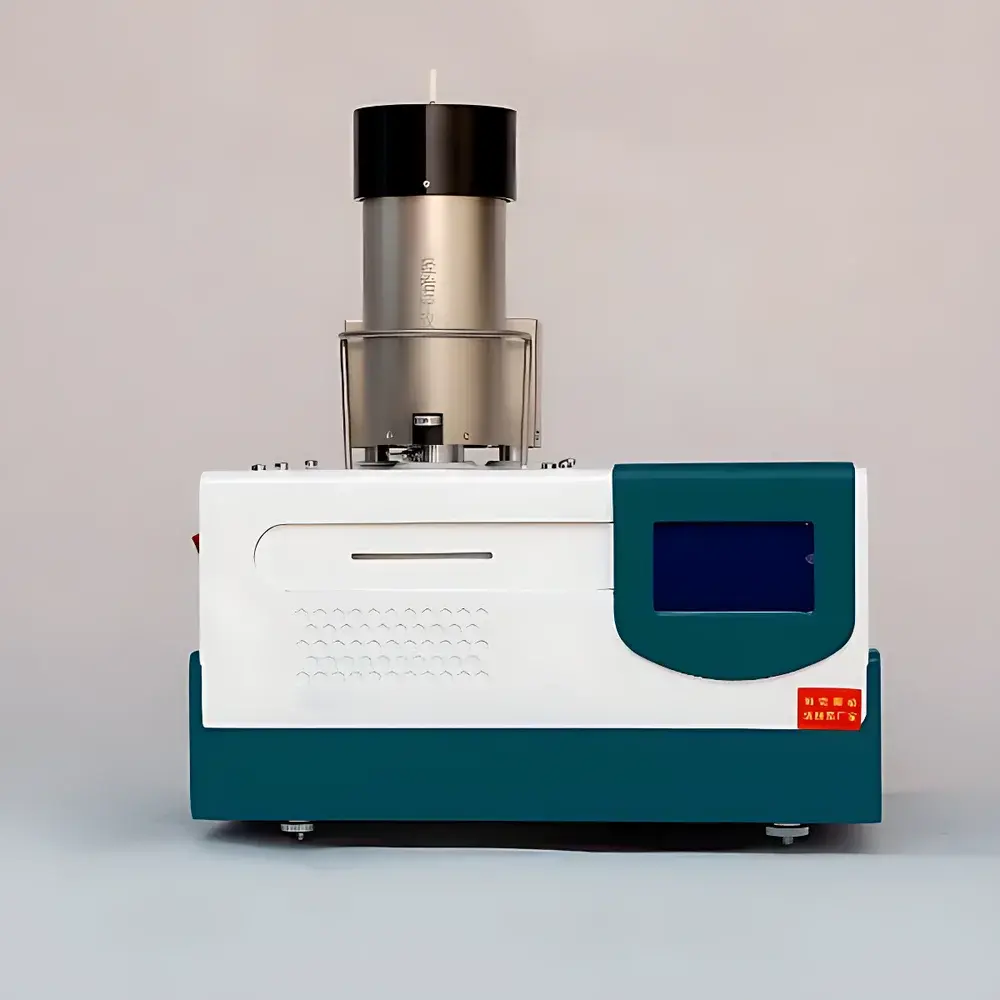
Henven HTG-3 Thermogravimetric Analyzer
| Brand | Henven |
|---|---|
| Origin | Beijing, China |
| Manufacturer Type | Direct Manufacturer |
| Regional Classification | Domestic (China) |
| Model | HTG-3 |
| Operating Environment | Ambient Pressure |
| Sample Capacity | Single Sample |
| Instrument Type | General-Purpose TGA |
| Temperature Range | Room Temperature to 1450 °C |
| Temperature Accuracy | ±0.1 °C |
| Temperature Precision | ±0.1 K |
| Dynamic Weighing Range | 0.01 mg – 5 g |
| Balance Sensitivity | 0.1 µg |
| Mass Accuracy | 0.1 µg |
| Heating/Cooling Rate | 0.1 – 100 K/min |
| Maximum Sample Mass | 5 g |
| Baseline Repeatability | 0.01 mg |
| Baseline Drift | 0.01 mg |
Overview
The Henven HTG-3 Thermogravimetric Analyzer is a high-stability, microbalance-integrated thermal analysis instrument engineered for precision measurement of mass change as a function of temperature or time under controlled atmospheric conditions. Based on the fundamental principle of thermogravimetry—where sample mass is continuously monitored during programmed thermal treatment—the HTG-3 delivers quantitative insight into thermal stability, decomposition kinetics, compositional volatilization, adsorption/desorption behavior, and oxidative/reductive reactions. Its operational range extends from ambient temperature to 1450 °C, enabling characterization of refractory ceramics, high-performance alloys, catalyst supports, pharmaceutical excipients, polymer fillers, and energy materials such as battery cathodes and carbon-based sorbents. The system employs a dual-thermocouple architecture: one continuously monitors furnace temperature independent of operation status, while the second provides real-time, in-situ sample temperature feedback—critical for accurate kinetic modeling and ASTM E1131-compliant data acquisition.
Key Features
- High-resolution microbalance with 0.1 µg sensitivity and ≤0.01 mg baseline repeatability, ensuring robust detection of subtle mass transitions (e.g., dehydration steps, trace additive loss).
- Programmable heating/cooling rates from 0.1 to 100 K/min, supporting both slow-scan stability profiling and rapid screening protocols.
- Integrated dual-gas mass flow control system with independent regulation of two gas streams; compatible with inert (N₂, Ar), oxidizing (air, O₂), reducing (H₂, CO), and corrosive atmospheres (custom corrosion-resistant MFCs available upon request).
- Modular crucible support system accommodating standard ceramic (Φ5×4 mm to Φ18×20 mm), aluminum, quartz, graphite, and platinum crucibles—enabling optimization for volatility, reactivity, and thermal conductivity requirements.
- Real-time dual-channel display (LCD) showing furnace temperature, sample temperature, absolute mass, % mass change, gas flow status, and system diagnostics.
- Extended isothermal capability: stable temperature hold up to 72 hours at any point within the 25–1450 °C range, essential for long-term degradation studies and equilibrium moisture analysis.
- Optional vacuum interface (down to 2.5×10⁻² Pa) and heated transfer lines (up to 200 °C) for coupling with GC, GC-MS, or FTIR systems—enabling evolved gas analysis (EGA) with minimal condensation or adsorption artifacts.
Sample Compatibility & Compliance
The HTG-3 accommodates diverse sample forms—including powders, granules, thin films, fibers, and small metallic coupons—with mass loading flexibility from sub-milligram traces to 5 g bulk specimens via interchangeable support rods. Its design conforms to core international thermal analysis standards, including ISO 11358 (polymer thermogravimetry), ASTM E1131 (standard test method for compositional analysis by TGA), and USP (thermal analysis in pharmaceutical development). The instrument supports GLP-compliant workflows through user-accessible calibration routines using certified reference materials (e.g., nickel, copper, calcium oxalate monohydrate) for simultaneous temperature and mass axis validation. Optional audit trail logging and electronic signature modules align with FDA 21 CFR Part 11 requirements for regulated laboratories.
Software & Data Management
Embedded firmware and PC-based analysis software provide full automation of acquisition, visualization, and post-processing. Standard outputs include TG (mass vs. temperature/time), DTG (first derivative), and DDTG (second derivative) curves. Advanced analytical functions include: quantitative residue calculation, multi-step decomposition modeling, isoconversional kinetic analysis (Friedman, Kissinger-Akahira-Sunose), comparative overlay of multiple runs, and customizable reporting templates. All data files are saved in open ASCII format for third-party integration. The system supports real-time screen capture at user-defined intervals and auto-ranging based on signal amplitude—eliminating manual gain adjustment during large-magnitude transitions. Software updates and custom algorithm development (e.g., proprietary kinetic models or regulatory report generators) are supported directly by Henven’s R&D team.
Applications
- Quantification of filler content, moisture, solvent residues, and volatile organic compounds (VOCs) in polymers and composites per ISO 3451 and ASTM D6370.
- Thermal stability assessment of active pharmaceutical ingredients (APIs) and excipients under ICH Q1A(R2) stress conditions.
- Decomposition pathway elucidation in metal-organic frameworks (MOFs), battery electrode materials, and catalyst precursors.
- Carbon content determination in steel alloys and ash content evaluation in coal, biomass, and lubricants (ASTM D3174, ISO 1171).
- In-situ monitoring of oxidation kinetics in high-temperature superalloys and ceramic matrix composites.
- Validation of pyrolysis mechanisms via coupled TGA-GC/MS for bio-oil and waste-derived feedstocks.
FAQ
What calibration standards are recommended for routine verification?
Nickel (Curie point at 354 °C), calcium oxalate monohydrate (three-stage decomposition), and certified alumina standards are routinely used for temperature and mass calibration.
Can the HTG-3 operate under dynamic vacuum without external pumping?
No—vacuum operation requires optional external vacuum pump integration; base pressure of 2.5×10⁻² Pa is achievable with the recommended rotary vane unit.
Is remote instrument monitoring supported?
Yes—Ethernet connectivity enables secure remote access for real-time status viewing, queue management, and limited parameter adjustment via authenticated web interface.
How is atmosphere switching handled during a single run?
The dual-MFC system allows seamless, programmable gas switching at user-defined temperature/time points with <100 ms response time and ±0.5% flow accuracy.
Does the software support kinetic modeling per ASTM E698?
Yes—isoconversional methods (Ozawa-Flynn-Wall, Friedman) and model-fitting approaches (n-th order, diffusion-controlled) are implemented with uncertainty propagation and confidence interval estimation.



