
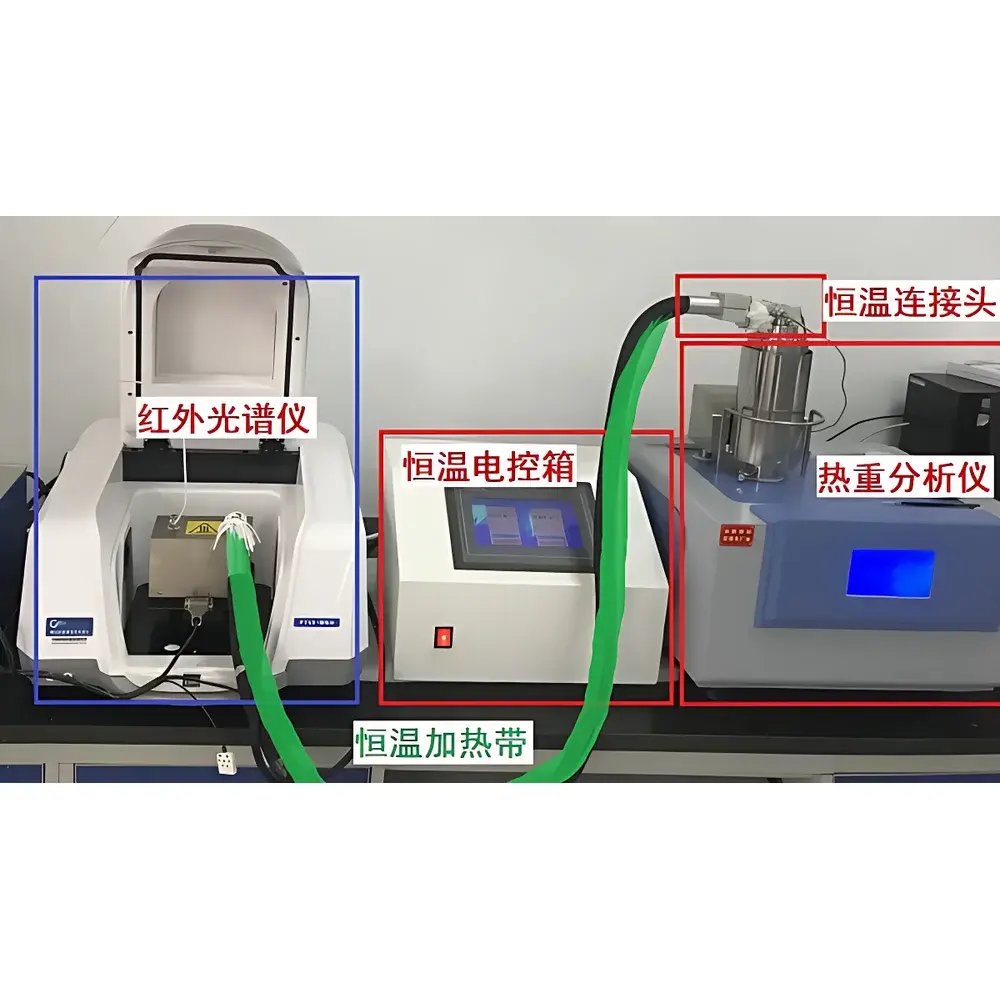
Henven HTG Thermogravimetric Analyzer Coupled with Fourier Transform Infrared Spectroscopy (TG-FTIR)
| Brand | Henven |
|---|---|
| Origin | Beijing, China |
| Manufacturer Type | Original Equipment Manufacturer (OEM) |
| Regional Classification | Domestic (China) |
| Model | HTG |
| Pricing | Available Upon Request |
Overview
The Henven HTG TG-FTIR Coupled System is an integrated thermal analysis platform engineered for real-time, in-situ identification of evolved gases during thermally induced decomposition, oxidation, or volatilization processes. It combines a precision thermogravimetric analyzer (TGA) with a high-sensitivity Fourier transform infrared (FTIR) spectrometer via a thermostatically controlled gas transfer interface. The system operates on the principle of evolved gas analysis (EGA): as a sample is heated under controlled atmosphere (N₂, air, or synthetic gas), mass loss events detected by the TGA are temporally correlated with FTIR spectral signatures acquired from the effluent gas stream. This correlation enables unambiguous assignment of functional groups (e.g., –OH, C=O, C–H, N–H, CO₂, H₂O, SO₂, NOₓ) to specific thermal events—providing mechanistic insight into degradation pathways, polymer stability, additive decomposition, or catalyst deactivation.
Key Features
- Integrated thermostatic gas transfer system: Includes a heated transfer line (up to 300 °C), temperature-stabilized IR interface cell, and programmable PID-controlled heating zones to prevent condensation or adsorption of semi-volatile species.
- Real-time synchronization: Hardware-triggered data acquisition ensures millisecond-level temporal alignment between TGA mass-loss curves and FTIR interferograms.
- Optimized gas flow path: Low-dead-volume stainless-steel conduit with inert surface treatment minimizes residence time and catalytic artifacts.
- OEM-designed control architecture: Fully integrated software suite manages both TGA furnace ramp rates, gas switching (up to 3 channels), and FTIR scan parameters within a single user interface.
- Modular expandability: Compatible with optional mass spectrometry (MS) or gas chromatography (GC) modules for orthogonal evolved gas characterization.
Sample Compatibility & Compliance
The HTG system accommodates solid and powdered samples (0.1–50 mg) across diverse material classes—including polymers, pharmaceuticals, composites, battery cathode materials, catalysts, and natural fibers. Sample pans are compatible with standard alumina, platinum, or gold-coated crucibles. The system supports atmospheric control per ISO 11358-1 (thermogravimetry) and spectral acquisition conforming to ASTM E1421 (standard practice for describing and measuring performance of FTIR spectrometers). Data integrity meets GLP-compliant requirements, with audit-trail-enabled software supporting 21 CFR Part 11 readiness (electronic signatures, user access levels, and change history logging).
Software & Data Management
The proprietary Henven Thermal Analysis Suite provides synchronized visualization of derivative thermogravimetry (DTG), mass loss (%) vs. temperature/time, and time-resolved FTIR absorbance spectra. Users can perform peak tracking, spectral subtraction, library searching (built-in Hummel Polymer, NIST, and custom libraries), and multivariate analysis (PCA, cluster mapping) directly within the environment. All raw data (TGA weight files, FTIR interferograms, and metadata) are stored in vendor-neutral HDF5 format, ensuring long-term archival compatibility and third-party processing interoperability (e.g., MATLAB, Python SciPy, OPUS).
Applications
- Pharmaceutical development: Quantifying residual solvents, identifying excipient–API interactions, and assessing thermal stability of amorphous solid dispersions.
- Advanced materials R&D: Elucidating pyrolysis mechanisms in carbon fiber precursors, char formation kinetics in flame-retardant polymers, and off-gassing behavior of encapsulants in microelectronics.
- Energy storage: Characterizing electrolyte decomposition pathways in Li-ion battery cathodes and quantifying HF generation during thermal runaway simulations.
- Environmental science: Monitoring VOC emissions from thermal desorption of contaminated soils and identifying halogenated byproducts in waste incineration studies.
- Textile engineering: Mapping moisture desorption, plasticizer migration, and flame-retardant decomposition profiles in synthetic fibers under regulated heating protocols.
FAQ
What temperature range does the HTG system support for the TGA furnace and transfer line?
The TGA furnace operates from ambient to 1100 °C; the thermostatically controlled transfer line and IR interface are rated for continuous operation up to 300 °C.
Is helium compatible as a carrier gas?
Yes—the system supports He, N₂, air, Ar, O₂, and custom gas mixtures via mass-flow-controlled inlet modules.
Can the FTIR module be upgraded post-purchase?
Yes—field-installable upgrades include MCT detector cooling, ATR accessories, and high-resolution optics (0.25 cm⁻¹).



