
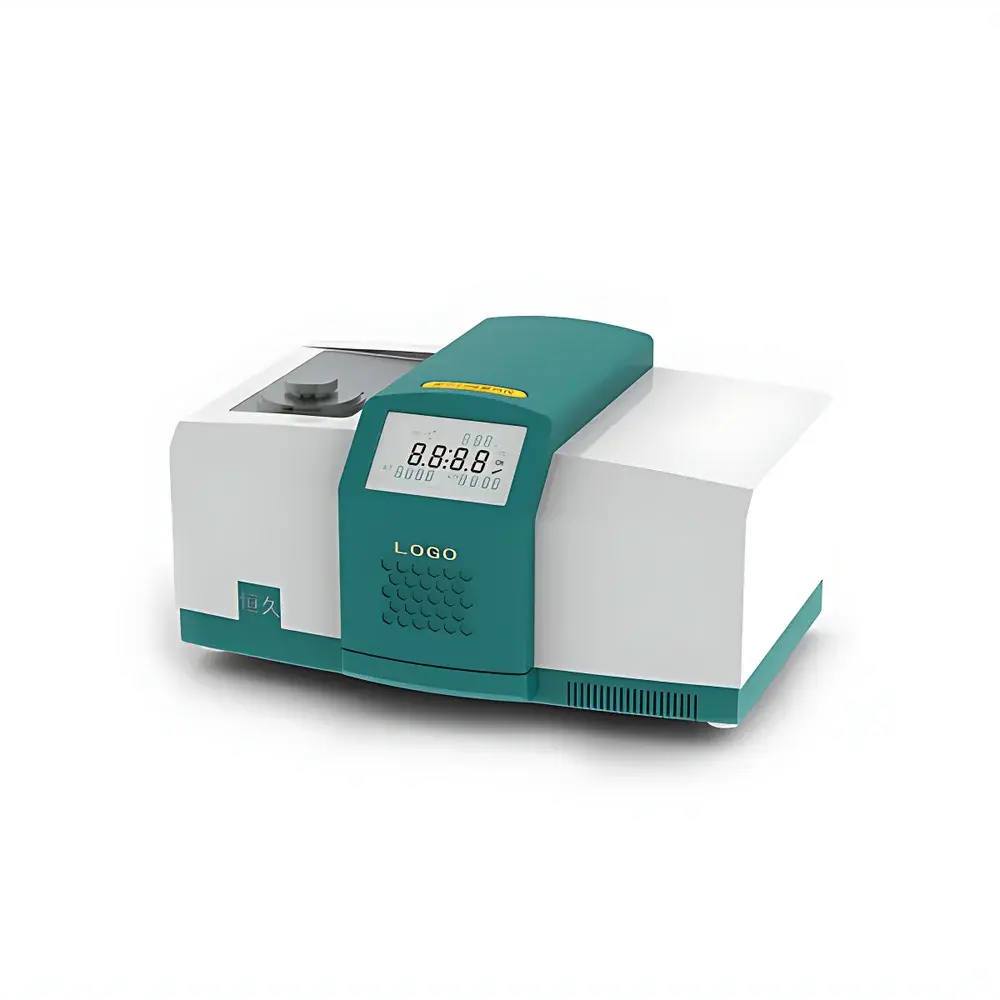
Henven HYD Oxidative Induction Time (OIT) Analyzer
| Brand | Henven |
|---|---|
| Origin | Beijing, China |
| Manufacturer | Henven Scientific Instrument Co., Ltd. |
| Type | Differential Scanning Calorimeter (DSC) |
| Model | HYD |
| Sample Capacity | 1 |
| Temperature Range | Ambient to 500 °C |
| Temperature Accuracy | ±0.1 °C |
| Temperature Precision | ±0.1 °C |
| Temperature Stability | ±0.1 °C |
| Heating/Cooling Rate | 0.1–80 K/min |
| DSC Signal Range | 0 to ±500 mW |
| DSC Resolution | ±0.1 µW |
| DSC Accuracy | ±0.1 µW |
| Crucible Volume | 0.06 mL or 0.12 mL |
| Atmosphere Control | Dual-gas (N₂/O₂) with Mass Flow Controllers (MFCs) |
| Programmable Thermal Profiles | Isothermal hold, linear ramp, gas-switch-triggered transition |
Overview
The Henven HYD Oxidative Induction Time (OIT) Analyzer is a dedicated differential scanning calorimeter engineered for precise thermal stability assessment of polymeric materials—particularly plastics and elastomers—under controlled oxidative environments. It operates on the fundamental principle of heat flow differential measurement between a sample and inert reference under programmed temperature conditions, in accordance with ASTM D3895, ISO 11357-6, and GB/T 19466.6–2009. The instrument implements a standardized OIT protocol: after equilibration under nitrogen, the atmosphere is automatically switched to oxygen at a defined isothermal temperature (e.g., 200 °C), and the onset of exothermic oxidation is detected via real-time DSC signal deviation. This onset—defined as the intersection of tangents to the baseline and rising oxidation curve—yields the oxidative induction time, a critical parameter for evaluating antioxidant efficacy and long-term thermal aging resistance.
Key Features
- Integrated monolithic DSC architecture minimizing thermal lag and electromagnetic interference, ensuring high signal fidelity and reproducibility across repeated OIT measurements.
- Ergonomic top-loading sample chamber enabling rapid, contamination-free insertion and alignment of standard aluminum crucibles (0.06 mL or 0.12 mL volume).
- Compact, low-thermal-mass furnace design delivering linear heating from ambient temperature with minimal thermal inertia—critical for accurate isothermal stabilization and precise OIT onset detection.
- Dual independent mass flow-controlled gas delivery system (N₂ and O₂) with programmable, timed switching; gas transition occurs within <15 seconds with flow stability ±0.5% FS.
- Two calibrated thermocouples: one continuously monitors furnace block temperature (active during idle and operation); the second measures actual sample temperature during active thermal profiling.
- Automated OIT calculation engine: detects baseline drift, constructs tangent lines, computes intersection point relative to gas-switch timestamp, and reports OIT in minutes with traceable metadata.
- Full remote diagnostics and calibration support via secure TCP/IP interface—enabling firmware updates, sensor verification, and parameter reconfiguration without on-site service.
Sample Compatibility & Compliance
The HYD analyzer accommodates solid polymer granules, pellets, films, and molded specimens (≤10 mg) compatible with standard DSC crucibles. It meets requirements for routine quality control and R&D testing in compliance with GB/T 17391–1998 (polyethylene OIT determination), GB/T 19466.6–2009 (plastics—DSC—Part 6: OIT), and ISO 11357-6:2018. Its hardware and software architecture support GLP-aligned data integrity: all thermal events, gas transitions, and calculated results are time-stamped, user-logged, and stored with immutable audit trails. Optional configuration supports 21 CFR Part 11-compliant electronic signatures and role-based access control when integrated with validated laboratory information management systems (LIMS).
Software & Data Management
Control and analysis are performed using Henven’s proprietary OIT-Studio software, running on Windows OS. The interface provides real-time dual-channel visualization (heat flow vs. time and temperature), interactive baseline correction, manual/automatic tangent placement, and customizable reporting templates. All raw DSC thermograms, metadata (gas sequence, ramp rate, hold duration), and derived OIT values are saved in vendor-neutral ASCII (.txt) and HDF5 formats. Batch processing mode enables sequential analysis of multiple samples with consistent evaluation parameters. Software permits user-defined calculation algorithms—custom mathematical models (e.g., Arrhenius-based extrapolation or derivative-based onset detection) can be embedded via documented API hooks upon request.
Applications
- Quantitative comparison of antioxidant performance in polyolefins (PE, PP), thermoplastic elastomers (TPE), and engineering resins.
- Stability screening of recycled polymer streams to assess residual stabilizer content and degradation history.
- Accelerated aging studies correlating OIT values with long-term thermo-oxidative behavior under ISO 1872-2 and ASTM D3045 protocols.
- Raw material release testing in automotive, medical packaging, and cable insulation manufacturing where regulatory compliance mandates OIT verification.
- Failure analysis of premature embrittlement or discoloration in field-aged components.
FAQ
What standards does the HYD OIT Analyzer support?
It natively supports GB/T 17391–1998, GB/T 19466.6–2009, ISO 11357-6:2018, and ASTM D3895. Custom method templates can be configured for internal SOPs or regional specifications.
Can the instrument perform non-OIT DSC experiments?
Yes—the HYD platform supports general DSC modes including melting point, crystallization temperature, glass transition (Tg), and heat capacity (Cp) measurement, though its thermal design prioritizes OIT repeatability over ultra-low-temperature or high-pressure capability.
How is temperature calibration verified?
Users may perform in-house calibration using certified reference materials (e.g., high-purity indium, tin, zinc) to validate both temperature accuracy (±0.1 °C) and enthalpy precision per ISO 11357-1.
Is the gas-switch timing synchronized with data acquisition?
Yes—gas valve actuation is hardware-triggered and timestamped within the same microsecond-resolution clock domain as DSC signal sampling, eliminating synchronization drift.
Does the system support automated sample changers?
Not natively; the HYD is optimized as a single-sample, high-reproducibility benchtop unit. For unattended multi-sample throughput, integration with third-party autosamplers requires custom mechanical and software interfacing.



