
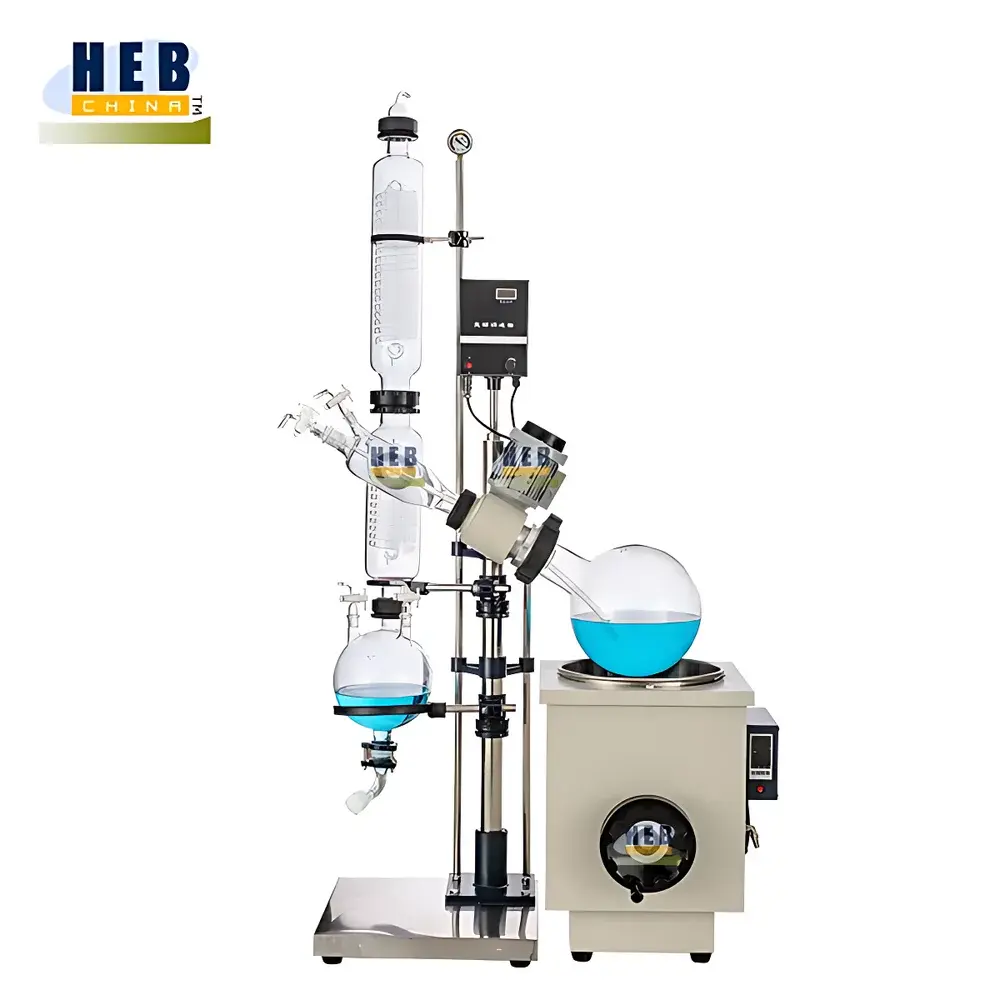
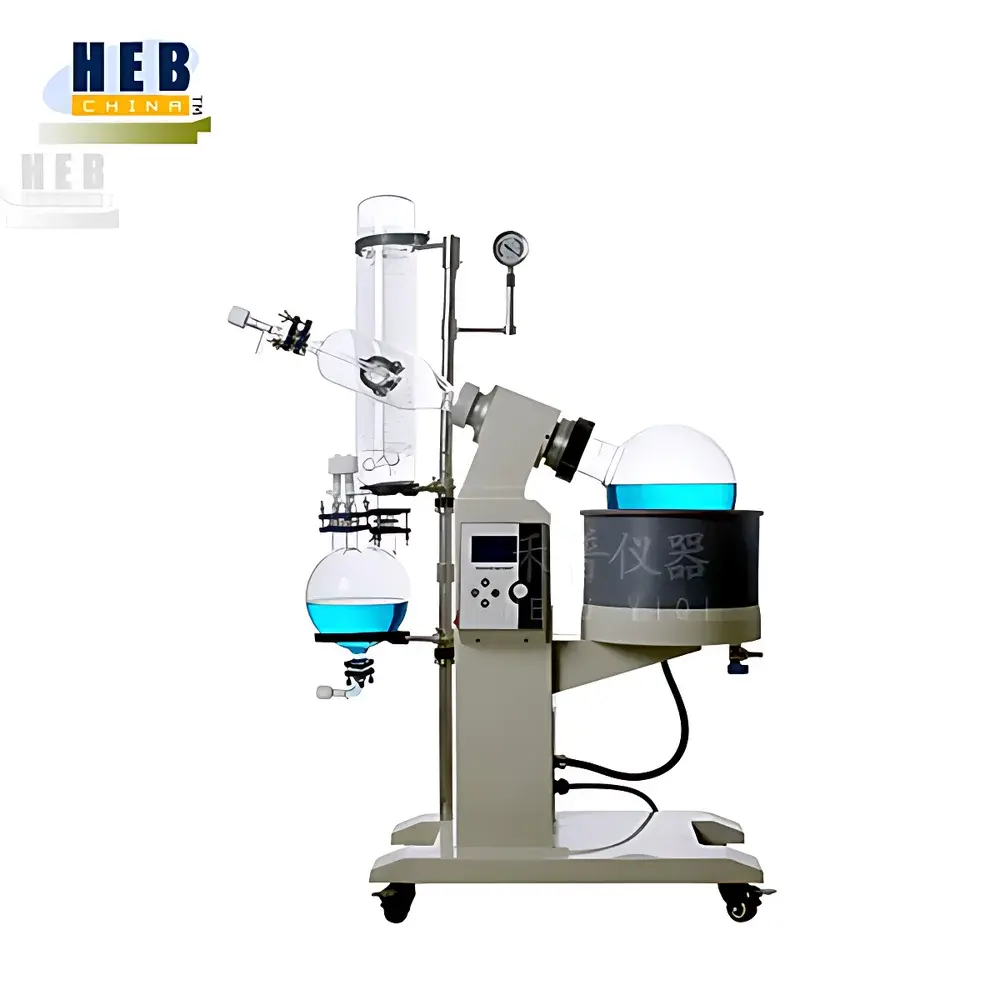
HePu R-1005 Rotary Evaporator
| [Brand | HePu (Jihepu) |
|---|---|
| Origin | Shandong, China |
| Model | R-1005 |
| Capacity | 5 L |
| Voltage/Frequency | 220 V / 50 Hz |
| Total Power | 2100 W |
| Rotation Speed | 0–120 rpm |
| Heating Temperature Range | Ambient to 180 °C |
| Temperature Control Accuracy | ±1 °C |
| Vacuum Degree | ≤0.095 MPa |
| Condenser Surface Area | 0.5 m² |
| Bath Lift Stroke | 140 mm |
| Dimensions (W×D×H) | 980 × 480 × 1260 mm |
| Net Weight | 46 kg] |
Overview
The HePu R-1005 Rotary Evaporator is an engineered solution for efficient, scalable solvent removal and concentration under reduced pressure—principally leveraging thin-film evaporation dynamics. Its operational principle relies on continuous rotation of the evaporation flask (5 L capacity), generating a uniform, high-surface-area liquid film along the inner wall while immersed in a precisely controlled heating bath (up to 180 °C). Simultaneous application of vacuum (≤0.095 MPa) lowers the boiling point of solvents, significantly accelerating evaporation kinetics without thermal degradation. Vaporized solvent passes through a vertical dual-layer serpentine condenser (Φ120 × 600 mm, 0.5 m² cooling surface), where it is efficiently liquefied via external coolant circulation (e.g., chiller or tap water) and collected in a 3 L receiving flask. Designed for integration into full laboratory purification workflows, the R-1005 requires ancillary equipment—including a compatible vacuum source (e.g., diaphragm, rotary vane, or water circulation pump) and a recirculating chiller or cold water supply—to achieve optimal performance and reproducibility.
Key Features
- High-integrity material construction: All wetted parts—including evaporation flask, condenser, collection flask, and feed valve—fabricated from borosilicate glass 3.3 (low thermal expansion coefficient) and PTFE, ensuring chemical inertness, thermal stability, and resistance to corrosion across organic, aqueous, and mildly acidic/basic media.
- Dual-motor precision drive system: Brushless DC geared motor (60 W) delivers smooth, spark-free rotation from 0–120 rpm with high torque retention; separate geared lift motor (40 W) enables precise, quiet electric bath elevation over 140 mm stroke.
- Intelligent thermal management: PT100 sensor embedded in stainless steel 304 bath pot provides real-time feedback for ±1 °C temperature control; integrated dry-run protection and overtemperature cutoff (>5 °C above setpoint) prevent heater damage and sample overheating.
- Modular vacuum handling: Analog oil-filled vacuum gauge with needle indicator; multi-port vacuum switching valve allows uninterrupted solvent collection and discharge without breaking vacuum or interrupting distillation.
- Ergonomic and safety-focused design: Insulated silicone bath cover minimizes heat loss and surface burn risk; dual independent fuses protect rotation and heating circuits; bottom drain valve (304 SS) and side-mounted PTFE/glass discharge valve (Φ50 flange, 260 mm clearance) facilitate rapid, residue-free cleanup.
- Human-machine interface: Large LCD panel simultaneously displays and controls rotation speed, bath temperature, and lift position; intuitive soft-key navigation simplifies parameter setting and monitoring during extended runs.
Sample Compatibility & Compliance
The R-1005 accommodates a broad spectrum of laboratory-scale purification tasks involving heat-sensitive natural extracts, synthetic intermediates, polymer solutions, and pharmaceutical actives. Its all-glass/PTFE fluid path meets general requirements for Good Laboratory Practice (GLP) environments where material traceability and minimal leachables are critical. While not certified to ISO 17025 or FDA 21 CFR Part 11 out-of-the-box, the system supports audit-ready operation when paired with validated vacuum pumps, calibrated chillers, and documented SOPs—including temperature mapping of the bath and periodic verification of vacuum gauge linearity. The absence of lubricants or elastomers in vapor pathways eliminates contamination risks associated with silicone grease or rubber gaskets—making it suitable for applications governed by USP <467> residual solvent testing protocols where extractable profiles must be tightly constrained.
Software & Data Management
The R-1005 operates as a standalone instrument with local parameter control only; no embedded data logging, USB export, or network connectivity is provided. However, its analog vacuum gauge output and digital temperature/rotation signals are accessible via optional third-party analog-to-digital interfaces (e.g., LabJack U3-HV or National Instruments DAQ modules), enabling integration into custom SCADA or LIMS platforms for time-stamped run records, trend analysis, and electronic batch record generation. For regulated environments requiring 21 CFR Part 11 compliance, users must implement external validation of connected acquisition hardware, define user access roles, and maintain audit trails for all configuration changes—functions not natively supported by the base unit.
Applications
- Concentration of natural product extracts (e.g., botanical infusions, essential oils) prior to HPLC or GC-MS analysis.
- Removal of low-boiling solvents (e.g., dichloromethane, ethyl acetate, hexane) following column chromatography or liquid–liquid extraction.
- Preparative-scale solvent exchange—e.g., transferring reaction mixtures from THF to ethanol for crystallization.
- Distillation of thermally labile compounds under gentle conditions (<60 °C bath + high vacuum) to avoid decomposition.
- Recovery and reuse of expensive or hazardous solvents in QC/QA laboratories, reducing waste disposal costs and environmental footprint.
- Process development support for scale-up studies, where consistent film formation and evaporation rate data inform larger rotary evaporator or falling-film evaporator specifications.
FAQ
What vacuum pumps are compatible with the R-1005?
Diaphragm, rotary vane, and water circulation pumps with ultimate vacuum ≤0.095 MPa and flow rates ≥12 L/min are recommended. For solvent recovery efficiency and pump longevity, chemically resistant diaphragm pumps (e.g., KNF N840.3FT.18) are preferred over oil-lubricated alternatives.
Is the condenser cooled by air or liquid?
The R-1005 uses liquid-cooled condensation exclusively—coolant enters/exits via two 16 mm OD quick-connect fittings on the condenser coil. Air cooling is insufficient for reliable condensation above 40 °C vapor temperatures.
Can the R-1005 handle viscous or particulate-containing solutions?
Yes—with limitations. Pre-filtration is advised for suspensions. For high-viscosity feeds (e.g., >500 cP), reduce rotation speed (≤40 rpm), increase bath temperature incrementally, and monitor film continuity visually through the glass joints.
Does the unit include a chiller or vacuum pump?
No. These are system-level components and must be selected and procured separately based on solvent type, throughput requirements, and facility infrastructure.
What maintenance intervals are recommended?
Inspect PTFE seals and glass joints monthly; clean condenser coils quarterly with ethanol or isopropanol; verify bath sensor calibration annually using a traceable reference thermometer.



