
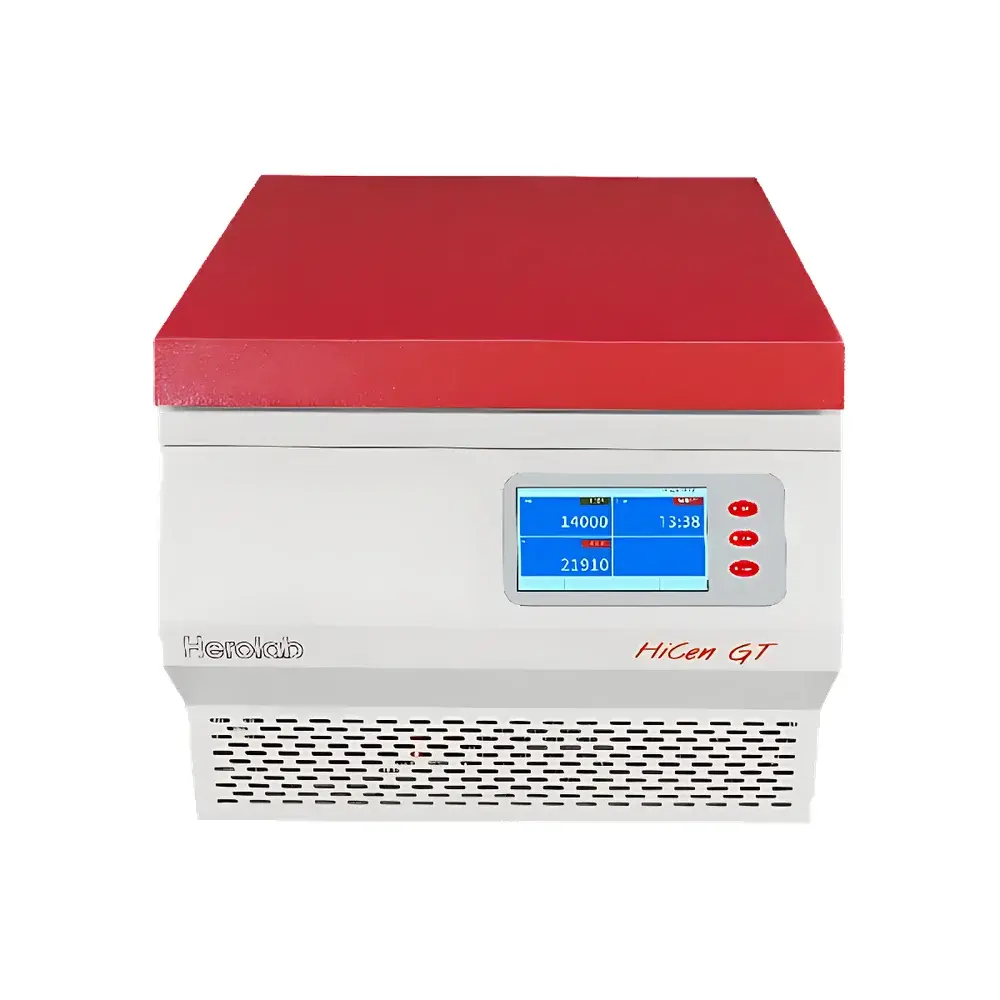
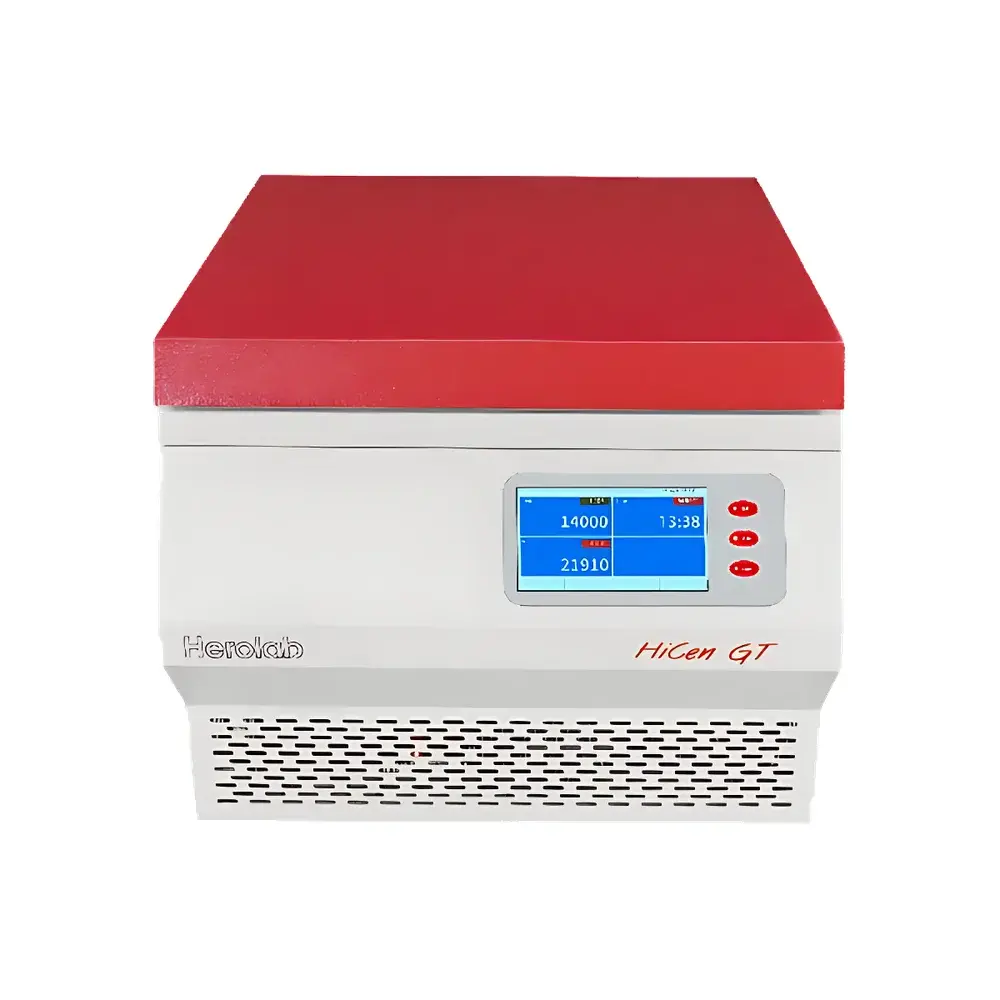
Herolab HiCen GT 4L Benchtop Centrifuge
| Brand | Herolab |
|---|---|
| Origin | Germany |
| Model | HiCen GT |
| Instrument Type | Benchtop Centrifuge |
| Speed Range | Up to 14,000 rpm |
| Max RCF (Angle Rotor) | 21,913 × g |
| Max RCF (Swing Rotor) | 3,962 × g |
| Max Capacity (Angle/Swing Rotor) | 4 × 1000 mL |
| Drive System | Maintenance-Free High-Speed Induction Motor with Auto-Centering |
| Transmission | Flexible Self-Centering Shaft |
| Braking System | Dynamic Reverse Magnetic Resistance Deceleration |
| Rotor Recognition | Automatic |
| Imbalance Detection | Integrated Real-Time Monitoring with Auto-Shutdown |
| Timer Function | Speed/RCF-Triggered Start |
| Power Supply | 230 V, 50–60 Hz |
| Dimensions (W×D×H) | 57.5 × 76.0 × 50.0 cm |
| Weight (Net) | 112 kg |
Overview
The Herolab HiCen GT is a high-performance, 4-liter benchtop centrifuge engineered for precision, reliability, and operational safety in demanding laboratory environments. Designed and manufactured in Germany, the HiCen GT operates on the principle of sedimentation-based separation—utilizing controlled rotational force (RCF) to separate components of heterogeneous mixtures based on density, size, and shape. Its robust architecture supports both angle and swing-bucket rotor configurations, enabling flexible adaptation across diverse sample types and protocol requirements. Unlike refrigerated models, the HiCen GT is a non-cooled centrifuge optimized for ambient-temperature applications where thermal stability is not a critical constraint—making it ideal for routine cell pelleting, polymer precipitation, large-volume buffer clarification, and preparative separations in molecular biology, clinical diagnostics, and industrial quality control labs.
Key Features
- Maintenance-free high-speed induction motor with auto-centering capability ensures consistent rotational stability and extended service life without periodic brush replacement or mechanical alignment.
- Flexible self-centering shaft minimizes vibration across speed ranges, enhancing run-to-run reproducibility and reducing mechanical wear during prolonged operation.
- Dynamic reverse magnetic resistance braking system enables rapid, controlled deceleration—reducing total cycle time while preserving sample integrity and rotor longevity.
- Integrated automatic rotor recognition and real-time imbalance detection provide fail-safe operation: the unit halts immediately upon detecting mass asymmetry exceeding ISO 21501-compliant thresholds.
- Speed/RCF-triggered timer initiates countdown only after reaching the target rotational velocity or relative centrifugal force—ensuring precise adherence to standardized protocols (e.g., ASTM D6986 for particulate sedimentation analysis).
- 19 compatible rotor options—including 15 angle rotors and 4 swing rotors—support scalable throughput from microcentrifuge tubes to 1-L bottles, accommodating ISO/IEC 17025-accredited workflows requiring traceable configuration records.
Sample Compatibility & Compliance
The HiCen GT accommodates a broad spectrum of sample containers—from 0.2 mL PCR tubes to 1,000 mL centrifuge bottles—across both fixed-angle and horizontal rotor geometries. All rotors are certified to DIN EN 61000-6-3 (EMC) and DIN EN 61000-6-2 (immunity), and conform to IEC 61010-1:2010 safety standards for laboratory electrical equipment. While the unit does not incorporate active refrigeration, its structural thermal mass and airflow-optimized housing maintain stable internal temperatures under continuous use—meeting requirements for non-critical thermal applications outlined in CLSI EP17-A2 guidelines. Rotor certification documentation—including maximum load limits, material compatibility (e.g., polypropylene, polycarbonate, stainless steel), and sterilization validation (autoclave/chemical)—is provided per batch and traceable via serial-numbered rotor IDs.
Software & Data Management
The HiCen GT features an embedded microprocessor-based control interface with non-volatile memory for storing up to 99 user-defined protocols. Each method includes configurable parameters: setpoint rpm/RCF, acceleration/deceleration profiles, hold time, and rotor ID. The system logs timestamped operational metadata—including actual run speed, final RCF, elapsed time, and fault codes—for audit-ready recordkeeping. While no external software suite is bundled, exported logs comply with CSV formatting for integration into LIMS platforms supporting ASTM E1578-20 (Laboratory Information Management Systems) and align with GLP/GMP documentation expectations for method traceability and instrument qualification (IQ/OQ/PQ).
Applications
- Routine pelleting of mammalian cells (e.g., HEK293, CHO) at 1,500–3,000 × g for downstream lysis and protein extraction.
- Clarification of fermentation broths and bioreactor harvests using 4 × 1,000 mL swing rotors at ≤4,500 rpm.
- Preparative isolation of extracellular vesicles and lipoprotein fractions via high-RCF angle-rotor runs (up to 21,913 × g).
- Quality assurance testing of suspensions, emulsions, and colloidal formulations per USP light-scattering particle size distribution protocols.
- High-volume buffer exchange and desalting in bioprocessing scale-up stages prior to chromatography.
FAQ
Is the HiCen GT suitable for GMP-regulated environments?
Yes—its deterministic control logic, auto-rotor identification, and immutable run-log storage support compliance with FDA 21 CFR Part 11 requirements when deployed with validated electronic records procedures.
Can the unit be operated with third-party rotors?
No—only Herolab-certified rotors are recognized by the auto-identification system; unauthorized rotors will not initialize, preventing unsafe operating conditions.
What maintenance intervals are recommended?
Annual verification of rotor integrity (crack inspection), calibration of speed/RCF accuracy per ISO 15197, and bearing performance assessment are advised—no routine lubrication or motor servicing is required due to the sealed induction drive.
Does the HiCen GT meet CE marking requirements for export to the EU?
Yes—the device carries full CE marking under the Machinery Directive 2006/42/EC and Electromagnetic Compatibility Directive 2014/30/EU, with technical documentation available upon request.
How is rotor lifetime tracked?
Each rotor includes a unique serial number linked to cumulative runtime and maximum speed history stored in the centrifuge’s firmware; this data is accessible via diagnostic mode and supports ISO 13485-compliant lifecycle management.



