
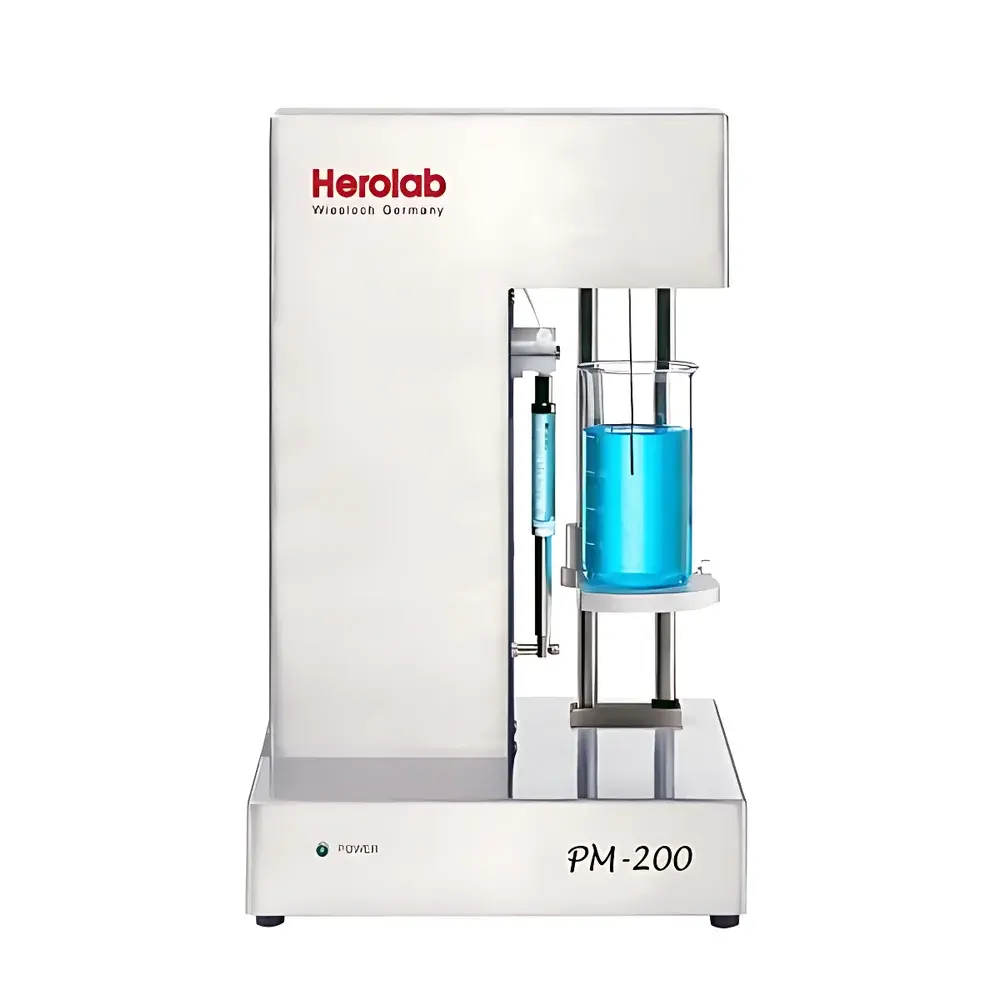
Herolab PM-200 Insoluble Particle Detector (Formerly KLOTZ Technology)
| Brand | Herolab |
|---|---|
| Origin | Germany |
| Model | PM-200 |
| Detection Principle | Light Obscuration (LO) |
| Particle Size Range | 1–200 µm or 2–400 µm (user-selectable) |
| Concentration Range | 0–70,000 particles/mL |
| Minimum Sample Volume | 100 µL |
| Measurement Accuracy | >95% |
| Compliance | USP <787>, <788>, <789>, <1787>, <1788> |
| Software | SW-CA with Audit Trail, Electronic Signatures, and Secure Data Management |
| Syringe Compatibility | 1 mL, 5 mL, 10 mL, 25 mL (interchangeable) |
| Interface | USB |
Overview
The Herolab PM-200 Insoluble Particle Detector is a fully automated, light obscuration (LO)-based analytical instrument engineered for quantitative determination of insoluble particulate matter in parenteral drug products, ophthalmic solutions, biologics, and other sterile liquid pharmaceuticals. Designed in accordance with the fundamental physical principle of particle-induced light attenuation—where particles traversing a precisely dimensioned flow cell interrupt a collimated light beam perpendicular to the fluid path—the PM-200 delivers high-reproducibility counts and size-resolved distributions across two calibrated detection ranges: 1–200 µm and 2–400 µm. This dual-range capability supports both compendial compliance (e.g., USP <788> requiring ≥10 µm and ≥25 µm thresholds) and extended characterization needs for process development and root-cause analysis. The system’s optical architecture, fluidic design, and signal processing firmware are co-developed with legacy KLOTZ laser particle sensing expertise, ensuring robust performance under stringent GxP laboratory conditions.
Key Features
- Fully automated sample aspiration, filtration-free measurement, and result reporting—minimizing operator intervention and inter-user variability.
- Modular syringe drive system supporting rapid interchange of standard glass or plastic syringes (1 mL, 5 mL, 10 mL, 25 mL) without recalibration.
- User-definable test methods—including custom particle size thresholds, pass/fail criteria, replicate count, and dilution factors—enabling alignment with internal quality standards beyond pharmacopoeial minimums.
- Optimized microfluidic channel geometry ensuring laminar flow and minimal particle re-orientation, critical for accurate cross-sectional area-based sizing.
- Integrated pressure monitoring and flow-rate stabilization to maintain consistent hydrodynamic conditions across varying sample viscosities and temperatures (15–30 °C operating range).
- Real-time signal diagnostics and automatic sensor validation routines prior to each run, supporting ALCOA+ data integrity principles.
Sample Compatibility & Compliance
The PM-200 accommodates aqueous and non-aqueous clear liquids, including saline, dextrose solutions, lipid emulsions (post-dilution), monoclonal antibody formulations, and vaccine suspensions—provided samples are optically transparent at the detection wavelength (typically 650 nm). It excludes opaque, highly viscous (>50 cP), or air-saturated matrices without prior degassing or dilution. Regulatory alignment is embedded at the system level: all electronic records—including raw pulse data, calibration logs, user actions, and report exports—are generated, stored, and protected per FDA 21 CFR Part 11 requirements. Full audit trail functionality, role-based access control, and electronic signature enforcement are natively implemented in SW-CA software, satisfying inspection readiness for EMA Annex 11, WHO TRS 992, and PIC/S PI 011 audits.
Software & Data Management
SW-CA (Software for Compendial Analysis) is a Windows-based application validated for pharmaceutical use. It provides method setup wizards, real-time particle event visualization, statistical summary dashboards, and automated report generation compliant with USP, EP, ChP, and JP templates. All data files are saved in encrypted, tamper-evident formats with immutable metadata (timestamp, operator ID, instrument serial number, calibration status). Version-controlled method libraries support multi-site harmonization, while database backup and restore protocols meet ISO/IEC 27001-aligned IT security policies. Export options include CSV, PDF/A-2, and XML for LIMS integration—retaining full traceability from raw signal to final certificate of analysis.
Applications
- Final container testing of injectables per USP <788> and EP 2.9.19.
- Filter integrity verification through upstream particle challenge studies.
- Stability-indicating assessment of protein aggregation kinetics during accelerated storage.
- Raw material qualification (e.g., excipients, water for injection) against ChP 0903 limits.
- Process validation support—including filling line monitoring and cleaning verification via rinse solution analysis.
- Investigations of visible particle incidents using sub-visible correlation workflows.
FAQ
Does the PM-200 require daily calibration with certified reference particles?
Yes—calibration with NIST-traceable polystyrene latex (PSL) standards is required before first use, after maintenance, and at defined intervals per site SOP (typically daily or per batch sequence). SW-CA enforces calibration lockout if expiry is exceeded.
Can the system detect transparent silicone oil droplets common in prefilled syringes?
Yes—silicone oil droplets ≥2 µm are reliably detected under the 2–400 µm range due to refractive index contrast with aqueous media; however, confirmation via orthogonal microscopy is recommended for regulatory submissions.
Is remote operation supported for unattended overnight runs?
No—SW-CA requires local interactive login for method execution and result approval; however, scheduled start times and post-run email alerts are configurable.
What documentation is provided for 21 CFR Part 11 compliance validation?
Herolab supplies a complete Validation Support Package (VSP), including IQ/OQ protocols, risk assessments, trace matrices, and pre-executed test scripts aligned with ASTM E2500 and GAMP 5.
How is carryover addressed between high-concentration samples?
The system performs an automated 60-second flush cycle with ultrapure water (or specified rinse solvent) between injections, verified by blank run acceptance criteria (<5 particles/mL in 100 µL blank).





