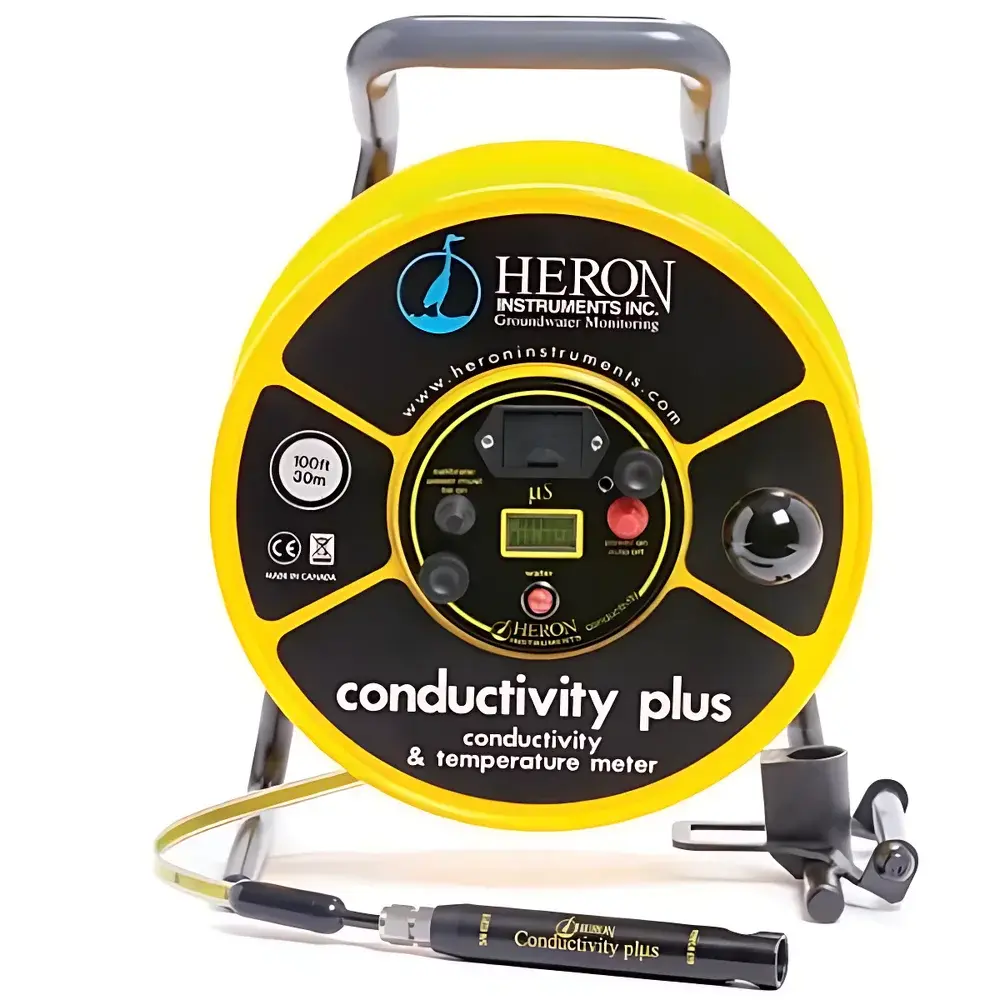
Heron C30/60/100 Conductivity Water Level Tape
| Brand | Heron |
|---|---|
| Origin | Canada |
| Model | C30 / C60 / C100 |
| Measurement Principle | Conductivity-based water level sensing with integrated temperature compensation |
| Conductivity Range | 0–80,000 µS/cm |
| Temperature Range | 0–50 °C |
| Conductivity Temperature Compensation Coefficient | 2.0 %/°C |
| Operating Tensile Strength | ASME-compliant stainless steel core |
| Max Operating Temperature | 50 °C |
| Product Category | Pressure-Independent Conductivity Water Level Sensor |
Overview
The Heron C30/60/100 Conductivity Water Level Tape is a field-deployable, direct-reading sensor system engineered for simultaneous measurement of water level, electrical conductivity (EC), and temperature in vertical boreholes, oil wells, risers, and estuarine monitoring points. Unlike pressure-based water level sensors—which require barometric compensation and are susceptible to density-driven errors—the C-series employs a calibrated conductive tape principle: the point at which the tape contacts water completes an electrical circuit, triggering precise position detection via embedded encoder wheels and resistive contact sensing. Conductivity is measured in situ using a dual-electrode cell mounted near the tape’s tip, enabling real-time assessment of salinity-driven stratification and intrusion dynamics. This makes the instrument especially valuable in coastal aquifer studies, saltwater intrusion monitoring, and contaminated site characterization where EC serves as a sensitive proxy for fluid composition shifts.
Key Features
- Triple-parameter acquisition: Synchronized depth, conductivity (0–80,000 µS/cm), and temperature (0–50 °C) readings recorded at user-defined intervals or on-demand.
- ASME-certified stainless steel tape core: Engineered for mechanical durability and consistent tensile performance under repeated deployment in abrasive or high-sediment environments.
- Integrated temperature compensation: Fixed 2.0 %/°C linear coefficient applied automatically to raw conductivity values—compliant with standard field calibration protocols per ASTM D1125 and ISO 7888.
- Backlit LCD display: Local readout of instantaneous EC, temperature, and depth without external power or data logging hardware; supports both metric and imperial depth units.
- Pressure-independent operation: Eliminates need for atmospheric reference lines, vent tubes, or differential transducers—ideal for unvented wells, sealed monitoring points, and tidal estuaries.
- Ruggedized housing and IP67-rated electronics: Designed for long-term exposure to humid, saline, or chemically aggressive field conditions.
Sample Compatibility & Compliance
The C30/60/100 is validated for use in freshwater, brackish, and full-strength seawater (up to 55,000 µS/cm typical), with stable response across pH 4–10 and redox ranges commonly encountered in groundwater and surface water systems. It meets applicable sections of ASTM D5092 (Standard Guide for Design and Installation of Ground Water Monitoring Wells) and supports regulatory reporting frameworks including US EPA Method 9060A (Conductivity) and ISO 10523 (Water quality — Determination of pH). Its passive sensing architecture requires no sample extraction or filtration, preserving in-situ geochemical integrity. The device is compatible with standard 2-inch and larger PVC, steel, or fiberglass casings and integrates seamlessly into existing well networks compliant with ITRC GW-1 and NGWA guidelines.
Software & Data Management
While the unit operates autonomously with local display, optional USB-C interface enables export of timestamped ASCII log files (.csv) containing depth, EC, temperature, and battery status. Data files conform to EPA-approved metadata structures for environmental monitoring submissions and support ingestion into common GIS platforms (e.g., ArcGIS Pro, QGIS) and LIMS systems. Firmware updates are performed via secure signed binaries, and audit trails—including calibration date, operator ID, and sensor verification codes—are retained in non-volatile memory. The system supports 21 CFR Part 11–compliant electronic records when paired with Heron’s certified desktop configuration utility (v3.2+), including role-based access control and immutable event logging.
Applications
- Coastal aquifer management: Tracking saline wedge migration and seasonal EC profiles in multi-level monitoring wells.
- Landfill leachate plume delineation: Identifying conductivity anomalies associated with chloride or sulfate contamination in downgradient observation wells.
- Estuarine mixing zone studies: Resolving vertical EC gradients during tidal cycles to quantify freshwater-saltwater interface dynamics.
- Oil and gas well integrity verification: Confirming annular fluid levels and detecting unexpected influxes via conductivity discontinuities.
- Long-term climate impact monitoring: Supporting USGS NWIS and UNESCO G-WADI initiatives through standardized, low-maintenance field instrumentation.
FAQ
Does the C30/60/100 require calibration before each use?
No—factory calibration is traceable to NIST-standard KCl solutions, and field verification is performed using a single-point check with 1413 µS/cm reference solution. Full recalibration is recommended annually or after 500 deployments.
Can the tape be used in highly turbid or sediment-laden water?
Yes—the conductive sensing mechanism is unaffected by suspended solids, oil films, or biofouling, unlike optical or ultrasonic methods. However, routine cleaning of the electrode tip is advised after use in high-organic environments.
Is the temperature compensation adjustable?
The default 2.0 %/°C coefficient aligns with natural waters at 25 °C; advanced users may configure alternative coefficients (1.8–2.2 %/°C) via firmware settings to match site-specific water chemistry.
What is the maximum recommended deployment depth for the C100 model?
The C100 variant supports up to 100 meters of vertical deployment with minimal tape sag error (< ±2 mm/m), verified under static load testing per ASME B30.9 standards.
How is battery life managed in remote installations?
The unit uses two replaceable AA lithium cells (10-year shelf life), delivering >10,000 measurements per set. Low-battery warnings appear on-screen, and voltage is logged with every reading for predictive maintenance planning.