
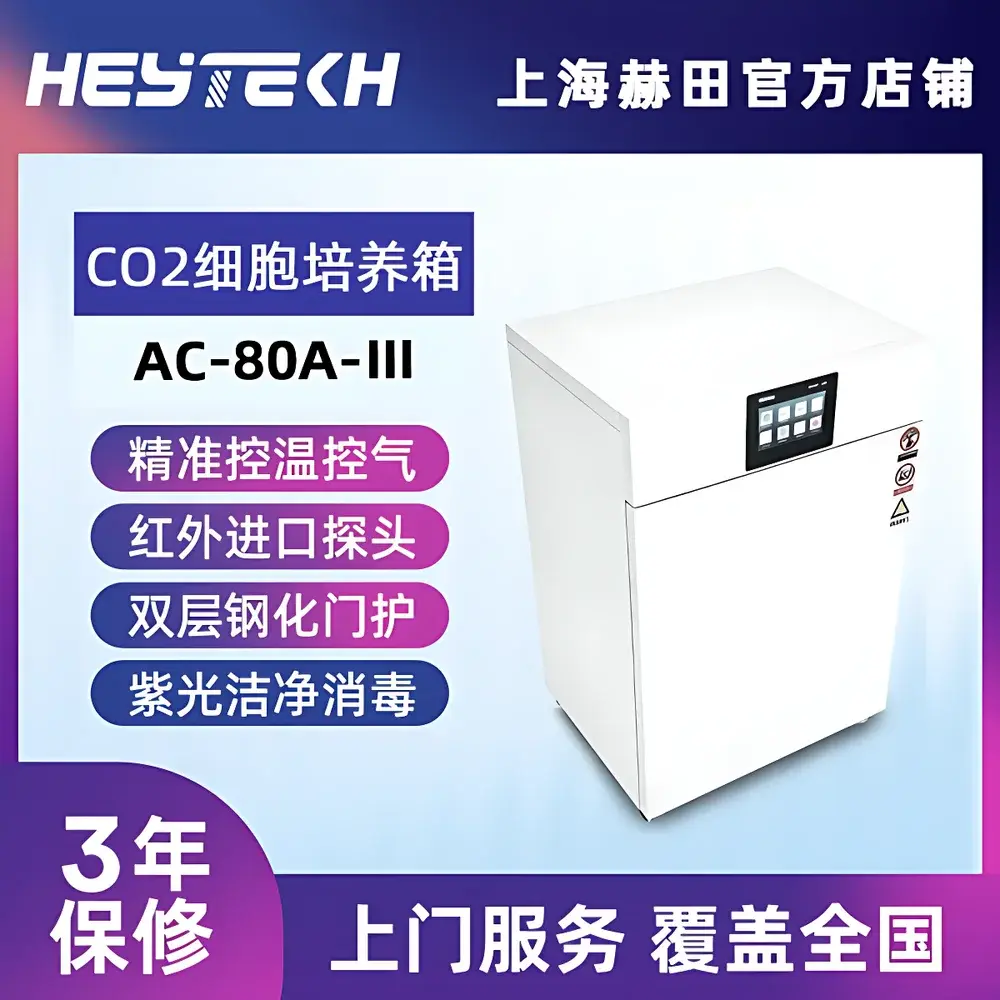
Herrytech YQ-80A-III Carbon Dioxide Incubator with Infrared CO₂ Sensor
| Brand | Herrytech |
|---|---|
| Origin | Shanghai, China |
| Model | YQ-80A-III |
| CO₂ Detection | Infrared (IR) |
| Temperature Control Range & Accuracy | Ambient +5°C to 65°C |
| CO₂ Concentration Control Range & Accuracy | 0–20% |
| Humidity Control | >95% RH (at stable 37°C operation) |
| Chamber Capacity | 80 L |
| Internal Dimensions | 400 × 400 × 500 mm (W × D × H) |
| Standard Configuration | Imported infrared microcomputer CO₂-specific concentration probe |
Overview
The Herrytech YQ-80A-III Carbon Dioxide Incubator is an engineered environmental control system designed for reliable, long-term mammalian cell culture under physiologically relevant conditions. It maintains precise, independent regulation of temperature, CO₂ concentration, and relative humidity—three critical parameters governing pH stability (via bicarbonate buffering), metabolic activity, and monolayer integrity in vitro. The incubator employs non-dispersive infrared (NDIR) spectroscopy for real-time, drift-free CO₂ measurement—a principle based on selective absorption of IR radiation at 4.26 µm—ensuring high specificity and minimal cross-sensitivity to water vapor or other atmospheric gases. Temperature is regulated via a PID-controlled heating system with platinum resistance (PT100) feedback, while humidity is sustained passively through stainless-steel water reservoirs enabling natural evaporation. Its 80 L working chamber supports standard T-25, T-75, and multi-well plate formats, making it suitable for routine passage, assay development, and small-scale bioprocessing workflows in academic, clinical, and pharmaceutical research settings.
Key Features
- Stainless steel inner chamber (SUS304) with seamless welding and electropolished finish—resistant to corrosion, autoclave-compatible, and compliant with ISO 14644-1 Class 5 cleanroom surface requirements.
- Imported Finnish NDIR CO₂ sensor with microcomputer-based closed-loop feedback control—provides continuous monitoring and automatic gas injection via solenoid valve, achieving ±0.1% CO₂ accuracy within the 0–20% range.
- Microprocessor-driven PID temperature controller with 0.1°C resolution and ±0.2°C uniformity across the chamber at 37°C (per ASTM E1910-22).
- Dual-door design: outer insulated door with magnetic seal and inner tempered glass door with independent anti-fog heating—reduces thermal and humidity transients during observation by >70% versus single-door systems.
- UV-C germicidal lamp (254 nm) integrated into the ceiling assembly, programmable for timed sterilization cycles—validated to achieve ≥3-log reduction of common airborne contaminants including Aspergillus niger, Staphylococcus aureus, and Bacillus subtilis spores.
- Real-time digital display of all operational parameters (temperature, CO₂ %, RH %, elapsed time) with password-protected parameter lockout—supports GLP-compliant documentation practices.
Sample Compatibility & Compliance
The YQ-80A-III accommodates standard cell culture vessels—including flasks (T-25 to T-225), Petri dishes (35–150 mm), multi-well plates (6–96-well), and roller bottles—without obstruction from internal fixtures. Its chamber geometry (400 × 400 × 500 mm) allows unimpeded airflow distribution per ISO 13408-1 Annex C guidelines for aseptic processing environments. The unit meets IEC 61010-1:2010 safety standards for laboratory equipment and complies with electromagnetic compatibility (EMC) requirements per EN 61326-1. While not certified for GMP manufacturing use, its operational traceability (via event logging and parameter retention) aligns with FDA 21 CFR Part 11 expectations for electronic records when paired with validated external data capture systems.
Software & Data Management
The embedded microcontroller logs timestamped values for temperature, CO₂, and humidity at user-selectable intervals (1–60 min), storing up to 30 days of data internally. Optional RS-485/Modbus RTU interface enables integration with centralized building management systems (BMS) or LIMS platforms for automated audit trail generation. All parameter changes are recorded with operator ID (if enabled), date/time stamp, and pre-/post-change values—supporting retrospective analysis during QA investigations or regulatory inspections. No proprietary software installation is required; raw CSV export is accessible via USB port for offline validation and statistical process control (SPC) charting.
Applications
This incubator serves as a foundational platform for applications requiring strict physiological mimicry: primary human cell expansion (e.g., fibroblasts, keratinocytes), induced pluripotent stem cell (iPSC) maintenance, co-culture models for tumor microenvironment studies, embryonic development assays, and IVF embryo incubation (as a non-clinical grade support instrument). It is routinely deployed in departments of molecular oncology, regenerative medicine, pharmacology (cytotoxicity screening), and vaccine development—particularly where reproducibility across serial passages or inter-laboratory collaborations is essential. Its 37°C / 5% CO₂ / >95% RH operational profile satisfies USP <1043> recommendations for cell-based assay environmental controls.
FAQ
What calibration standards are recommended for the infrared CO₂ sensor?
The NDIR sensor is factory-calibrated using NIST-traceable 5.00% CO₂ in nitrogen. Annual recalibration against certified gas standards (e.g., Air Liquide CertiGas®) is advised per ISO/IEC 17025 requirements.
Is the humidity level actively controlled or passively maintained?
Humidity is passively sustained via stainless-steel water pans; no ultrasonic or steam generator is included. At 37°C, equilibrium RH exceeds 95% when pans are filled to indicated level and door openings are minimized.
Can this incubator be used for hypoxic cell culture (e.g., 1–5% O₂)?
No. The YQ-80A-III regulates only CO₂ and temperature. Oxygen modulation requires tri-gas (O₂/CO₂/N₂) capability, available in Herrytech’s YQ-TG series.
Does the UV lamp cycle require manual initiation?
Yes—UV sterilization is manually triggered via front-panel menu; no automatic daily cycle is built-in to prevent unintended exposure during active culture periods.
What power supply specifications does the unit require?
Single-phase 220 VAC ±10%, 50 Hz, with dedicated 16 A circuit breaker and grounded outlet—no voltage stabilizer needed under typical lab mains conditions.



