
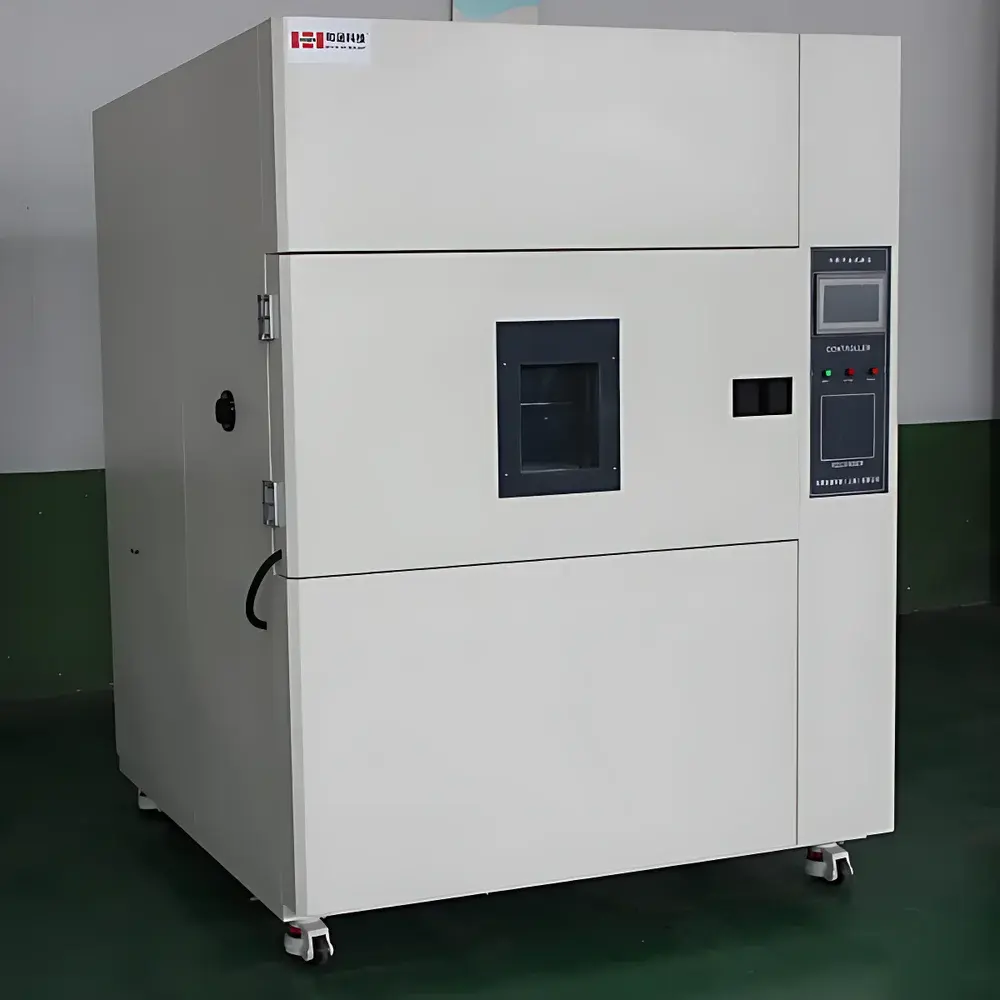
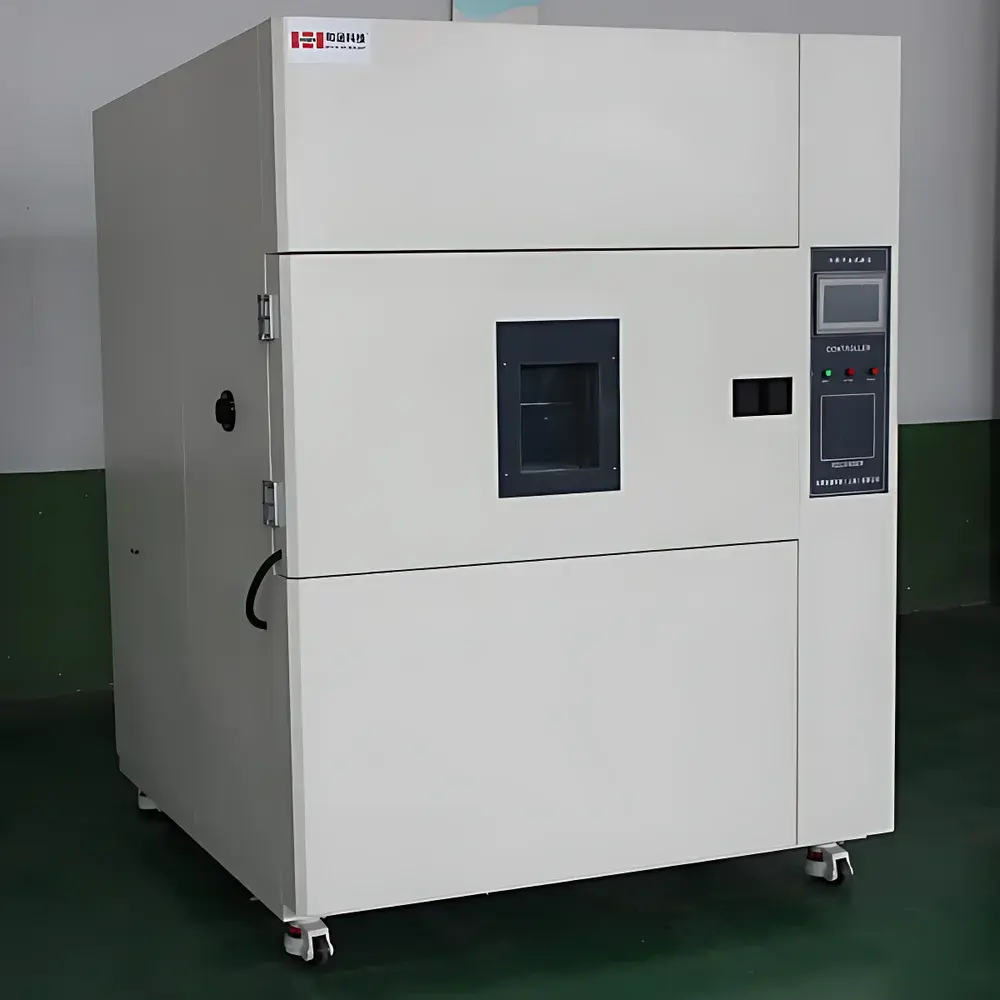
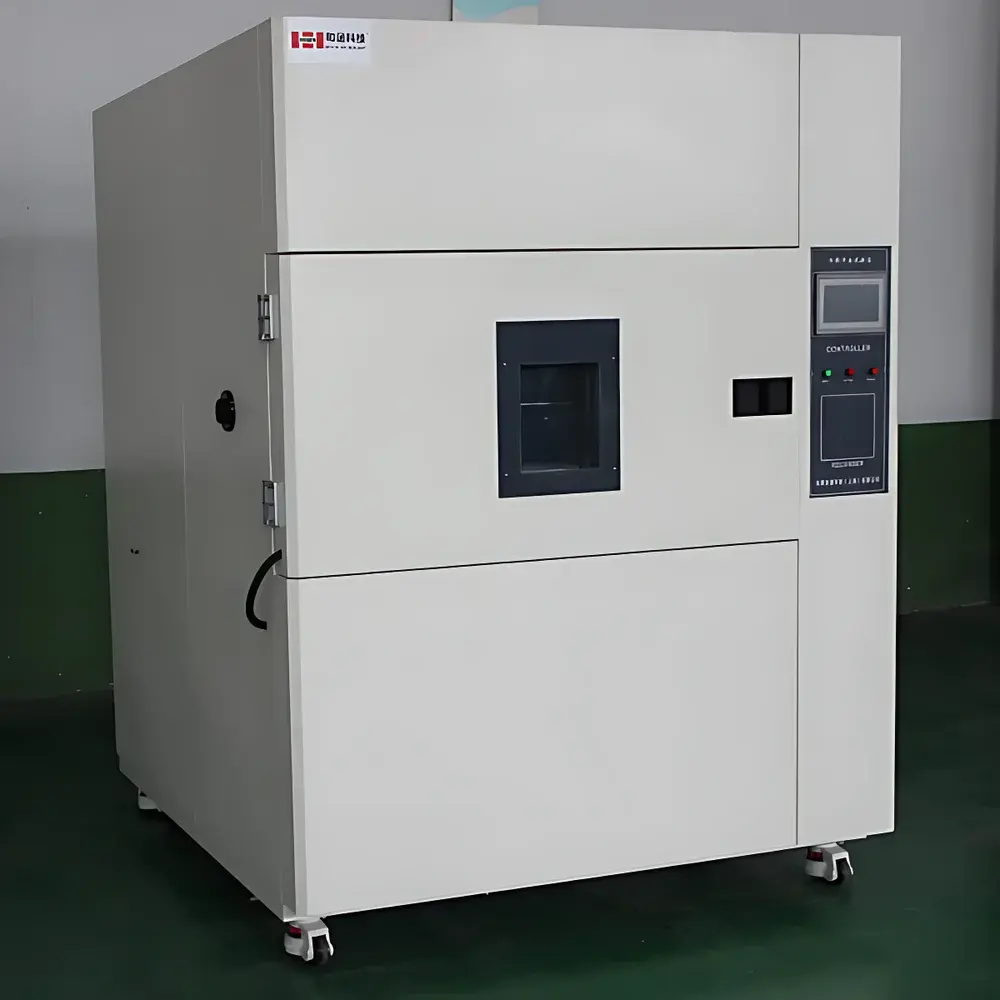
HESON HS-CJ-500B Thermal Shock Test Chamber
| Brand | HESON |
|---|---|
| Origin | Shanghai, China |
| Manufacturer Type | Direct Manufacturer |
| Product Category | Domestic |
| Model | HS-CJ-500B |
| Price Range | USD 28,000 – 70,000 (FOB Shanghai) |
| High-Temperature Zone Range | RT+10°C to +200°C |
| Low-Temperature Zone Range | −10°C to −65°C (B-type configuration) |
| Thermal Shock Temperature Range | +60°C to −55°C |
| Temperature Stability | ±0.5°C |
| Temperature Uniformity | ±2.0°C |
| Heating Rate | ≤30 min (RT to +200°C) |
| Cooling Rate | ≤55 min (+25°C to −65°C) |
| Door Switching Time | ≤10 s |
| Temperature Recovery Time | ≤5 min |
| Controller Resolution | 0.1°C (temperature), 0.01°C (display) |
| Power Supply | AC 380 V ±10%, 50 ±0.5 Hz, 3-phase 4-wire + PE |
Overview
The HESON HS-CJ-500B Thermal Shock Test Chamber is a dual-zone, mechanically actuated thermal shock system engineered for rapid, repeatable exposure of test specimens to extreme temperature transitions. It operates on the principle of physical separation between high- and low-temperature chambers, with specimens transferred via a horizontal or vertical lift mechanism—ensuring minimal thermal mass interference and high-fidelity shock profile replication. Unlike single-chamber ramp-based systems, this unit delivers true step-change thermal stress through physical relocation of samples between independently controlled environments. Designed for accelerated reliability validation in electronics, automotive components, aerospace materials, and advanced polymers, the HS-CJ-500B supports qualification testing per international standards including IEC 60068-2-14 (Test N), MIL-STD-810H Method 503.5, and GJB 150.5A–2009. Its architecture enables precise simulation of field-relevant thermal cycling conditions—including cold-to-hot and hot-to-cold transitions—with programmable dwell times, cycle counts, and start-point selection (high- or low-temperature initiation).
Key Features
- Dual independent chamber design: High-temperature zone (RT+10°C to +200°C) and low-temperature zone (−10°C to −65°C, B-type) with separate refrigeration and heating circuits.
- High-speed transfer mechanism: Specimen carrier completes chamber switching in ≤10 seconds, minimizing transition delay and ensuring compliance with stringent recovery-time requirements (≤5 minutes).
- Advanced PID + PLC control architecture: Fully automated microprocessor-based regulation with auto-tuning capability; all critical functions—including compressor staging, heater sequencing, and airflow modulation—managed by industrial-grade programmable logic controller.
- Robust thermal insulation: 150 mm thick polyurethane (PU) foam + mineral wool composite layer minimizes heat leakage and improves energy efficiency during extended cycling.
- True-color touchscreen controller: HESON E-series 7-inch TFT LCD interface with multilingual (English/Chinese) menu navigation, USB mouse/touch-pen support, and real-time graphical display of chamber status and setpoint tracking.
- Comprehensive safety interlocks: Dual-stage overtemperature protection, phase-sequence monitoring, compressor high-pressure cutout, fan overcurrent detection, ground-fault circuit interruption, and emergency power-off activation upon voltage instability.
- Modular refrigeration system: Two-stage cascade cooling using R404A (high stage) and R23 (low stage); all compressors sourced from Tier-1 European or North American OEMs and certified for long-term operation under cyclic load.
Sample Compatibility & Compliance
The HS-CJ-500B accommodates test specimens up to 80 × 80 × 80 cm (W×H×D), with internal chamber volume of 500 L and external footprint of 190 × 230 × 155 cm. A standard 50 mm diameter test port (sealable with silicone gasket) permits feedthrough of power, signal, or sensor cables. The stainless steel (SUS 304) interior resists corrosion from condensate and chemical outgassing, while the SECC outer shell with epoxy-powder coating ensures durability in laboratory and production-floor environments. This system meets full regulatory alignment with GB/T 2423.22–2002 (Temperature Change), GJB 150.5A–2009 (Temperature Shock), IEC 60068-2-14, and EIA-364-32 (Thermal Shock for Connectors). Optional data logging via YOKOGAWA DR230 or integrated controller memory supports GLP/GMP audit trails when paired with time-stamped CSV export.
Software & Data Management
The embedded HESON E controller provides full-cycle programmability—including up to 999 segments per profile, 999 cycles per test, and user-defined dwell durations at each temperature extreme. RS-232 and optional RS-485 interfaces enable bidirectional communication with host PCs running proprietary Windows-based software for remote program editing, real-time data acquisition, alarm history review, and report generation (PDF/Excel). All temperature readings are traceable to T-type thermocouples calibrated per ISO/IEC 17025–accredited procedures. Audit-ready features include electronic signature support, change logs for parameter edits, and tamper-proof timestamping—all compliant with FDA 21 CFR Part 11 requirements when deployed in regulated manufacturing environments.
Applications
This chamber is routinely deployed in failure analysis labs and quality assurance departments for evaluating solder joint integrity in PCB assemblies, delamination resistance in multilayer ceramic capacitors (MLCCs), seal performance in hermetic packages, and dimensional stability in carbon-fiber composites. In automotive Tier-1 supplier validation, it replicates under-hood thermal transients experienced during engine start-stop cycles. For medical device manufacturers, it verifies housing material resilience across sterilization–cool-down sequences. Additional use cases include qualification of battery module thermal management systems, optical lens adhesion testing under cryogenic exposure, and accelerated aging of encapsulated MEMS sensors.
FAQ
What is the difference between thermal shock and temperature cycling?
Thermal shock involves rapid transfer between two extreme, stable temperature zones—inducing high strain rates due to instantaneous differential expansion. Temperature cycling uses gradual ramping within a single chamber, resulting in lower mechanical stress but longer test duration.
Can the HS-CJ-500B perform tests below −65°C?
The B-type configuration supports down to −65°C; C-type models extend to −75°C. Custom configurations for ultra-low temperatures require consultation with HESON engineering prior to order.
Is the controller compatible with LabVIEW or MATLAB?
Yes—via ASCII protocol over RS-232 or TCP/IP (with optional Ethernet module), enabling native integration into automated test systems using SCPI-like command sets.
Does the system include calibration documentation?
Each unit ships with factory calibration certificate covering temperature uniformity, stability, and recovery time—traceable to national metrology institutes (NIM, China) with uncertainty budgets provided.
What maintenance intervals are recommended for the refrigeration system?
Compressor oil analysis and filter-drier replacement every 2,000 operating hours; full system leak check and refrigerant recharge annually—or after any major chamber door seal replacement.



