
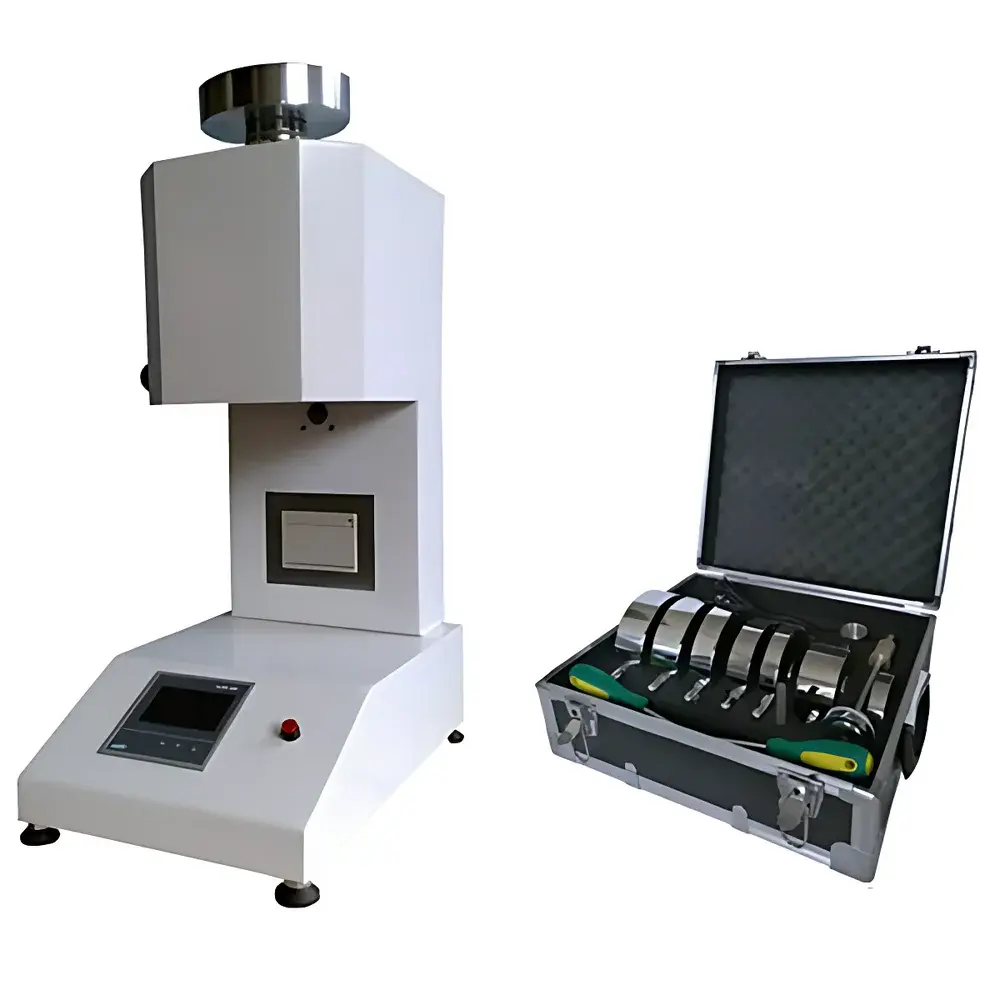
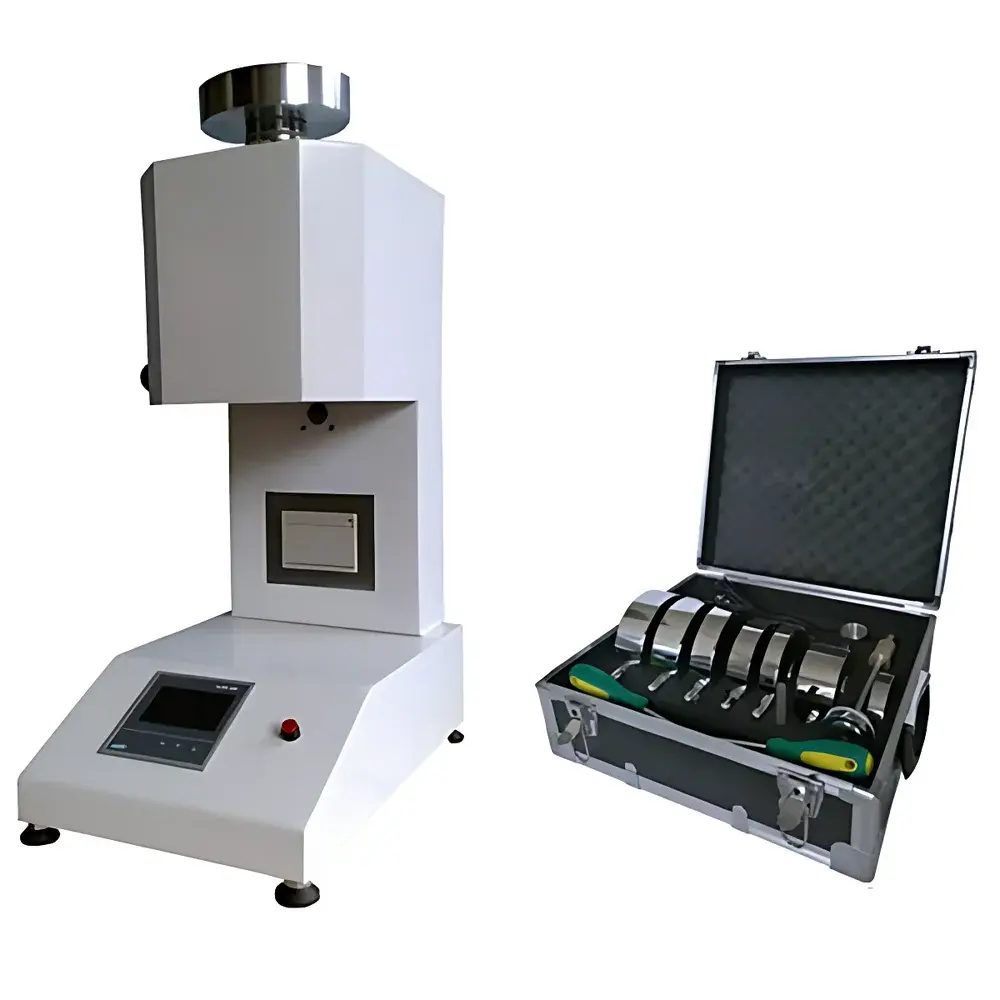
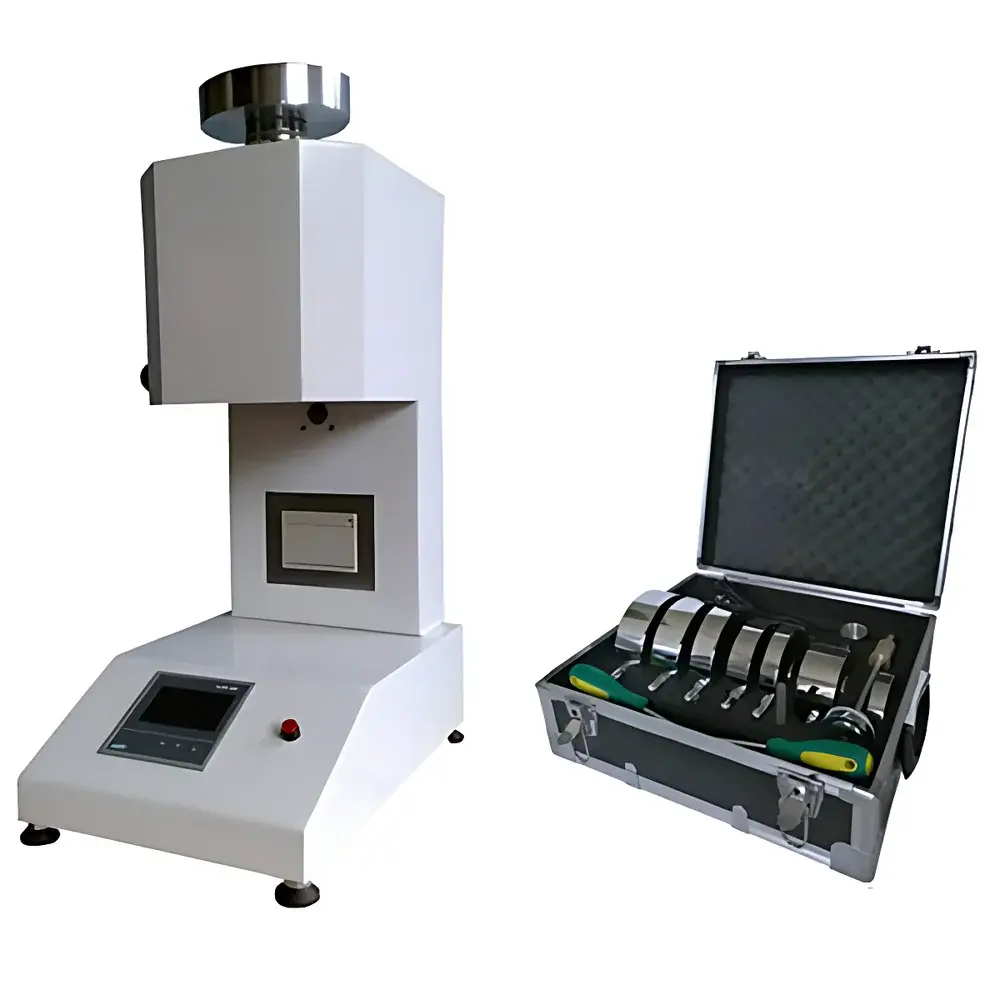
HESON HS-XNR-400A Melt Flow Indexer
| Brand | HESON |
|---|---|
| Origin | Shanghai, China |
| Manufacturer Type | Direct Manufacturer |
| Product Origin | Domestic (China) |
| Model | HS-XNR-400A |
| Price Range | USD 150–15,000 (FOB) |
| Die Orifice Diameter | Φ2.095 ± 0.005 mm |
| Die Orifice Length | 8.000 ± 0.025 mm |
| Barrel Inner Diameter | Φ9.550 ± 0.007 mm |
| Barrel Length | 152.0 ± 0.1 mm |
| Piston Head Diameter | 9.474 ± 0.007 mm |
| Piston Head Length | 6.350 ± 0.100 mm |
| Temperature Range | Ambient to 450 °C |
| Temperature Stability | ±0.2 °C |
| Operating Interface | Keypad Input |
| Display | LCD Screen |
| Reporting | Integrated Thermal Printer |
| Material Feed Method | Manual Loading |
| Melt Cutting Modes | Manual / Time-Controlled / Automatic |
| Test Principle | Gravimetric (MFR, ASTM D1238 / ISO 1133 Compliant) |
| Standard Load Masses (8 Levels) | 0.325 kg, 1.2 kg, 2.16 kg, 3.8 kg, 5.0 kg, 10.0 kg, 12.5 kg, 21.6 kg |
| Die Material | Tungsten Carbide |
| Calibration Compliance | GB/T 3682–2000, ISO 1133:1997, ASTM D1238–2023 |
Overview
The HESON HS-XNR-400A Melt Flow Indexer is a precision-engineered gravimetric instrument designed for the standardized determination of Melt Mass Flow Rate (MFR) and Melt Volume Flow Rate (MVR) of thermoplastic polymers under controlled temperature and load conditions. Based on the fundamental principle of extrusion rheometry—where molten polymer is forced through a standardized capillary die under defined gravitational or applied mass loading—the HS-XNR-400A delivers repeatable, traceable results aligned with international test standards. Its microprocessor-controlled thermal system enables rapid heating (≤15 min from ambient to 400 °C), precise isothermal stabilization (±0.2 °C over full 450 °C range), and automatic recovery after sample loading—critical for minimizing thermal history effects and ensuring inter-laboratory reproducibility. The instrument operates exclusively in gravimetric mode per ISO 1133-1 and ASTM D1238, eliminating volumetric measurement variables such as melt density uncertainty.
Key Features
- Microprocessor-driven test sequence execution: fully automated timing, cutting, calculation, and reporting per pre-programmed standard protocols (e.g., ISO 1133 Method A)
- High-stability heating block with PID-controlled dual-zone thermal regulation, ensuring axial and radial temperature uniformity across the barrel and die assembly
- Precision-machined tungsten carbide die (Φ2.095 ± 0.005 mm × 8.000 ± 0.025 mm) certified to ISO 1133 Annex B dimensional tolerances
- Calibrated barrel geometry (Φ9.550 ± 0.007 mm inner diameter; 152.0 ± 0.1 mm length) and piston assembly (9.474 ± 0.007 mm head diameter) meeting ASTM D1238 dimensional requirements
- Eight-tier standard load configuration (0.325–21.6 kg) with NIST-traceable stainless-steel weights supplied; optional load extension kits available for high-viscosity engineering resins
- Integrated thermal printer supporting GLP-compliant report generation—including date/time stamp, operator ID field, test parameters, raw cut masses, calculated MFR (g/10 min), and pass/fail status against specification limits
- LCD interface with multilingual menu support (English default); keypad navigation optimized for glove-compatible operation in production lab environments
Sample Compatibility & Compliance
The HS-XNR-400A accommodates a broad spectrum of thermoplastic materials including polyethylene (PE), polypropylene (PP), polycarbonate (PC), ABS, PET, PBT, and high-temperature resins such as polyetherimide (PEI) and polyphenylene sulfide (PPS). It supports both virgin and compounded formulations containing fillers (e.g., glass fiber, mineral, carbon black) up to 40 wt% loading, provided melt homogeneity is verified prior to extrusion. All mechanical dimensions, thermal performance, and procedural logic comply with ISO 1133:2011 (Parts 1 & 2), ASTM D1238–23, GB/T 3682–2018 (revised version of GB/T 3682–2000), and DIN ISO 1133. The system architecture supports audit-ready documentation for ISO/IEC 17025-accredited laboratories and satisfies foundational requirements for FDA-regulated polymer processing validation under 21 CFR Part 11 when paired with secure user access controls and electronic signature modules.
Software & Data Management
While the HS-XNR-400A operates as a standalone benchtop unit with embedded firmware, its thermal printer output generates machine-readable reports compatible with LIMS integration via OCR or direct serial export (RS-232 port optional). Firmware revision logs, calibration history, and test parameter archives are retained in non-volatile memory for ≥10,000 cycles. Optional PC-based data acquisition software (sold separately) enables real-time melt flow curve plotting, statistical process control (SPC) charting per ASTM E2587, batch trending, and export to CSV, PDF, or XML formats compliant with 21 CFR Part 11 electronic record requirements—including time-stamped audit trails, role-based permissions, and electronic signatures.
Applications
- Quality control of incoming polymer pellets and regrind in injection molding and extrusion facilities
- Routine monitoring of melt viscosity shifts during polymerization reactor optimization and catalyst development
- Batch-to-batch consistency verification for medical-grade compounds (ISO 10993-12 compliant materials)
- Stability assessment of recycled HDPE/PP streams subjected to multiple thermal histories
- Pre-qualification screening of flame-retardant or conductive composites prior to rheological characterization on rotational rheometers
- Supporting technical data sheet generation for ISO 9001-certified material suppliers
FAQ
What standards does the HS-XNR-400A officially support?
It conforms to ISO 1133:2011 (Parts 1 and 2), ASTM D1238–23, GB/T 3682–2018, and DIN ISO 1133. Full dimensional certification documentation is provided with each instrument.
Is the die made of hardened steel or tungsten carbide?
The standard die is precision-ground tungsten carbide (WC), offering superior wear resistance and dimensional stability over >5,000 test cycles—essential for high-volume QC labs.
Can the instrument perform volume flow rate (MVR) measurements?
No—the HS-XNR-400A is configured exclusively for gravimetric MFR testing per ISO 1133-1. MVR requires integrated piston displacement transduction and melt density input, which this model does not include.
Does it support GLP-compliant audit trails?
Yes—when used with optional PC software and configured user roles, it meets core GLP data integrity requirements including electronic signatures, change control logs, and immutable test records.
What maintenance intervals are recommended for routine calibration?
Temperature sensor calibration is advised every 6 months using NIST-traceable reference thermocouples; die and barrel dimensional verification should occur annually per ISO 1133 Annex B protocols.





