
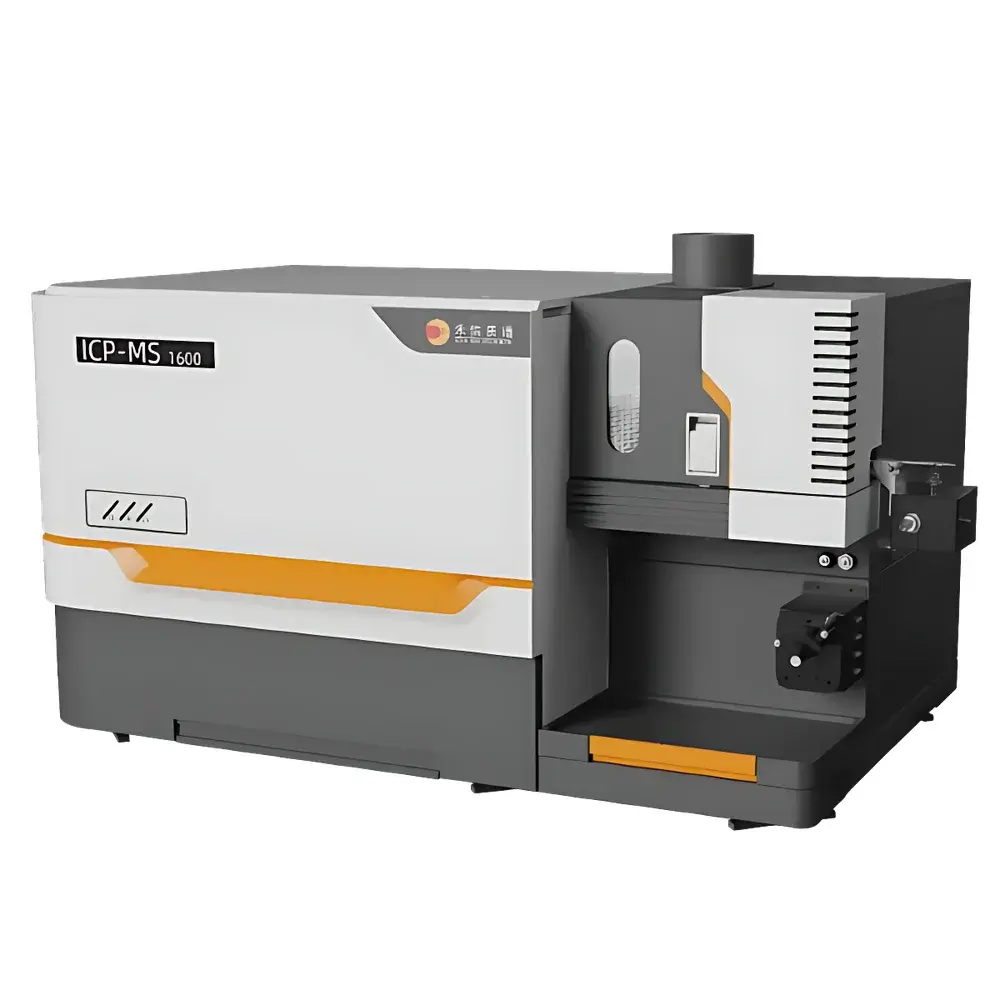
HEXIN ICP-MS 1600 Inductively Coupled Plasma Mass Spectrometer
| Brand | HEXIN MASS SPECTROMETRY |
|---|---|
| Origin | Guangdong, China |
| Manufacturer Type | Authorized Distributor |
| Product Origin | Domestic (China) |
| Model | ICP-MS 1600 |
| Instrument Type | Quadrupole Mass Spectrometer |
| Application Environment | Laboratory, Mobile Lab, Online Monitoring |
| Mass Range (amu) | Available upon request |
| Unit Mass Resolution (amu) | Available upon request |
| Detection Limit (ng·L⁻¹) | Available upon request |
| Sensitivity (Mcps / mg·L⁻¹) | Available upon request |
| Short-Term Stability (RSD) | Available upon request |
| Long-Term Stability (RSD) | Available upon request |
Overview
The HEXIN ICP-MS 1600 is a compact, high-performance quadrupole-based inductively coupled plasma mass spectrometer engineered for trace elemental analysis, isotopic ratio measurement, and speciation studies in demanding analytical laboratories. It integrates a robust RF-driven argon plasma source—capable of achieving >6,000 K ionization temperatures—with a thermally stable quadrupole mass filter and low-noise electron multiplier detection system. This architecture enables efficient ionization of >90% of the periodic table elements, including refractory species (e.g., B, P, Si, W), while minimizing polyatomic interferences through optimized collision/reaction cell geometry and kinetic energy discrimination. Designed for compliance with ISO/IEC 17025 requirements for testing laboratories, the ICP-MS 1600 delivers reproducible quantification across six to eight orders of magnitude linear dynamic range, supporting both routine regulatory analysis and research-grade isotopic fingerprinting.
Key Features
- Compact Footprint: 40% reduction in overall instrument volume versus prior-generation systems—measuring under 1.2 m² floor space—enabling deployment in space-constrained labs, mobile analytical platforms, or cleanroom-integrated process monitoring stations.
- Adaptive Plasma Interface: Patented three-axis (X/Y/Z) automated torch positioning system ensures repeatable plasma sampling geometry, reducing signal drift during extended runs and improving inter-day precision.
- Enhanced Thermal Management: Internal recirculating cooling system with 400% increased heat exchange surface area maintains critical components—including RF generator, vacuum pumps, and detector electronics—at stable operating temperatures (±0.5 °C), directly contributing to long-term signal stability.
- Electromagnetic Immunity: Multi-layered Faraday shielding, grounded RF chamber design, and filtered power distribution suppress external EMI/RFI noise, ensuring consistent mass calibration and peak shape fidelity in shared laboratory environments.
- Modular Power Architecture: Isolated, hot-swappable power modules minimize downtime during maintenance and reduce risk of cascading failure—supporting continuous operation in GLP-compliant environmental or clinical testing workflows.
Sample Compatibility & Compliance
The ICP-MS 1600 accepts liquid samples introduced via standard nebulizers (e.g., Meinhard, PFA microflow) and desolvating systems (e.g., Aridus II, Apex Q). It supports direct coupling with HPLC, IC, and CE for elemental speciation analysis (e.g., As(III)/As(V), Cr(III)/Cr(VI)). Solid sample analysis is enabled via laser ablation (LA-ICP-MS) using compatible third-party ablation cells. The system meets mechanical and electrical safety requirements per IEC 61010-1 and electromagnetic compatibility standards IEC 61326-1. Software audit trails, user access controls, and electronic signature support align with FDA 21 CFR Part 11 and EU Annex 11 for regulated environments.
Software & Data Management
HEXIN’s proprietary MassHunter-compatible acquisition and processing software provides full control over plasma parameters (RF power, gas flows), mass scanning modes (peak hopping, scanning, time-resolved), and interference correction algorithms (mathematical, on-mass, and reaction-gas based). Raw data files conform to mzML 1.1 open format. Integrated reporting tools generate ASTM E2912-compliant calibration curves, QC charts (Levey-Jennings, Shewhart), and isotopic ratio uncertainty propagation per ISO 11097. All method files, spectra, and audit logs are stored in an encrypted SQLite database with configurable retention policies and role-based export permissions.
Applications
- Environmental monitoring: Ultra-trace metal analysis in drinking water (EPA Method 6020B), seawater, soil digests, and airborne particulate matter (PM₂.₅/PM₁₀).
- Clinical and biological research: Quantification of essential/toxic elements (e.g., Se, Cd, Pb, U) in serum, urine, and tissue homogenates per CLIA and CAP guidelines.
- Geochemical and nuclear forensics: Isotopic ratio determination (e.g., ²³⁵U/²³⁸U, ⁸⁷Sr/⁸⁶Sr) with internal standardization using ¹¹⁵In or ¹⁹³Ir.
- Materials science: Impurity profiling in high-purity silicon, Li-ion battery cathode materials, and semiconductor precursors (ASTM F3012).
- Food safety: Screening for heavy metals (As, Cd, Pb, Hg) in infant formula, rice, and dietary supplements per EU Commission Regulation (EU) No 2023/915.
FAQ
What mass calibration standards are supported?
Certified multi-element solutions (e.g., Inorganic Ventures ICV-4, Spex CertiPrep MS-MIX-2) covering masses from ⁷Li to ²³⁸U, traceable to NIST SRM 3100 series.
Is the system compatible with collision/reaction gases?
Yes—supports He, H₂, NH₃, and O₂ gas delivery with programmable flow control (0–5 sccm) and real-time reaction kinetics monitoring.
Can the instrument be integrated into LIMS or ELN platforms?
Native support for ASTM E1578-compliant instrument interfacing via OPC UA and HTTP REST API; optional middleware available for LabWare LIMS and Benchling ELN integration.
What vacuum system configuration is used?
Dual-stage turbomolecular pumping: 300 L/s primary pump backed by dry scroll forepump, achieving base pressure <5 × 10⁻⁸ mbar in the mass analyzer region.
Are application-specific method packages available?
Pre-validated methods for EPA 6020B, ISO 17294-2, and USP / are included; custom method development services offered under HEXIN’s Application Support Program.
Related Products







