
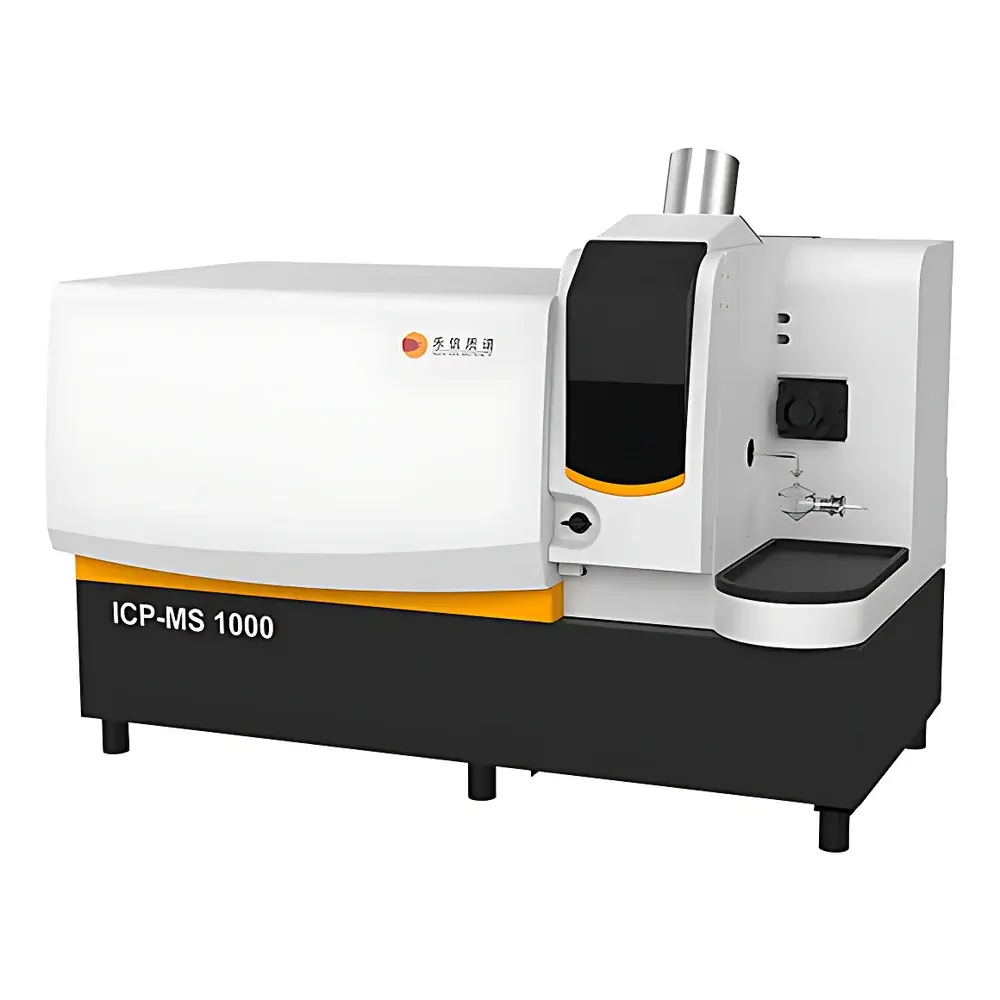
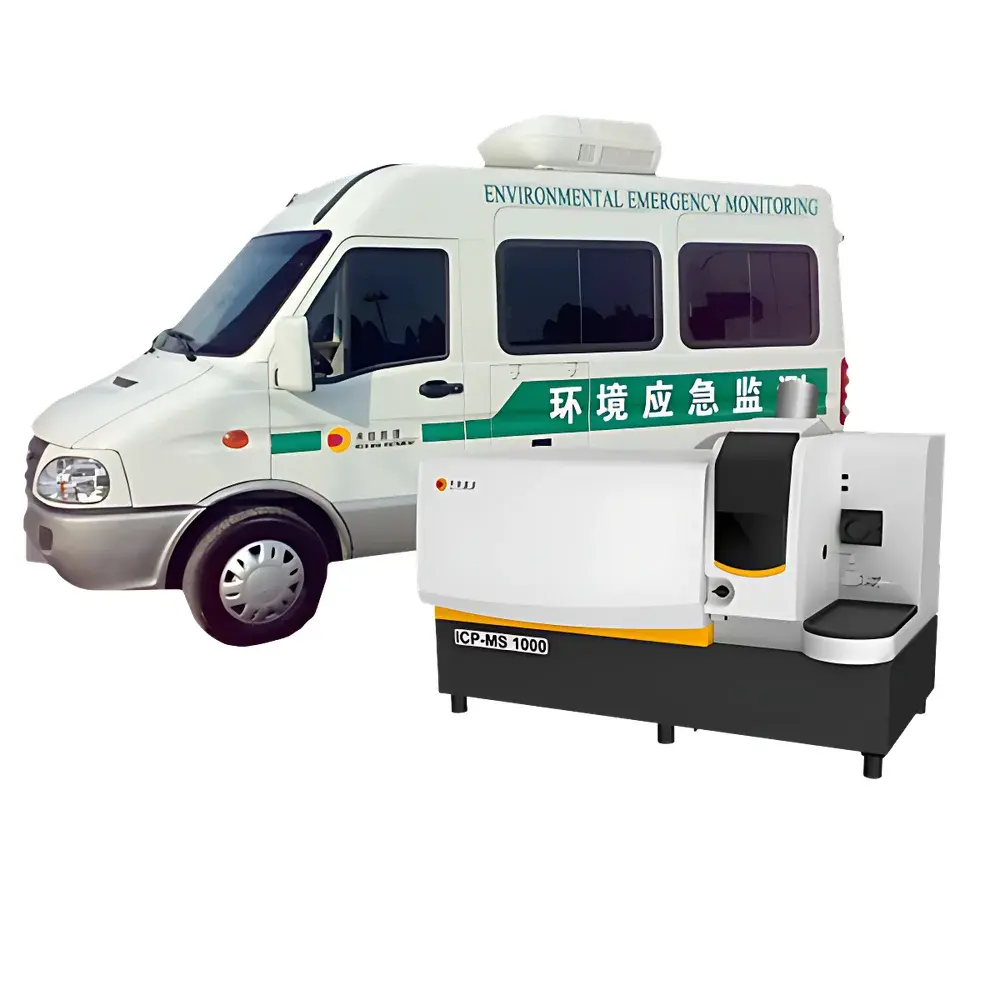
Hexin Mass Spectrometry ICP-MS 1000 Mobile Emergency Heavy Metal Monitoring System
| Brand | Hexin Mass Spectrometry |
|---|---|
| Origin | Guangdong, China |
| Model | ICP-MS 1000 |
| Configuration | Vehicle-mounted integrated system with ICP-MS, sampling toolkit, power & gas supply units, communication module, and environmental control subsystem |
| Vacuum System | Dual turbo-molecular pumps (cold-start time ≈ 30 min) |
| Sample throughput | ~3–5 min per sample (post-preparation) |
| Power Supply | Dual-mode (AC grid + imported industrial-grade generator) |
| Vibration isolation | Full-vehicle active/passive damping architecture |
| Air purification | Onboard catalytic filtration compliant with GB/T 18883–2022 indoor air quality standards |
| Regulatory alignment | Designed to support EPA Method 200.8, ISO 17294-2:2016, and China HJ 680–2013 workflows |
Overview
The Hexin Mass Spectrometry ICP-MS 1000 Mobile Emergency Heavy Metal Monitoring System is a fully integrated, vehicle-based analytical platform engineered for rapid, field-deployable quantification of trace heavy metals in aqueous environmental matrices. Built around a high-sensitivity inductively coupled plasma mass spectrometer (ICP-MS), the system implements quadrupole mass filtering coupled with collision/reaction cell technology to resolve polyatomic interferences and deliver sub-pg/L detection limits for elements including As, Cd, Cr, Cu, Hg, Ni, Pb, Sb, and U. Unlike benchtop ICP-MS instruments requiring climate-controlled laboratories, this mobile unit maintains analytical integrity under dynamic operational conditions—enabling real-time decision support during contamination incidents, regulatory compliance verification, and spatially distributed water quality surveillance. Its architecture bridges the gap between fixed online monitoring networks and laboratory-grade metrology, delivering lab-equivalent data fidelity directly at sampling points without sample transport delays or preservation artifacts.
Key Features
- Dual-stage vacuum architecture: Equipped with two high-capacity turbo-molecular pumps, achieving base pressure <1×10⁻⁸ mbar within 30 minutes of cold start—ensuring stable ion transmission and minimizing downtime between field deployments.
- Field-optimized sample throughput: Integrated automated sample introduction (micro-flow nebulizer + cyclonic spray chamber) and fast-scanning mass acquisition enable full elemental analysis (including isotopic ratio measurement) in ≤5 minutes per prepared aqueous sample.
- Redundant, mission-critical power management: Seamless switching between municipal AC input (220 V / 50 Hz) and a certified industrial diesel generator (rated ≥15 kVA), supporting continuous operation over 72 hours without external grid dependency.
- Structural resilience for mobile operation: All optical, vacuum, and detector assemblies are mounted on vibration-damped optical tables; the chassis incorporates hydraulic leveling and seismic-grade isolators meeting ISO 10816-1 vibration severity Class A specifications.
- Operator-centric environmental control: Closed-loop air handling system featuring HEPA + activated carbon + catalytic oxidation stages ensures exhaust emissions comply with GB/T 18883–2022 and WHO indoor air guidelines—protecting both personnel health and ambient air quality.
Sample Compatibility & Compliance
The system is validated for direct analysis of filtered surface water, groundwater, wastewater effluents, and drinking water sources (0.45 µm membrane filtration required). Matrix tolerance supports total dissolved solids (TDS) up to 0.2% w/v without dilution. Calibration linearity (R² > 0.9999) is verified across 0.001–100 ng/L ranges for regulated priority metals, with recovery rates of 92–105% in spiked natural water matrices. Data acquisition and reporting conform to GLP principles and support audit trails required under China’s HJ 630–2011 and US EPA 200.8 revision 5. Instrument software includes electronic signature capability aligned with FDA 21 CFR Part 11 Annex 11 expectations for regulated environmental testing.
Software & Data Management
Control and data processing are executed via Hexin’s proprietary MassHunter™-compatible acquisition suite (v4.2+), featuring method-driven workflows, real-time interference correction algorithms, and automated QC flagging (e.g., internal standard drift >5%, blank elevation >3σ). Raw data files (.raw) adhere to mzML 1.1 open format standards. Field-generated reports include full metadata (GPS coordinates, timestamp, operator ID, instrument status logs) and are exportable as PDF/A-1b or CSV for integration into national environmental information platforms (e.g., China’s National Environmental Monitoring Network—NEMN). Remote diagnostics and firmware updates are supported via LTE/5G-enabled secure VPN tunneling.
Applications
- Rapid response to industrial spill events (e.g., antimony leakage from mining operations, lead release from battery recycling facilities)
- Supplemental monitoring of river basins lacking permanent online stations—enabling quarterly or event-triggered transect surveys
- Verification of remediation efficacy at contaminated sites (e.g., post-excavation groundwater plume tracking)
- Supporting emergency regulatory actions under China’s Environmental Protection Law Article 47 and the Emergency Response Plan for Sudden Environmental Incidents
- Inter-laboratory comparison studies and proficiency testing programs administered by CNAS-accredited reference labs
FAQ
What sample preparation is required prior to analysis?
Filtered (0.45 µm) aqueous samples require only acidification to 2% v/v HNO₃; no digestion is needed for dissolved metal fraction analysis.
Can the system operate unattended overnight?
Yes—scheduled batch runs with auto-sampler integration and remote alarm notification (SMS/email) support unattended 24-hour operation.
Is isotopic ratio measurement supported?
Yes—the quadrupole mass analyzer provides reproducible ¹¹³Cd/¹¹¹Cd, ²⁰⁸Pb/²⁰⁶Pb, and ¹²¹Sb/¹²³Sb ratios with RSD <1.2% (n=6) under field conditions.
How is calibration traceability maintained?
Certified multi-element standards (NIST SRM 3100 series) are used daily; calibration verification standards (CVS) are analyzed every 10 samples per batch.
What cybersecurity protocols are implemented?
All network interfaces enforce TLS 1.2+ encryption; local storage uses FIPS 140-2 validated AES-256 disk encryption; user access follows role-based permissions with session timeout enforcement.
Related Products







