
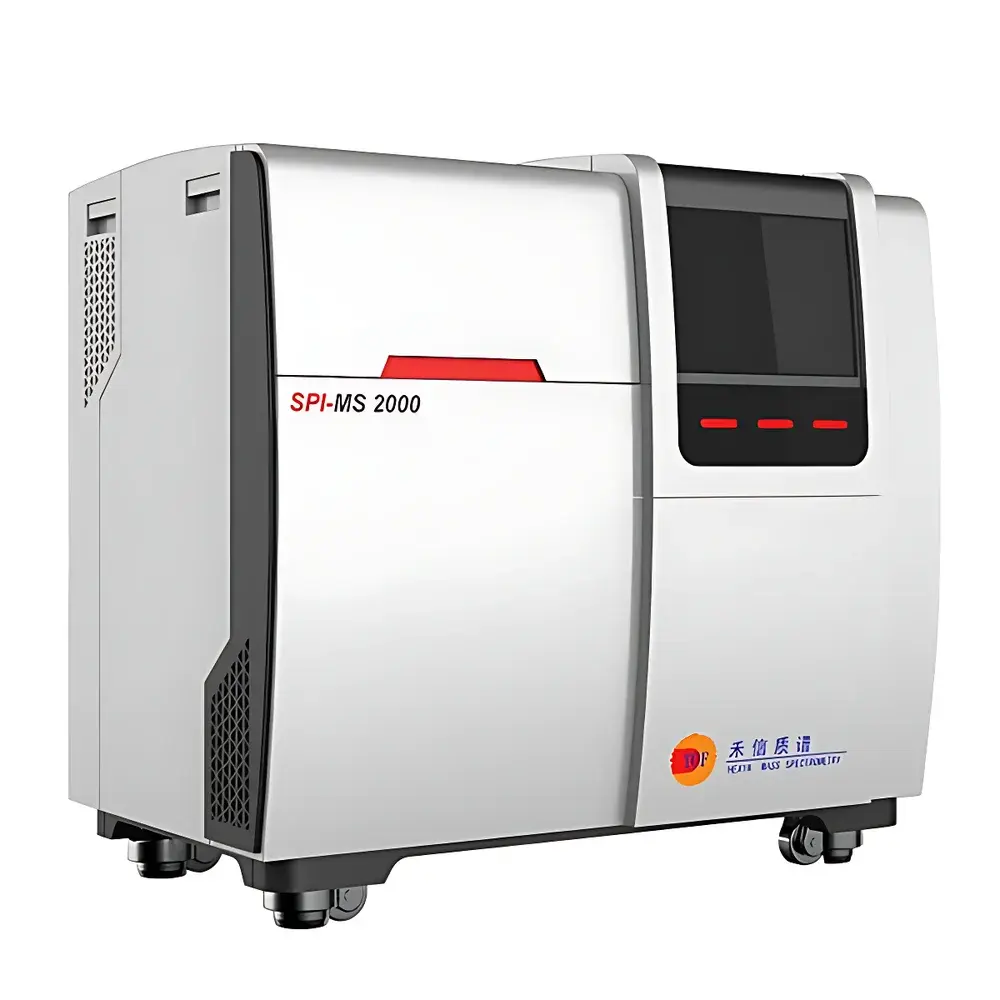
HEXIN SPIMS 2000 Real-Time Multi-Component VOCs Mobile Monitoring System
| Brand | HEXIN MASS SPECTROMETRY |
|---|---|
| Origin | Guangdong, China |
| Manufacturer Type | Authorized Distributor |
| Country of Origin | China |
| Model | SPIMS 2000 |
| Pricing | Upon Request |
Overview
The HEXIN SPIMS 2000 is a field-deployable, real-time multi-component volatile organic compounds (VOCs) monitoring system engineered for high-temporal-resolution mobile atmospheric surveillance. At its core resides an online time-of-flight mass spectrometer (TOF-MS) with electron ionization (EI) source, enabling sub-second spectral acquisition and quantitative analysis of C₂–C₁₂ hydrocarbons, oxygenated VOCs (e.g., aldehydes, ketones, alcohols), halogenated compounds, and aromatic species without pre-concentration. Unlike traditional canister-based or GC-MS methods requiring offline laboratory analysis (hours to days), the SPIMS 2000 performs continuous, unattended in-situ measurement during vehicle-mounted surveys—delivering time-resolved concentration profiles with 1–5 second temporal resolution and pptv-level detection limits for key anthropogenic tracers (e.g., benzene, toluene, isoprene, acetaldehyde). Its architecture supports dynamic plume tracking, spatially resolved emission mapping, and rapid source attribution—making it suitable for regulatory response, industrial fence-line monitoring, and urban air quality campaign support.
Key Features
- Real-time TOF-MS engine with 3,000 FWHM across m/z 10–300
- Integrated gas-phase calibration system using certified standard mixtures traceable to NIST SRMs
- Onboard meteorological sensor suite (wind speed/direction, temperature, humidity, GPS) synchronized at 1 Hz
- Ruggedized chassis designed for vehicular integration: IP54-rated enclosure, shock-damped optical bench, and thermal-stabilized ion optics
- Automated spectral deconvolution and compound identification using HEXIN’s proprietary spectral library (≥850 VOCs)
- Embedded edge-computing module for real-time background subtraction, peak integration, and concentration calculation (ppbv/pptv)
Sample Compatibility & Compliance
The SPIMS 2000 draws ambient air directly through a heated stainless-steel inlet (180 °C) to prevent condensation and wall losses of semi-volatile organics. It accommodates variable sampling flow rates (0.5–2.0 L/min) and operates continuously across ambient temperatures from −20 °C to +45 °C. All analytical workflows adhere to EPA Method TO-15A principles for real-time VOC quantification and are compatible with data reporting requirements under China’s HJ 1019-2019 (Environmental Monitoring Technical Specification for Soil and Groundwater) and HJ 604-2017 (Ambient Air – Determination of Total Hydrocarbons, Methane and Non-Methane Hydrocarbons by Gas Chromatography). Raw spectral data and processed concentration time series are structured in netCDF-4 format, supporting interoperability with national air quality data platforms and enabling audit-ready traceability per GLP-compliant field operations.
Software & Data Management
The HEXIN VOCs Mobile Analytics Platform (VMAP) provides a unified web-based interface for instrument control, real-time visualization, and post-mission analysis. VMAP implements ISO/IEC 17025-aligned data integrity safeguards—including electronic signatures, immutable audit logs, and version-controlled method templates. Spatial data are georeferenced and rendered in interactive 3D maps (WebGL-based) overlaid with administrative boundaries, industrial facility footprints, and traffic networks. The platform supports role-based access control (RBAC), automated report generation (PDF/Excel), and API-driven integration with municipal environmental management systems (EMS). Mobile application support enables field technicians to receive task assignments, annotate geo-tagged anomalies, and submit verification photos—all synchronized with central database timestamps compliant with FDA 21 CFR Part 11 electronic record requirements.
Applications
- Mobile emission hotspot identification and source apportionment in industrial parks and urban agglomerations
- Dynamic boundary-layer VOC profiling during photochemical smog episodes
- Pre- and post-control effectiveness evaluation of VOC abatement technologies (e.g., RTO, activated carbon adsorption)
- Support for regional air quality forecasting model initialization and validation
- Compliance screening for fugitive emissions under China’s “Blue Sky Defense War” action plan and local VOCs total emission caps
- Emergency response to chemical spills or accidental releases involving volatile organics
FAQ
What mass spectrometry technique does the SPIMS 2000 employ?
It utilizes electron ionization time-of-flight mass spectrometry (EI-TOF-MS) with orthogonal acceleration and reflectron design.
Does the system require cryogenic cooling or consumable gases?
No. It operates with ambient air as the carrier and requires no liquid nitrogen, helium, or hydrogen—only standard 220 V AC power and onboard compressed air for pneumatic actuators.
Can the SPIMS 2000 be integrated with existing air quality monitoring networks?
Yes. It supports MODBUS TCP, MQTT, and RESTful APIs for seamless ingestion into SCADA systems and national environmental data centers.
Is the spectral library customizable for region-specific compounds?
Yes. Users may import custom mass spectra and retention indices (if coupled with optional GC front-end) and validate them via internal standard response factors.
What cybersecurity protocols are implemented in the VMAP software?
VMAP conforms to IEC 62443-3-3 SL2 requirements, including TLS 1.2+ encryption, OAuth 2.0 authentication, and quarterly penetration testing reports available upon NDA.
Related Products




